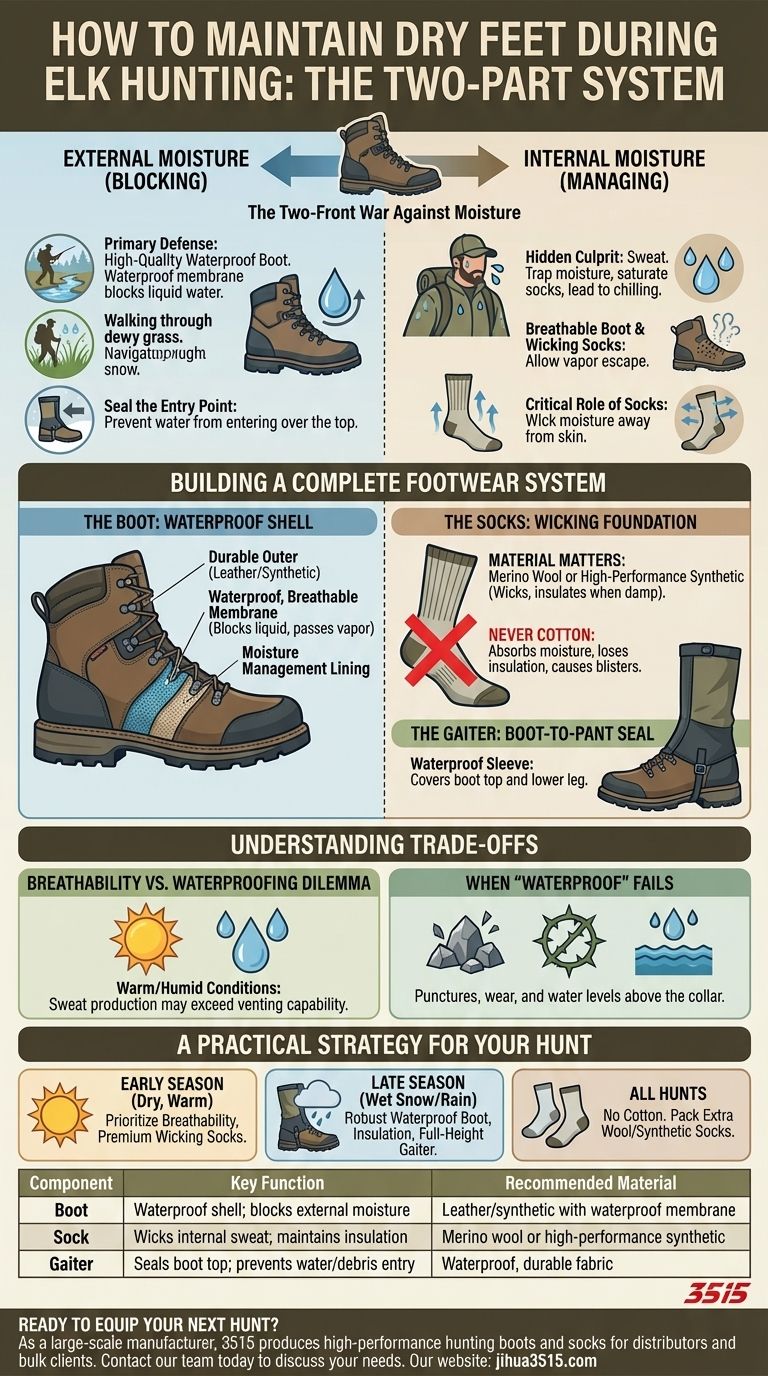
The key to keeping your feet dry during an elk hunt is a two-part system: a fully waterproof boot to block external moisture and a high-performance sock to manage internal moisture from sweat. Failing to address both sources of moisture is the most common reason hunters end up with wet, cold feet in the backcountry.
Your footwear is not a single product but a complete system. Success depends on managing the two-front war against moisture: blocking water from getting in while actively moving sweat out.
The Two Sources of Moisture: External vs. Internal
Every hunter's primary concern is keeping water out. However, the moisture your own body produces can be an equally significant problem, leading to blisters and heat loss.
Combating External Moisture (The Obvious Threat)
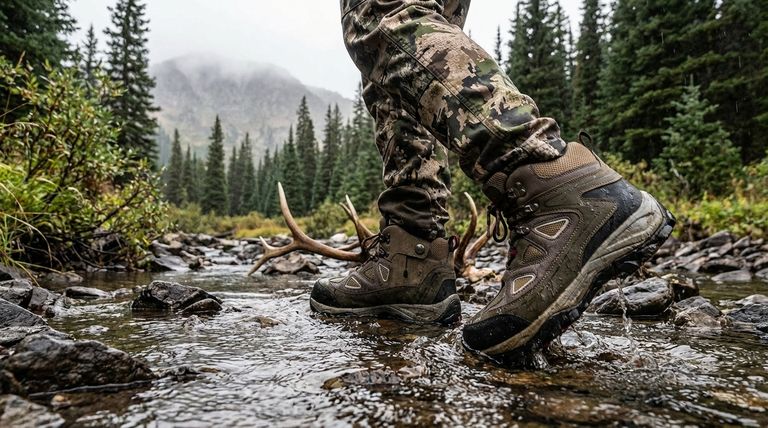
External water comes from crossing creeks, walking through dewy fields, or navigating snow-covered slopes.
Your primary defense is a high-quality waterproof boot. Look for boots constructed with a waterproof, breathable membrane sandwiched between an inner lining and the outer material.
It is also critical to seal the entry point at the top of your boot. Water and snow can easily get in over the collar, completely bypassing the boot's waterproofing.
Managing Internal Moisture (The Hidden Culprit)
A long day of hiking generates a surprising amount of sweat. If this moisture is trapped against your skin, it saturates your socks, compromises insulation, and leads to chilling.
This is where your boot's "moisture management lining" and, more importantly, your socks come into play. A breathable boot allows sweat vapor to escape, but only if your socks effectively pull that moisture off your skin first.
Building a Complete Footwear System
Thinking of your boots, socks, and pants as an integrated system is the most effective way to guarantee dry feet.
The Role of the Boot
The boot serves as your waterproof shell. The outer material, often leather or a synthetic textile, provides durability and some water resistance.
The real waterproofing comes from an internal bootie or membrane. This technology is designed to block liquid water molecules from entering while allowing smaller water vapor (sweat) molecules to exit.
The Critical Importance of Socks
Your socks are the foundation of the system. Their job is to wick moisture away from your skin and move it toward the boot's breathable membrane.
Merino wool or high-quality synthetic materials excel at this. They pull moisture away from your skin even when damp and retain their insulating properties.
Never wear cotton socks. Cotton absorbs moisture, loses all insulation when wet, and holds cold water directly against your skin, accelerating heat loss and causing blisters.
Securing the Boot-to-Pant Interface
Preventing water and debris from entering the top of your boot is non-negotiable.
While simply pulling your pant leg over the boot helps, the professional solution is to use a gaiter. A gaiter is a waterproof sleeve that covers the top of your boot and your lower leg, creating a highly effective seal.
Understanding the Trade-offs
No system is perfect. Understanding the limitations of your gear is crucial for managing expectations and adapting to conditions.
The Breathability vs. Waterproofing Dilemma
Even the most advanced waterproof membranes have a limit to how much moisture they can vent.
In very warm and humid conditions, you may produce sweat faster than the boot can expel it. Your feet may feel damp from sweat, even if the boot's waterproofing is holding perfectly against external water.
When "Waterproof" Fails
A waterproof membrane can be physically punctured by sharp rocks or thorns. Over time, constant flexing can also create stress points that wear out the membrane.
Furthermore, if you submerge your boot in water that is higher than the top of the boot, it will flood. A membrane cannot stop water from simply pouring in over the collar.
A Practical Strategy for Your Hunt
Your specific gear choices should adapt to the expected conditions of your hunt.
- If your primary focus is an early-season hunt in dry, warm weather: Prioritize a highly breathable, uninsulated boot and premium merino wool socks to manage sweat.
- If your primary focus is a late-season hunt in wet snow or rain: Choose a robustly waterproof boot, potentially with insulation, and always pair it with a full-height gaiter.
- For any elk hunt, regardless of season: Never use cotton socks, and always pack at least one extra pair of high-quality wool or synthetic socks to change into midday.
Ultimately, a dry hunt is the result of a well-planned system working in harmony.
Summary Table:
| Component | Key Function | Recommended Material |
|---|---|---|
| Boot | Waterproof shell; blocks external moisture | Leather/synthetic with waterproof membrane |
| Sock | Wicks internal sweat; maintains insulation | Merino wool or high-performance synthetic |
| Gaiter | Seals boot top; prevents water/debris entry | Waterproof, durable fabric |
Ready to equip your next hunt with the right footwear system?
As a large-scale manufacturer, 3515 produces a comprehensive range of high-performance hunting boots and socks for distributors, brand owners, and bulk clients. Our production capabilities ensure durable, waterproof boots and advanced moisture-wicking socks designed for the toughest conditions.
Contact our team today to discuss your hunting footwear needs and discover how we can support your business with reliable, high-quality products.
Visual Guide
Related Products
- Wholesale Lightweight Tactical Boots Custom Manufacturer for Desert & Combat Use
- Durable Leather Tactical Boots Wholesale & Custom Manufacturing for Brands
- High-Traction Suede Tactical Boots Wholesale & Custom Manufacturing
- Durable Spiked Camouflage Boots Wholesale & Factory Production
- Wholesale Waterproof Tactical Boots Custom Suede & High-Traction Soles
People Also Ask
- What are the common types of combat boots? Find the Right Boot for Your Mission
- What specialized protections do tactical boots offer? Maximize Endurance with High-Performance Footwear
- What is the role of high-frequency acquisition hardware in technical skill analysis for outdoor and tactical boots?
- How is the compatibility of polymer materials demonstrated in smart footwear? Enhancing Tactical & Training Performance
- How does additive manufacturing equipment reduce environmental risks? Sustainable Tactics for Modern Footwear Production