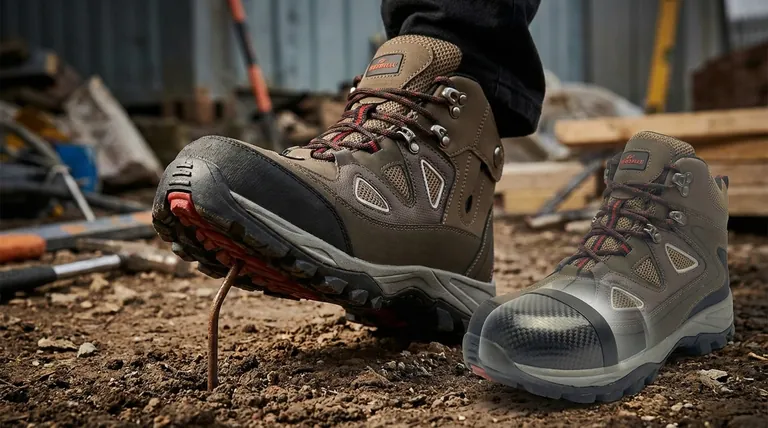
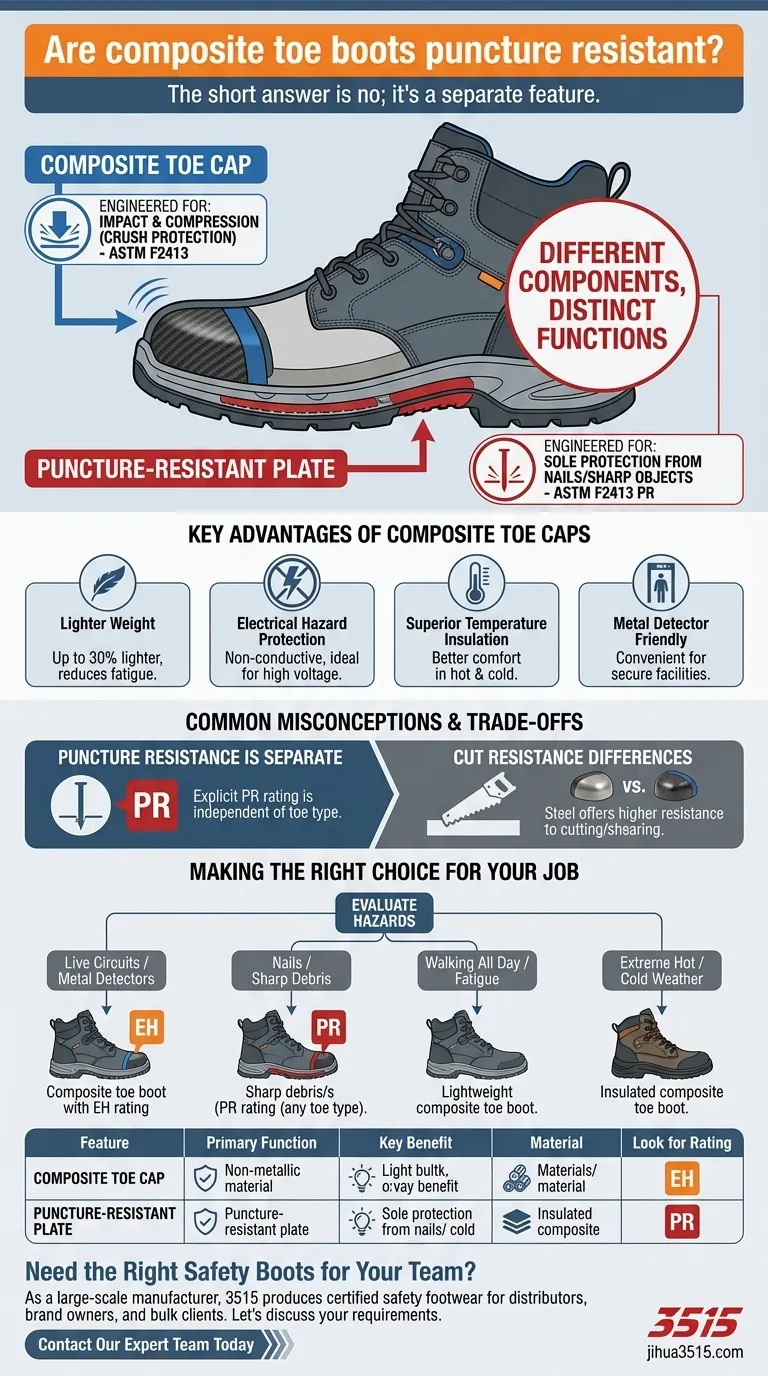
The short answer is no; the composite toe cap itself is not designed for puncture resistance. This feature is entirely separate from the type of safety toe a boot has. A boot’s ability to protect you from a nail or sharp object underfoot depends on a dedicated puncture-resistant plate built into the sole.
The core misunderstanding is confusing toe protection with sole protection. Composite toe caps are engineered for impact and compression resistance for your toes, while puncture resistance is an independent safety feature for the sole of your foot that a boot may or may not have.
Deconstructing the Safety Boot
To select the right footwear, you must understand that a safety boot is a system of different protective components, each with a specific job. The "composite toe" label only describes one of those components.
The Role of the Composite Toe Cap
A composite toe cap is made from non-metallic materials like Kevlar, carbon fiber, fiberglass, or plastic.
Its sole purpose is to meet ASTM standards for protecting your toes from being crushed by heavy falling or rolling objects (impact and compression).
The Role of the Puncture-Resistant Plate
Puncture resistance comes from a special plate positioned in the midsole of the boot, directly under your foot.
This plate is specifically designed to stop sharp objects like nails from penetrating the sole and injuring your foot. It can be made of steel or flexible non-metallic fabrics.
Key Advantages of the Composite Toe
While not related to puncture resistance, composite toe caps offer significant advantages over traditional steel toes in certain work environments.
Lighter Weight for Less Fatigue
Composite materials are significantly lighter than steel, often reducing the boot's weight by up to 30%. This minimizes foot fatigue over long workdays.
Electrical Hazard Protection
Because they are made from non-metallic materials, composite toes do not conduct electricity. This makes them the ideal choice for electricians and engineers working in high-voltage environments.
Superior Temperature Insulation
Unlike steel, which readily conducts heat and cold, composite materials provide much better insulation. This keeps your feet more comfortable in both extreme heat and cold weather conditions.
Metal Detector Compatibility
The absence of metal makes these boots convenient for workers who must frequently pass through metal detectors, such as in law enforcement or at secure facilities.
Understanding the Trade-offs and Misconceptions
Choosing the right boot means being clear about what a feature does and does not do. The most common point of confusion is attributing all safety features to the toe cap.
Puncture Resistance is a Separate Rating
A boot is only puncture-resistant if it is explicitly rated for it. When buying boots, look for a "PR" (Puncture Resistant) designation in the safety specifications. This rating is independent of whether the boot has a composite, steel, or alloy toe.
Cut Resistance Differences
The toe cap itself is primarily for impact, not cuts from a tool like a chainsaw. While both steel and composite toes meet the same impact standards, steel is an inherently harder material that can offer more resistance to being cut or sheared through.
Focus on the Hazard, Not Just the Material
The most critical mistake is choosing a boot based on the toe material alone. You must first assess your workplace hazards and then look for a boot with the specific ratings (e.g., EH for Electrical Hazard, PR for Puncture Resistant) that mitigate those risks.
Making the Right Choice for Your Job
Your work environment should dictate your choice. Evaluate your daily risks to select a boot that provides comprehensive protection, not just a single feature.
- If your primary focus is working around live circuits or metal detectors: A composite toe boot with an EH rating is your safest and most convenient option.
- If your primary focus is protection from nails and sharp debris: You must select a boot with a PR rating, regardless of whether it has a composite or steel toe.
- If your primary focus is reducing fatigue from walking all day: The lighter weight of a composite toe boot will provide a significant advantage in comfort.
- If your primary focus is working in extreme hot or cold weather: A composite toe boot will offer superior insulation and keep your feet more comfortable than a steel toe boot.
Ultimately, understanding how a safety boot is constructed is the key to protecting yourself effectively.
Summary Table:
| Feature | Composite Toe Cap | Puncture-Resistant Plate |
|---|---|---|
| Primary Function | Protects toes from impact/compression | Protects sole of foot from sharp objects |
| Key Benefit | Lightweight, non-conductive, temperature neutral | Stops nails/objects from penetrating the sole |
| Material | Kevlar, carbon fiber, fiberglass, plastic | Steel or flexible non-metallic fabrics |
| Look for Rating | ASTM F2413 for Impact/Compression | ASTM F2413 PR (Puncture Resistant) |
Need the Right Safety Boots for Your Team?
Understanding the distinction between toe protection and sole safety is critical for workplace safety. As a large-scale manufacturer, 3515 produces a comprehensive range of certified safety footwear for distributors, brand owners, and bulk clients.
We can help you source or customize the perfect boots that combine the right safety features—like composite toes and puncture-resistant plates—for your specific job hazards.
Let's discuss your requirements and ensure your workforce is properly protected.
Contact our expert team today for a consultation
Visual Guide
Related Products
- Wholesale Durable Safety Boots Manufacturer Customizable Steel Toe Work Boots
- Durable Leather Moc Toe Work Boots for Wholesale & Custom Manufacturing
- Wholesale Mesh Steel Toe Safety Shoes with Dial Closure Factory Production
- Wholesale Durable Breathable Safety Boots Custom OEM Manufacturer
- Wholesale Customizable Safety Boots Durable & Protective Footwear Manufacturing
People Also Ask
- What are the pros and cons of steel toe work boots? A Guide to Maximum Protection vs. Comfort
- What are the different types of steel toe work boots? Choose the Right Boot for Your Job
- What is the history of steel toe work boots? From German Invention to Modern Safety Standard
- How much weight can steel toe work boots withstand? Unpacking the 3,372 lb. Safety Standard
- What are some common myths about steel toe work boots? Debunked for Modern Workers