
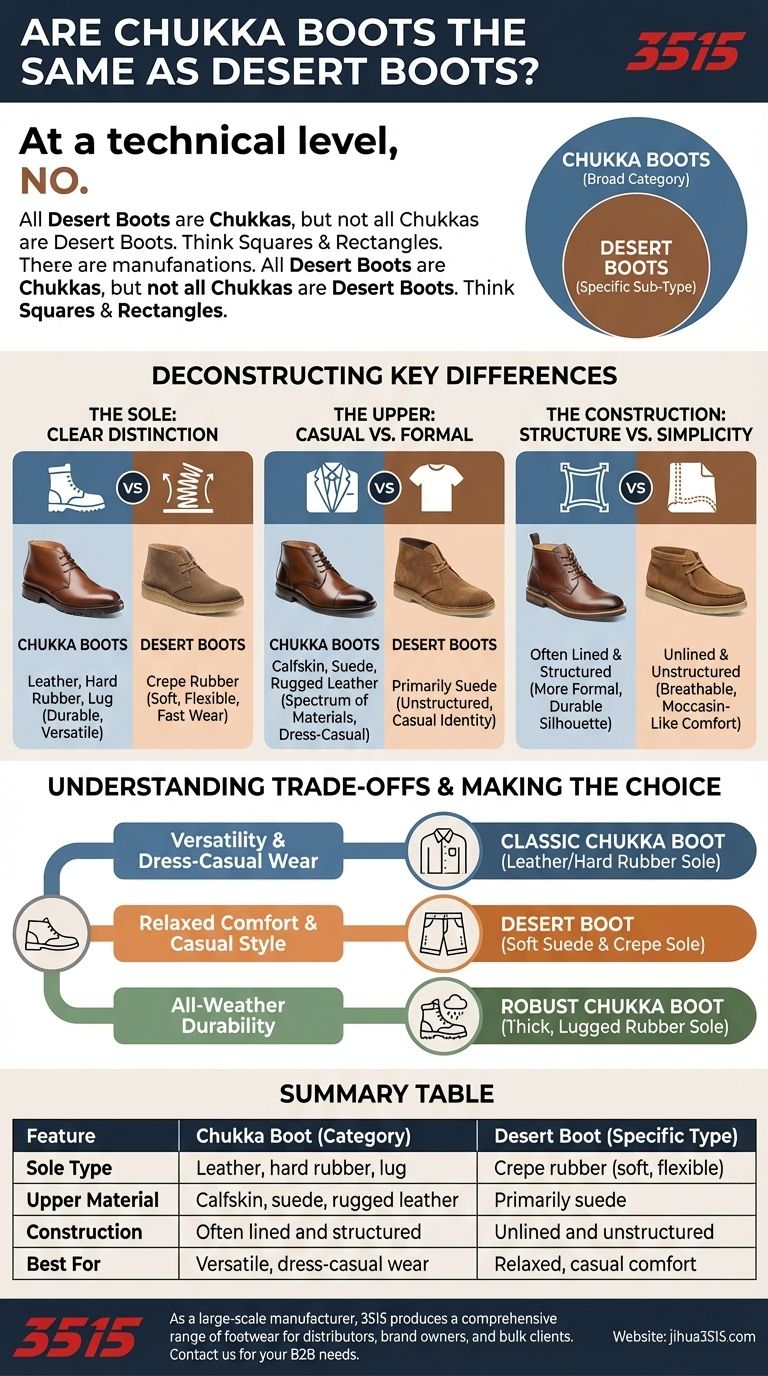
At a technical level, no, they are not the same. While all desert boots are a type of chukka boot, not all chukka boots are desert boots. The chukka is a broad category of ankle-high boots, while the desert boot is a very specific variation defined by its unlined suede upper and a soft, flexible crepe rubber sole.
The core distinction lies in specificity: "Chukka" is a general blueprint for an ankle boot, whereas "Desert Boot" is a specific, historically defined model of that blueprint, optimized for casual comfort.
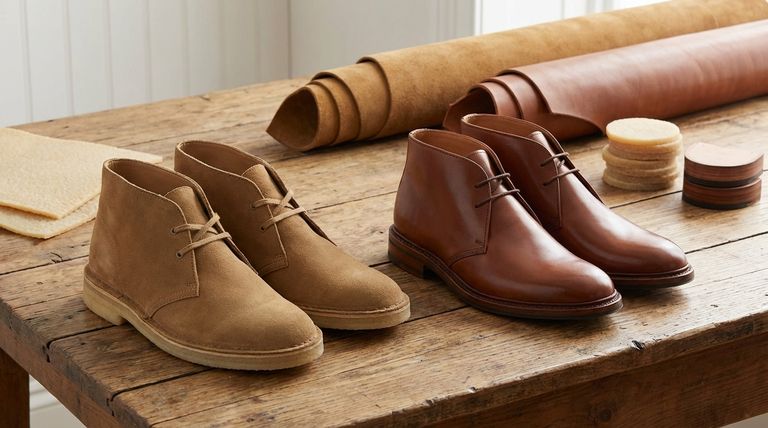
The Fundamental Relationship: Category vs. Specific Model
To understand the difference, it's best to think of the relationship like squares and rectangles. A square is a specific type of rectangle, but not every rectangle is a square.
Chukka Boots: The Broad Category
A chukka boot is defined by a simple set of characteristics: it's an ankle-high boot with two or three pairs of eyelets for lacing.
Beyond that, the details can vary widely. Chukkas can be made from polished calfskin, suede, or other leathers. Their soles can be made of leather, hard rubber, or even rugged commando-style lugs.
Desert Boots: The Specific Sub-Type
The desert boot is a specific chukka created during World War II and popularized by the brand Clarks.
It adheres to the chukka blueprint but is distinguished by its traditionally unstructured suede upper and, most importantly, a plantation crepe rubber sole. This construction made it lightweight, flexible, and comfortable in hot, sandy conditions.
Deconstructing the Key Differences
The confusion between the terms is common because many brands label their boots incorrectly. However, three core technical differences separate a true desert boot from the wider chukka category.
The Sole: The Clearest Distinction
The most definitive feature of a desert boot is its crepe rubber sole. This natural rubber is soft, bouncy, and very flexible, providing significant comfort.
Chukka boots, on the other hand, can feature a much wider range of soles. Dressier versions have stitched leather soles, while more versatile models use durable hard rubber soles.
The Upper Material: Casual vs. Formal Potential
Desert boots are almost always made of suede. While some brands offer leather versions, the boot's identity is rooted in soft, casual suede.
Chukkas are made from a spectrum of materials. A polished calfskin leather chukka is a dress-casual staple, while a rugged oiled leather chukka serves an entirely different purpose.
The Construction: Simplicity vs. Structure
A traditional desert boot is unlined and unstructured. This simple construction makes it breathable and allows it to conform to your foot like a moccasin, enhancing its casual nature.
Many chukka boots are leather-lined and more structured. This adds durability and gives them a more formal silhouette, allowing them to be paired with dress trousers or a casual suit.
Understanding the Trade-offs
Choosing between them involves more than just style; it involves understanding their functional limitations.
The Limitation of Crepe Soles
The crepe sole that defines the desert boot is its greatest strength and biggest weakness. While incredibly comfortable, it wears down faster than hard rubber, gets dirty easily, and offers poor traction in wet conditions.
The Problem of Interchangeable Terms
Many manufacturers and retailers use "chukka" and "desert boot" interchangeably. This marketing confusion means you must inspect the boot's specific features—the sole and the material—rather than relying on the label alone.
Durability and Formality
The unstructured suede of a desert boot is inherently more casual and less durable than a well-made, leather-lined chukka. A polished leather chukka can be maintained and resoled for years, occupying a space that a desert boot cannot.
Making the Right Choice for Your Wardrobe
Your choice should be dictated entirely by your intended use case and personal style.
- If your primary focus is versatility and dress-casual wear: Choose a classic chukka boot with a leather or slim hard rubber sole.
- If your primary focus is relaxed comfort and casual style: The desert boot is the superior choice for its soft suede and flexible crepe sole.
- If your primary focus is all-weather durability: Seek a chukka boot made from robust leather with a thick, studded, or commando-style rubber sole.
Ultimately, knowing the difference empowers you to select the right tool for your specific stylistic and functional needs.
Summary Table:
| Feature | Chukka Boot (Category) | Desert Boot (Specific Type) |
|---|---|---|
| Sole Type | Leather, hard rubber, lug | Crepe rubber (soft, flexible) |
| Upper Material | Calfskin, suede, rugged leather | Primarily suede |
| Construction | Often lined and structured | Unlined and unstructured |
| Best For | Versatile, dress-casual wear | Relaxed, casual comfort |
As a large-scale manufacturer, 3515 produces a comprehensive range of footwear for distributors, brand owners, and bulk clients. Whether you need durable chukka boots for versatile styling or comfortable desert boots for casual markets, our production capabilities cover all types of shoes and boots. Let us help you source the perfect footwear for your customers. Contact us today to discuss your manufacturing needs!
Visual Guide
Related Products
- Premium Wholesale Tactical Style Safety Shoes Boots with Quick Lacing
- Wholesale Safety Boots Manufacturer for Custom & Private Label Orders
- Factory Direct Wholesale Rain Boots Durable Waterproof & Fully Customizable
- Wholesale High-Traction Camo Boots - Custom Manufacturer for Brands
- Durable Leather High-Ankle Tactical Boots for Wholesale & Custom Manufacturing
People Also Ask
- How are gait analysis research findings applied to the functional design of safety shoes and tactical boots?
- How can specialized footwear mitigate safety risks? High-Volume OEM/ODM Solutions since 1951
- How does anthropomorphic design influence material selection? Enhance Footwear Performance through Biological Alignment
- Why is the synchronization of craftsmanship and UX development emphasized for bulk customization of safety shoes?
- How do quality certification standards for safety shoes reduce perceived risk? Buy Online with Technical Certainty



















