The Manager and the Marathon
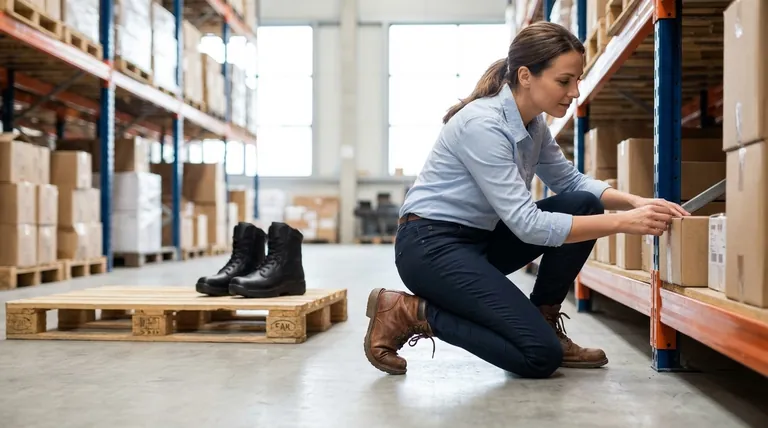
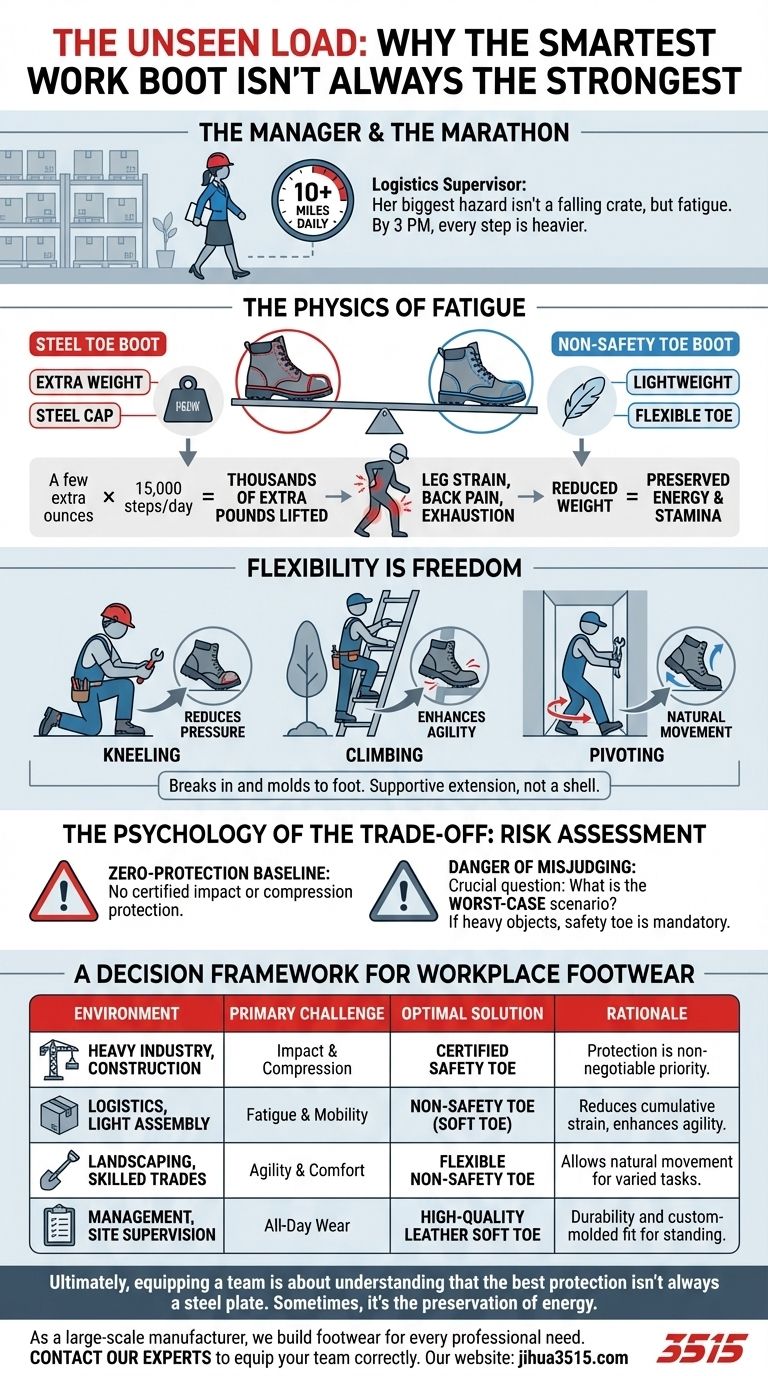
Consider a logistics supervisor. She walks nearly ten miles a day on concrete floors. Her biggest occupational hazard isn't a falling crate; it's the slow, grinding accumulation of physical fatigue. By 3 PM, every step feels heavier. This isn't a failure of her endurance, but potentially a failure of her equipment.
We instinctively equate "work boot" with "steel toe." It's a mental shortcut that equates safety with strength. But in many professional environments, the most significant risk isn't a single, catastrophic impact. It's the cumulative load of thousands of daily steps. This is where the non-safety toe boot emerges not as a compromise, but as a superior engineering choice for a specific mission.
The Physics of Fatigue
A steel toe cap adds weight. While the amount seems negligible on its own, its effect is magnified over a long day. Lifting that extra weight with every single step is a hidden tax on your energy.
Think of it this way: a few extra ounces, lifted 15,000 times, amounts to lifting thousands of extra pounds over the course of a shift. This energy expenditure directly translates into leg strain, lower back pain, and end-of-day exhaustion. By removing the reinforced toe, a non-safety boot fundamentally redesigns the energy equation for the wearer, prioritizing stamina over impact resistance.
Flexibility is Freedom
Beyond weight, a reinforced toe box introduces rigidity. It creates a structural barrier that resists the natural bending of your foot. This becomes immediately apparent in jobs that require more than just walking.
- Kneeling: Electricians, plumbers, and mechanics spend significant time crouched or kneeling. A flexible boot moves with them, reducing pressure and discomfort.
- Climbing: Landscapers or maintenance workers who navigate uneven terrain or climb ladders need agility. A rigid boot can feel clumsy and restrictive.
- Pivoting: Anyone working in tight spaces values the ability to move their feet naturally.
The absence of a safety cap allows the boot, especially one made of high-quality leather, to break in and mold perfectly to the wearer's foot. It becomes less of a protective shell and more of a supportive extension of the body.
The Psychology of the Trade-Off
Choosing a non-safety toe boot is a deliberate act of risk assessment. It's an acknowledgment that different environments demand different tools. This decision, however, must be built on an honest understanding of its absolute limits.
Acknowledging the Zero-Protection Baseline
This is the most critical point: a non-safety toe boot offers no certified protection against impact or compression. It is not a "lesser" safety boot; it is a different category of footwear entirely. In any environment with a genuine risk of falling objects or rolling equipment, a certified safety toe is the only responsible choice.
The Danger of Misjudging the Environment
The most common failure is not in the equipment, but in the assessment. A workplace that seems low-risk can change instantly. The crucial question isn't "What does my job entail on an average day?" but "What is the worst-case scenario my feet could encounter?" If the answer involves heavy objects, the choice is made for you.
A Decision Framework for Workplace Footwear
Your choice of boot should be a calculated decision based on your daily operational reality.
| Work Environment Scenario | Primary Challenge | Optimal Boot Solution | Rationale |
|---|---|---|---|
| Heavy Industry, Construction | Impact & Compression | Certified Safety Toe | Protection is the non-negotiable priority. |
| Logistics, Light Assembly | Fatigue & Mobility | Non-Safety Toe (Soft Toe) | Reduces cumulative strain and enhances agility for high-step-count roles. |
| Landscaping, Skilled Trades | Agility & Comfort | Flexible Non-Safety Toe | Allows natural movement for kneeling, crouching, and navigating varied terrain. |
| Management, Site Supervision | All-Day Wear | High-Quality Leather Soft Toe | Provides durability and a custom-molded fit for extended periods of standing. |
Ultimately, equipping a team is about understanding that the best protection isn't always a steel plate. Sometimes, it's the preservation of energy and the reduction of physical strain that keeps a worker safe, alert, and productive.
As a large-scale manufacturer, we build footwear for the full spectrum of industrial and professional needs. We understand that the right boot is the one that precisely matches the demands of the job, whether that requires certified impact resistance or lightweight, ergonomic comfort.
If you're looking to equip your team with footwear that is perfectly suited to their environment, Contact Our Experts.
Visual Guide
Related Products
- Durable Leather Work Boots for Wholesale & Custom Manufacturing
- Durable Leather Work Boots for Wholesale & Custom OEM Manufacturing
- Durable Leather Work Boots Wholesale Manufacturer & Custom Factory
- Durable Leather Moc Toe Work Boots for Wholesale & Custom Manufacturing
- Wholesale Durable 6-Inch Work Boots | Custom & Private Label Manufacturer
Related Articles
- How Job-Specific Work Boot Designs Enhance Safety and Efficiency
- How Work Boots Engineer Safety: The Science Behind Impact and Compression Protection
- The Unseen Physics of Failure: Why Work Boots Are Your Most Critical PPE
- How to Extend Work Boot Lifespan: Science-Backed Care for Safety & Savings
- How Work Boots Became Everyday Heroes: Comfort, Health & Style Combined