The Anatomy of a 'Simple' Accident
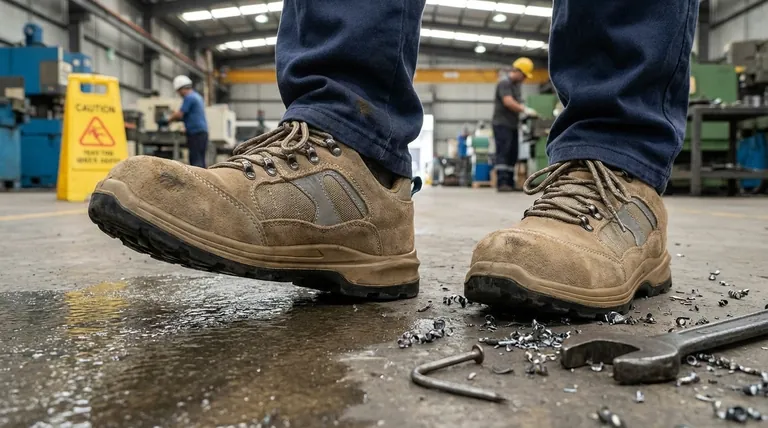
A maintenance worker steps onto a patch of coolant. His foot slips a mere inch, but he recovers his balance instantly. The moment is forgotten.
But it shouldn't be. That tiny slip wasn't a random event; it was a system failure. It was a failure of friction, a breakdown in the contract between the worker's boot and the floor. We tend to view work boots as just durable footwear, but this is a critical psychological error. They are a highly engineered piece of Personal Protective Equipment (PPE) designed to constantly negotiate with the laws of physics on our behalf.
When we see them as just shoes, we become blind to their silent, ongoing work—and to the ways they can fail.
The Forces That Compromise Foot Safety
Every workplace is a dynamic environment governed by physical forces. A proper safety boot is a tool designed to master them. An inadequate boot is a liability that exposes the user to the raw, unforgiving nature of those forces.
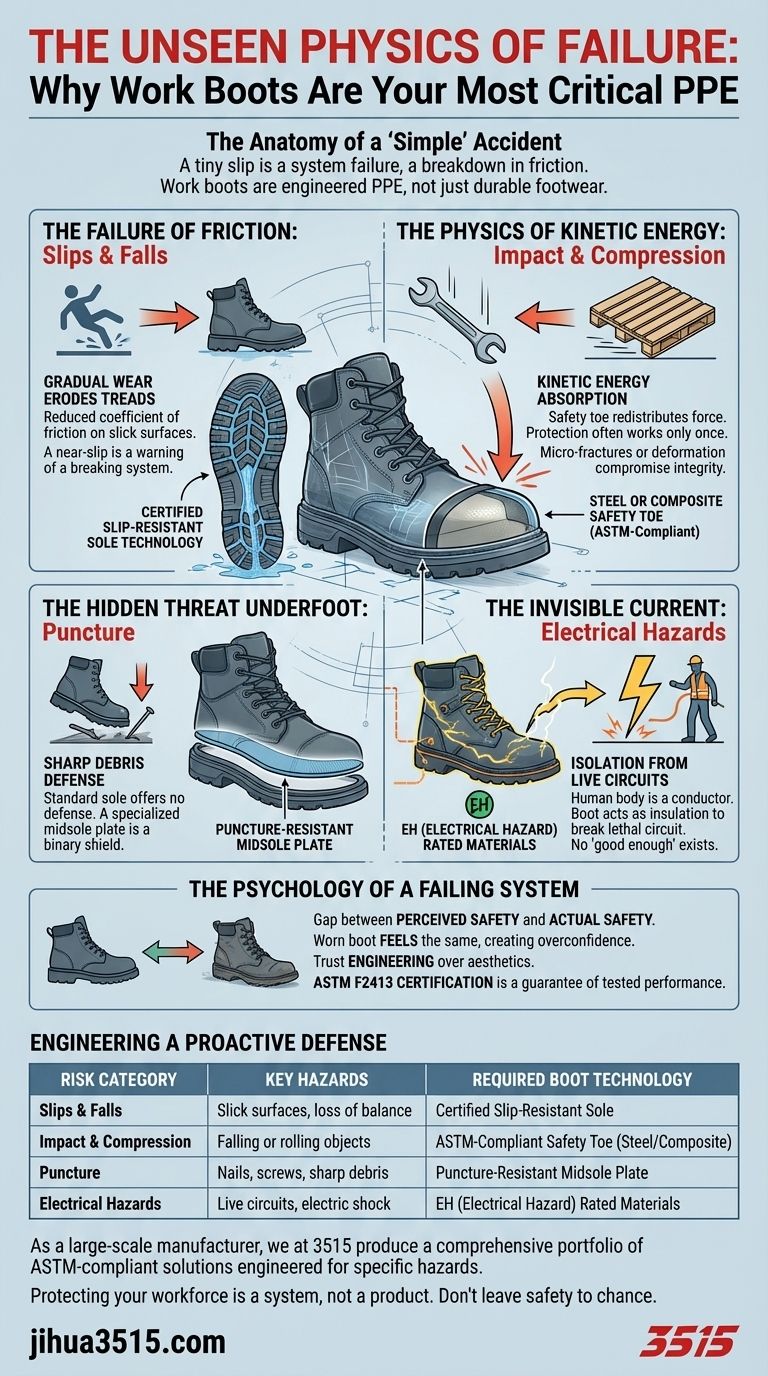
The Failure of Friction: Slips & Falls
The most common workplace accidents are often the most preventable. A slip-resistant sole isn't just rubber; it's a carefully designed system of treads meant to channel away liquids and maximize the coefficient of friction on a given surface.
The insidious danger is gradual wear. Over months of use, these treads erode, silently reducing their effectiveness. The boot may still look intact, but its ability to grip has been fatally compromised. That near-slip wasn't bad luck; it was a warning that the system is breaking down.
The Physics of Kinetic Energy: Impact & Compression
A dropped wrench or a rolling pallet carries a surprising amount of kinetic energy. A safety toe, whether steel or composite, is engineered to do one thing: absorb and redistribute that force away from the delicate bones of the foot.
But this protection often works only once. A significant impact can cause micro-fractures in a composite toe or deform a steel one, even with no visible damage. The boot's structural integrity is gone. It offers a false sense of security, ready to fail completely during the next incident.
The Hidden Threat Underfoot: Puncture
Worksites are littered with random, sharp threats—a stray nail, a shard of metal, a screw. A standard sole offers no meaningful defense.
A puncture-resistant boot contains a specialized plate in the midsole. It’s a simple, binary shield. It's either there or it isn't. Choosing footwear without this feature in an environment with ground debris is a gamble with devastating stakes.
The Invisible Current: Electrical Hazards
For anyone working near live circuits, the human body is a potential conductor. An Electrical Hazard (EH) rated boot is a piece of insulation. It is specifically designed with non-conductive materials to isolate the wearer from the ground, breaking a potentially lethal circuit.
This is not a feature where "good enough" exists. The boot is either EH-rated and compliant, or it is a direct path for electricity. There is no middle ground.
The Psychology of a Failing System
The greatest risk is the gap between perceived safety and actual safety. A worn-out, compromised, or non-compliant boot feels no different on the foot than a new one. This creates a dangerous overconfidence.
Compliance with standards like ASTM F2413 isn't about bureaucracy; it’s a guarantee. It certifies that the boot has been tested to withstand specific, measurable forces. Choosing a non-compliant boot is choosing to operate with an unknown variable in your safety equation. You are trusting aesthetics over engineering.
Engineering a Proactive Defense
True workplace safety isn't reactive. It’s a deliberately engineered system that starts from the ground up. The process is simple: identify the specific physical risks in your environment, and then deploy the specific technology designed to neutralize them.
This isn't about buying "sturdy boots." It's about making a precise engineering choice.
| Risk Category | Key Hazards | Required Boot Technology |
|---|---|---|
| Slips & Falls | Slick surfaces, loss of balance | Certified Slip-Resistant Sole |
| Impact & Compression | Falling or rolling objects | ASTM-Compliant Safety Toe (Steel/Composite) |
| Puncture | Nails, screws, sharp debris | Puncture-Resistant Midsole Plate |
| Electrical Hazards | Live circuits, electric shock | EH (Electrical Hazard) Rated Materials |
As a large-scale manufacturer, we at 3515 produce a comprehensive portfolio of footwear to meet these precise challenges. For distributors, brand owners, and bulk clients, we provide the confidence of ASTM-compliant solutions engineered for specific hazards—from slip resistance to EH-rated protection. We believe that protecting your workforce is a system, not a product.
Don't leave safety to chance. Begin engineering your defense against the physics of failure today. Contact Our Experts
Visual Guide
Related Products
- Durable Leather Work Boots for Wholesale & Custom Manufacturing
- Durable Leather Work Boots for Wholesale & Custom OEM Manufacturing
- Durable Leather Work Boots Wholesale Manufacturer & Custom Factory
- Durable Leather Moc Toe Work Boots for Wholesale & Custom Manufacturing
- Wholesale Leather Work Boots with Customizable Wedge Sole for Brands
Related Articles
- How Job-Specific Work Boot Designs Enhance Safety and Efficiency
- How Work Boots Engineer Safety: The Science Behind Impact and Compression Protection
- How to Extend Work Boot Lifespan: Science-Backed Care for Safety & Savings
- How Work Boots Became Everyday Heroes: Comfort, Health & Style Combined
- How Engineered Foot Support in Work Boots Prevents Workplace Injuries