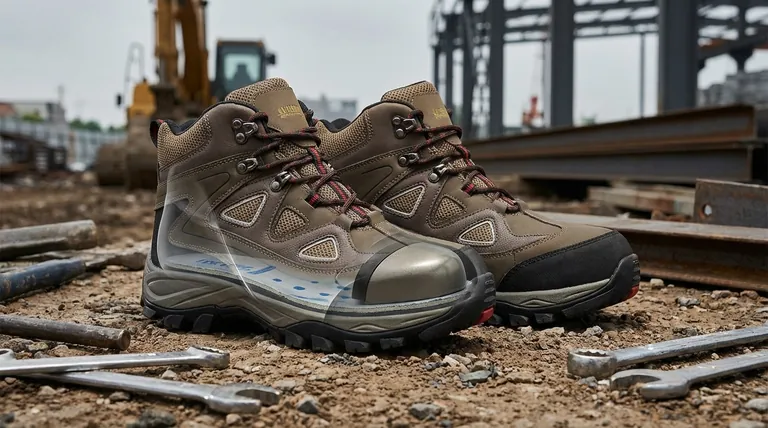
We Trust What We Can See
We judge a boot by its leather, its laces, its aggressive tread. We value its comfort and its weight. These are tangible qualities we can assess with our hands and eyes.
But the most critical features of a tactical or safety boot are invisible. They aren't aesthetic choices; they are engineered promises.
These promises are written in the language of safety certifications—codes like ASTM F2413 and NFPA 1971. They represent a guarantee, lab-tested and verified, that the boot will perform its duty when a specific danger materializes. Understanding them is to understand the physics of protection.
The Anatomy of a Promise: Core ASTM Standards
The American Society for Testing and Materials (ASTM) doesn't guess. It creates standards that allow for repeatable, objective tests of a material's limits. For footwear, this means translating real-world hazards into measurable forces.
Beyond the Steel Toe: The Physics of Impact
A safety toe isn't just a piece of metal in a boot. It's a precisely engineered structure designed to deflect and absorb kinetic energy.
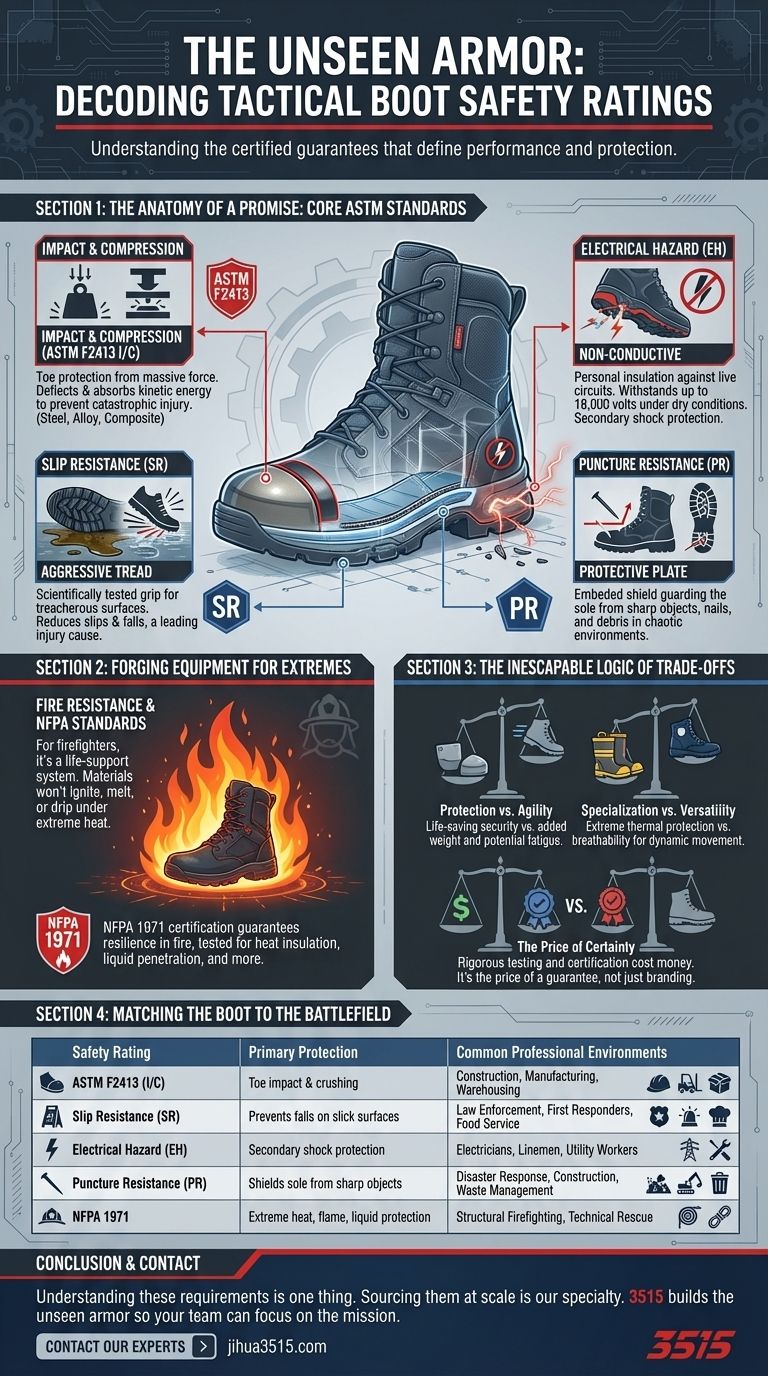
The ASTM F2413 standard for impact and compression resistance is the bedrock of protective footwear. It certifies that the toe cap—whether made of traditional steel, lighter alloys, or modern composites—can withstand a specific, massive force without collapsing. It’s a physical guarantee that a dropped tool or a rolling cart won't result in a catastrophic injury.
The Deceptive Simplicity of Grip
Slips and falls seem like simple accidents, but they are a leading cause of serious workplace injury. Our brains are notoriously bad at judging the coefficient of friction on a wet or oily surface until it’s too late.
A Slip-Resistant (SR) rating is the data-driven answer to this human bias. It means the outsole's material and tread pattern have been scientifically tested to maintain grip on treacherous surfaces, providing a layer of security your intuition cannot.
The Invisible Threat: Insulating Against Electrical Hazard
For an electrician or utility worker, the ground beneath their feet can become part of a deadly circuit.
An Electrical Hazard (EH) rated boot is a piece of personal insulation. Its sole and heel are constructed from non-conductive materials that can, under dry conditions, withstand 18,000 volts. This feature is unseen and unfelt, yet it provides a critical barrier—a life-saving gap in the circuit—when a stray current seeks a path to ground.
Defying the Unseen Nail: Puncture Resistance
On a construction site or in a disaster zone, the ground is littered with hidden threats. A nail, a shard of glass, or a piece of rebar can easily penetrate a standard sole.
The Puncture-Resistant (PR) rating signifies a protective plate embedded in the midsole. Traditionally steel, these plates are now often flexible woven composites, offering protection without sacrificing mobility. They are a shield for the sole of the foot, guarding against the sharp debris of a chaotic environment.
Forging Equipment for Extremes
Some professions operate where the environment itself is the primary adversary. For them, standard ratings are just the starting point.
The Crucible: Fire Resistance and NFPA Standards
For a firefighter, a boot isn't just footwear; it's a component of a life-support system. It must function in conditions that would destroy anything else.
Boots rated for Fire Resistance (FR) use materials, threads, and adhesives that won't ignite, melt, or drip under extreme heat. For structural firefighters in the U.S., this culminates in meeting standards from the National Fire Protection Association (NFPA).
An NFPA 1971 certification is a testament to a boot’s resilience. It has been subjected to a battery of tests for heat insulation, liquid penetration, puncture resistance (from above and below), and more. It is a promise that the boot will hold its form and protect its wearer in the heart of a fire.
The Inescapable Logic of Trade-offs
There is no single boot that is perfect for every mission. The engineering of protection is an exercise in balancing competing priorities.
-
Protection vs. Agility: A steel toe and a puncture-resistant plate add life-saving security, but they also add weight. This can increase fatigue over a long patrol and slightly reduce a user's nimbleness.
-
Specialization vs. Versatility: An NFPA-certified boot offers incredible thermal protection, but it is often heavy and less breathable, making it ill-suited for a police officer who needs to cover miles of city streets on foot.
-
The Price of Certainty: Rigorous testing and certification cost money. This isn't for branding; it's the price of a guarantee. The higher cost reflects the advanced materials and independent verification that prove the boot will work as promised.
Matching the Boot to the Battlefield
Choosing the right boot is an act of honest risk assessment. The codes and ratings are your guide. They allow you to match a proven solution to the known hazards of your environment.
| Safety Rating | Primary Protection | Common Professional Environments |
|---|---|---|
| ASTM F2413 (I/C) | Toe protection from impact & crushing | Construction, Manufacturing, Warehousing |
| Slip Resistance (SR) | Prevents falls on wet or slick surfaces | Law Enforcement, First Responders, Food Service |
| Electrical Hazard (EH) | Secondary shock protection | Electricians, Linemen, Utility Workers |
| Puncture Resistance (PR) | Shields sole from sharp objects | Disaster Response, Construction, Waste Management |
| NFPA 1971 | Extreme heat, flame, and liquid protection | Structural Firefighting, Technical Rescue |
Understanding these complex requirements is one thing. Sourcing footwear for an entire team that verifiably meets the right standards, at scale, is a significant operational challenge. As a large-scale manufacturer, 3515 specializes in this exact challenge. We produce a comprehensive range of certified footwear—from ASTM-compliant safety boots to NFPA-rated emergency response gear—for distributors, major brands, and bulk clients.
We build the unseen armor so your team can focus on the mission. If you need to equip professionals with footwear that offers a tested, certified guarantee of protection, we have the production capabilities to deliver.
Visual Guide
Related Products
- Durable Leather Tactical Boots Wholesale & Custom Manufacturing for Brands
- High-Traction Suede Tactical Boots Wholesale & Custom Manufacturing
- Durable Leather High-Ankle Tactical Boots for Wholesale & Custom Manufacturing
- Durable Mid-Cut Tactical Boots for Wholesale & Private Label
- Wholesale Waterproof Tactical Boots Custom Suede & High-Traction Soles
Related Articles
- Why Your Tactical Boots Wear Out So Fast—And the Procurement Mistake Behind It
- The Agility-Protection Paradox: Deconstructing Safety in Modern Tactical Footwear
- Why Your Tactical Boots Keep Failing—And Why 'Tougher' Isn't the Answer
- How Tactical Boots Deliver Long-Term Value: A Cost & Performance Breakdown
- The Procurement Officer's Gamble: Why 'Tough Enough' Isn't Good Enough for Tactical Boots













