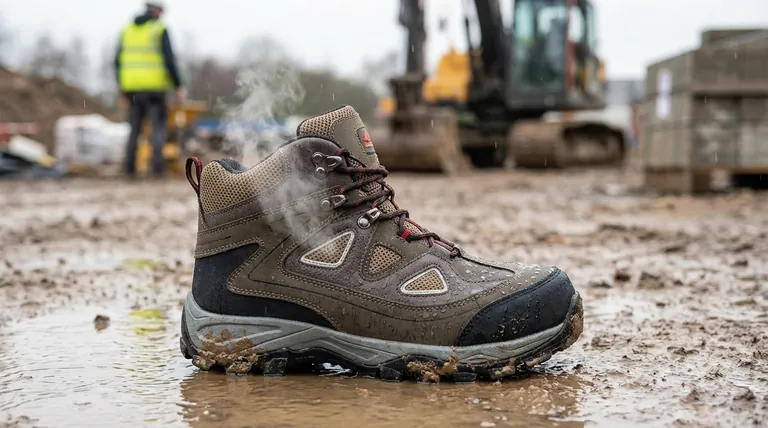
The Cognitive Cost of a Wet Boot
Imagine a construction worker on a damp, cold morning. A light rain has made the ground slick with mud. Her steel-toed boots are doing their job, keeping the puddles out. Yet, six hours into her shift, her socks are soaked.
The culprit isn't the rain. It’s the half-cup of sweat her own feet have produced, now trapped inside a non-breathable shell. The dampness creates friction, a blister is forming, and her feet are cold. This isn't just discomfort; it's a cognitive drain. Every step is a nagging distraction, pulling focus away from the heavy machinery and potential hazards around her.
This is the central, often misunderstood, challenge of high-performance safety footwear. The battle for a dry, safe foot is fought on two fronts simultaneously: against moisture from the outside and moisture from the inside.
The Obvious Threat: The Shield Against the Elements
Waterproofing is the feature we see and understand. It’s the first line of defense, a physical barrier that stops rain, mud, and spills from penetrating the boot.
More Than Dry Socks
Its importance goes far beyond comfort. When skin is chronically damp, it softens and breaks down (a process called maceration), creating a perfect breeding ground for fungal and bacterial infections. In cold weather, water's role as a thermal conductor becomes critical. A wet foot loses heat up to 25 times faster than a dry one, turning a cold day into a dangerous one by increasing the risk of frostbite and draining body heat.
Waterproofing is the non-negotiable shield. But a shield that traps you with an internal enemy is an incomplete solution.
The Insidious Threat: The Swamp from Within
The average pair of feet can sweat more than a cup of moisture during a demanding workday. Without an escape route, this vapor becomes trapped, condensing into liquid. The boot becomes a swamp of its own making.
This internally-generated moisture is just as damaging as external water. It causes the friction that leads to blisters, the dampness that encourages fungus, and a slick internal surface that reduces stability.
The Psychology of Discomfort
A worker with "swamp foot" isn't just uncomfortable; they are fundamentally distracted. The human brain has a limited budget for attention. Discomfort consumes a portion of that budget, reducing a worker's situational awareness and increasing the likelihood of a mistake or accident. A failure in footwear technology can easily become a failure in workplace safety.
This is where the science of breathability becomes essential.
The Elegance of Asymmetry
Truly advanced footwear employs materials with a beautiful, simple piece of engineering: microporous membranes.
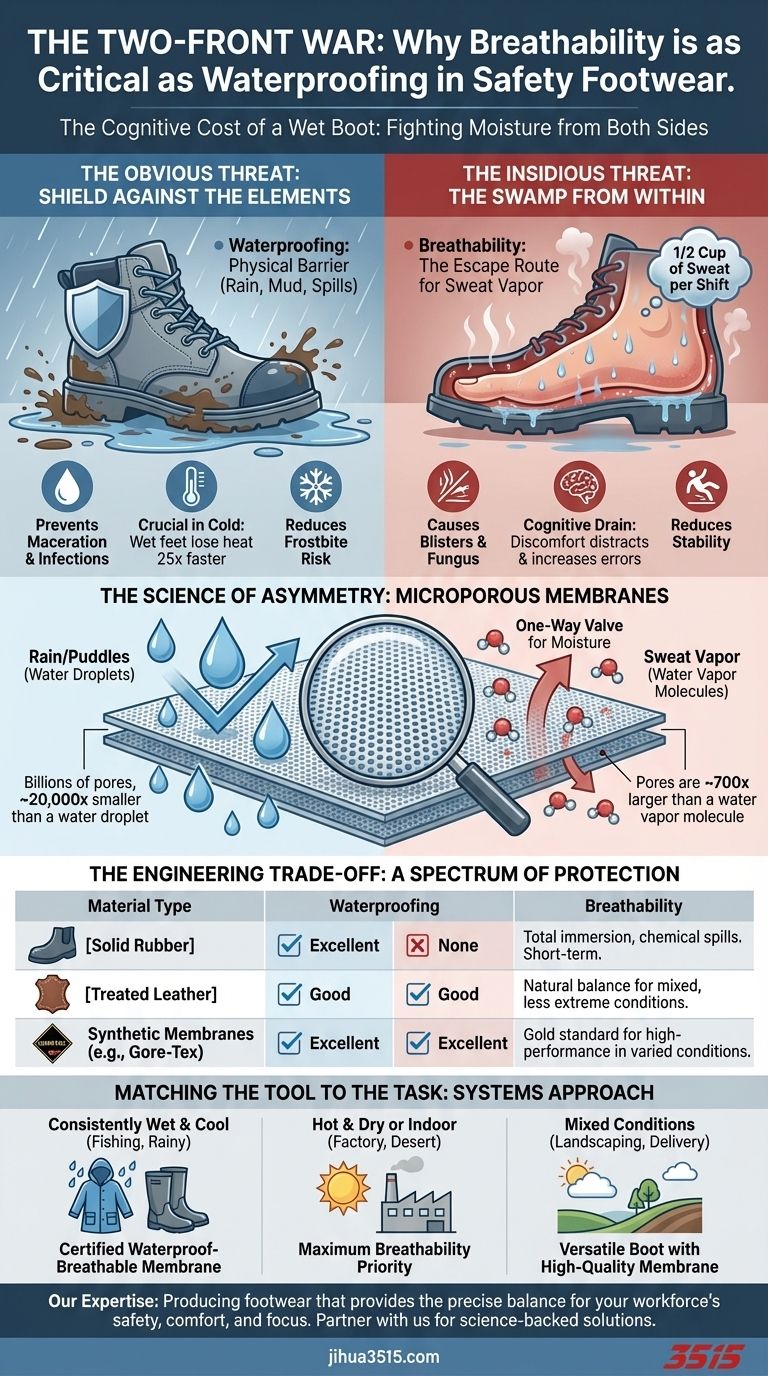
These membranes, like Gore-Tex, are engineered with billions of pores per square inch. Each pore is approximately 20,000 times smaller than a liquid water droplet, yet 700 times larger than a water vapor molecule.
This creates an asymmetrical barrier. It is impenetrable to external water (rain, puddles), but allows internal moisture (hot sweat vapor) to pass through and escape. It’s a one-way valve for moisture at a molecular level, constantly working to equalize the micro-environment inside the boot.
The Engineering Trade-off: A Spectrum of Protection
It is crucial to understand that waterproofing and breathability exist on a spectrum. The most waterproof materials are often the least breathable.
| Material Type | Waterproofing | Breathability | Use Case |
|---|---|---|---|
| Solid Rubber | Excellent | None | Total immersion, chemical spills. Unsuitable for long-wear. |
| Treated Leather | Good | Good | A natural balance for mixed, less extreme conditions. |
| Synthetic Membranes | Excellent | Excellent | The gold standard for high-performance in varied conditions. |
The goal of modern footwear design is not to maximize one feature, but to find the optimal balance for a specific task and environment.
Matching the Tool to the Task
Choosing the right footwear requires a systems approach—analyzing the environment and the demands on the worker to provide the correct tool for the job.
- Consistently Wet & Cool Environments: Workers on fishing docks or in rainy climates need a certified waterproof-breathable membrane to manage both external water and internal sweat.
- Hot & Dry or Indoor Environments: A factory worker or desert-based contractor's main challenge is sweat. Maximum breathability should be the priority to prevent internal moisture buildup.
- Mixed Conditions with Unpredictable Weather: For landscapers or delivery drivers, a versatile boot with a high-quality membrane provides the best all-around performance, adapting to changing conditions throughout the day.
As a large-scale manufacturer, we understand that "one size fits all" is a recipe for failure in safety footwear. Our expertise lies in producing a comprehensive range of boots and shoes engineered to meet these specific environmental challenges. We partner with distributors and brand owners to develop footwear that provides the precise balance of waterproofing and breathability required to keep a workforce safe, comfortable, and focused.
To equip your team with footwear that wins the war on both fronts, you need a manufacturing partner who understands the science. Contact Our Experts
Visual Guide
Related Products
- Safety Footwear Wholesale Manufacturer for Custom OEM/ODM Production
- Premium Suede Sport Safety Shoes for Wholesale & Bulk Orders
- Premium Safety Shoes with Rotating Buckle Safety Sneakers
- Premium Lightweight Safety Shoes for Wholesale & Bulk Orders
- Puncture-Resistant Velcro Safety Boots for Wholesale & Custom Manufacturing
Related Articles
- How Safety Footwear Materials Dictate Workplace Protection and Long-Term Value
- How to Match Safety Footwear Features to Workplace Hazards: A Risk-Based Guide
- How Safety Footwear Engineering Solves Industry-Specific Environmental Hazards
- Beyond the Logo: Decoding the Critical Shift from ANSI to ASTM in Safety Footwear
- More Than a Mandate: The Engineering and Psychology of Safety Footwear


















