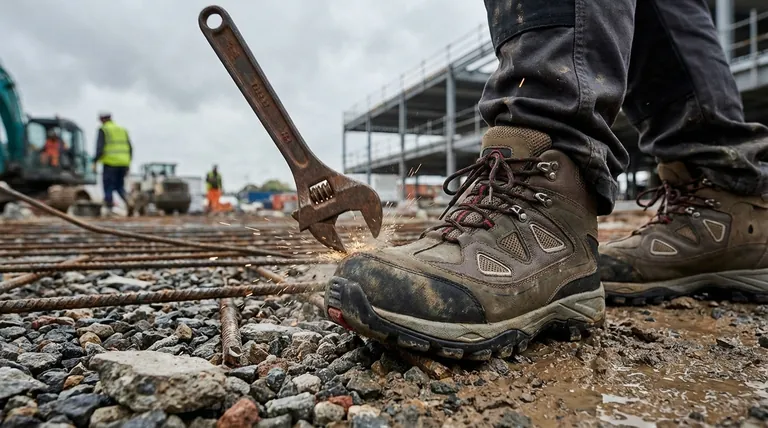
The 7% Miscalculation
In the landscape of workplace safety, foot injuries account for a startling 7% of all cases. This isn't just a statistic; it's a systemic failure in perception.
We tend to view safety shoes as a passive part of a uniform—a box to be checked on a compliance form. This is a fundamental, and dangerous, miscalculation.
A safety shoe is not apparel. It is a piece of specialized, task-specific machinery. The psychological gap between seeing it as a mandate versus seeing it as a tool is where most of that 7% of injuries occur.
The Physics of the Workplace: A Hazard-Based Analysis
Every work environment is governed by its own set of physical laws and potential threats. The function of safety footwear is to act as an engineered interface between the worker and these specific hazards.
The Kinetic and Punctual Threats of Construction
On a construction site, potential energy is everywhere: a hammer on a scaffold, a cinder block on a ledge. When dropped, it becomes kinetic energy. The primary job of a steel-toed boot is to absorb and dissipate that force, preventing a crushing injury. Simultaneously, the ground is a minefield of sharp objects like rebar and nails. A puncture-resistant sole isn't just a feature; it's a shield against a direct, disabling threat.
The Corrosive and Mechanical Forces of Manufacturing
Factory floors present a dual risk. Heavy machinery—presses, lathes, forklifts—poses a constant impact and crush hazard. But there's also the silent threat of chemical exposure. Here, the footwear serves as a personal containment system, engineered from materials designed to resist degradation from specific acids, bases, or solvents.
The Gravity and Friction of Logistics
The physics of a warehouse are simpler but no less dangerous. Gravity is the main antagonist, pulling packages from high shelves. Crush protection is essential. The second variable is the coefficient of friction. Spills and polished concrete floors create low-friction zones where a slip can be catastrophic. A slip-resistant sole is a critical component for maintaining stability and control.
The Unseen Dangers in Clinical Settings
In laboratories and healthcare facilities, the dangers are often invisible. Dropped scalpels or shattered glass vials pose a puncture risk, while chemical or biological spills can cause harm through skin contact. The footwear must act as an impermeable barrier against microscopic but potent threats.
The System's Levers: Compliance and Maintenance
Simply having the right shoe is not enough. The system of safety relies on two human-operated levers: the diligence of its maintenance and the discipline of its use.
The Psychology of Compliance
Why would an employee neglect to wear their provided gear? It's rarely malice. It's often a cognitive bias—underestimating a low-probability, high-impact event. Or it's a simple desire for comfort.
An employer's responsibility extends beyond procurement. It is to engineer a culture of safety where the function of the tool is understood, and compliance becomes a shared professional standard, not just a rule.
The Engineering of Integrity: A Tool, Not Apparel
You would never use a dull saw or a rusty wrench. A neglected safety shoe is no different. It is a compromised tool.
- Material Degradation: Caked-on dirt and grime are not just cosmetic. They hold moisture, which can make leather and synthetic materials brittle and prone to cracking.
- Structural Failure: Abrasive particles grind away at stitching and sole adhesives, silently destroying the shoe's structural integrity.
- Compromised Performance: A dirty, stiff shoe loses its breathability and flexibility, becoming an annoyance that can distract a worker at a critical moment.
Maintenance is not cleaning; it is the process of preserving the shoe's engineered protective capabilities.
Designing the Solution: Matching the Tool to the Task
The selection of safety footwear cannot be a one-size-fits-all decision. It must be a precise prescription based on a thorough diagnosis of the work environment.
| Industry / Setting | Primary Hazard(s) | Essential Engineering Feature(s) |
|---|---|---|
| Construction & Infrastructure | Impact, Crush, Puncture | Reinforced Toes, Puncture-Resistant Soles |
| Manufacturing & Production | Heavy Machinery, Chemicals | Impact Protection, Chemical Resistance |
| Logistics & Warehousing | Falling Objects, Slippery Surfaces | Crush Protection, Slip-Resistant Soles |
| Healthcare & Laboratories | Sharps, Spills | Puncture Resistance, Impermeable Uppers |
This level of specification can be a complex procurement challenge, especially for large organizations with diverse operational needs. The ideal solution is a manufacturing partner with the capability to produce a comprehensive range of footwear, engineered for every specific hazard. As a large-scale manufacturer, 3515 produces a full spectrum of safety shoes and boots tailored to the unique risks your industry faces.
Choosing the right tool is the first step to mitigating risk and protecting your people. For a partner that understands the engineering and can deliver the precise solution for every industrial environment, Contact Our Experts.
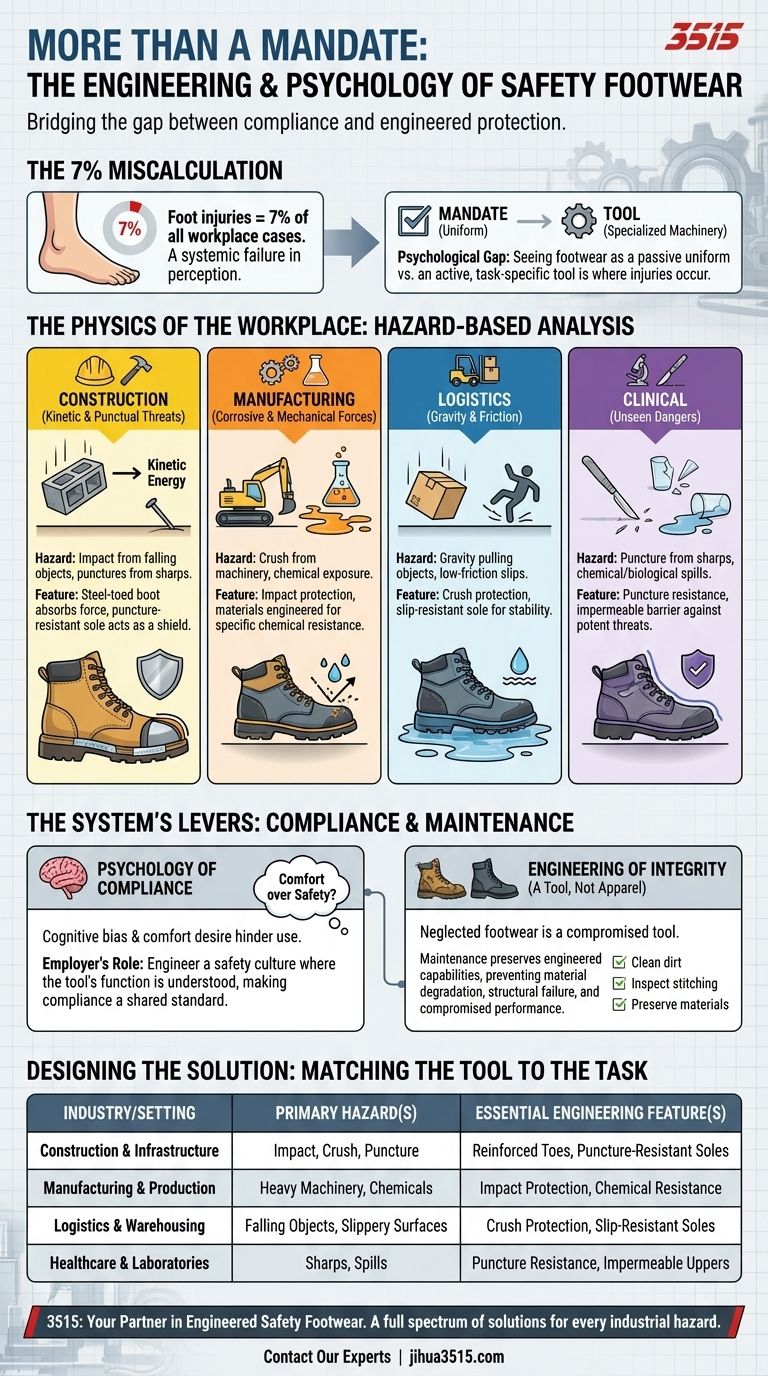
Visual Guide
Related Products
- Safety Footwear Wholesale Manufacturer for Custom OEM/ODM Production
- Premium Suede Sport Safety Shoes for Wholesale & Bulk Orders
- Premium Safety Shoes with Rotating Buckle Safety Sneakers
- Premium Lightweight Safety Shoes for Wholesale & Bulk Orders
- Puncture-Resistant Velcro Safety Boots for Wholesale & Custom Manufacturing
Related Articles
- How Safety Footwear Materials Dictate Workplace Protection and Long-Term Value
- How to Match Safety Footwear Features to Workplace Hazards: A Risk-Based Guide
- How Safety Footwear Engineering Solves Industry-Specific Environmental Hazards
- Beyond the Logo: Decoding the Critical Shift from ANSI to ASTM in Safety Footwear
- How Employers Select Safety Footwear: A Compliance-Focused Guide for Workers


















