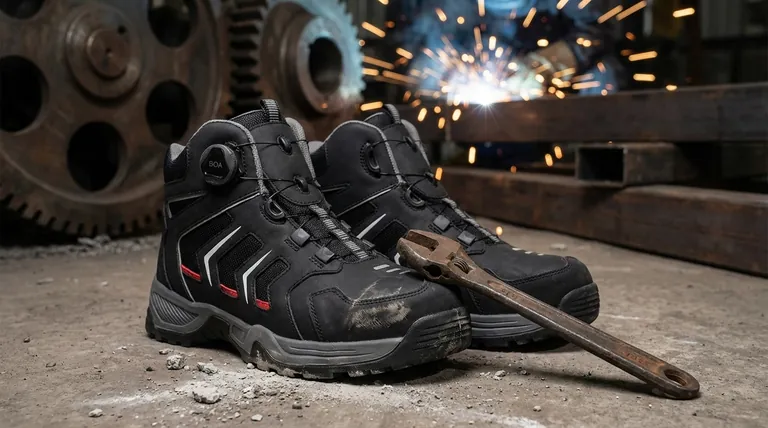
A 50-Pound Mistake
Imagine a bustling factory floor. A mechanic, perched on a ladder, loses their grip on a heavy-duty wrench. It falls three feet, tumbling end over end. Below, another worker is focused on their task, oblivious.
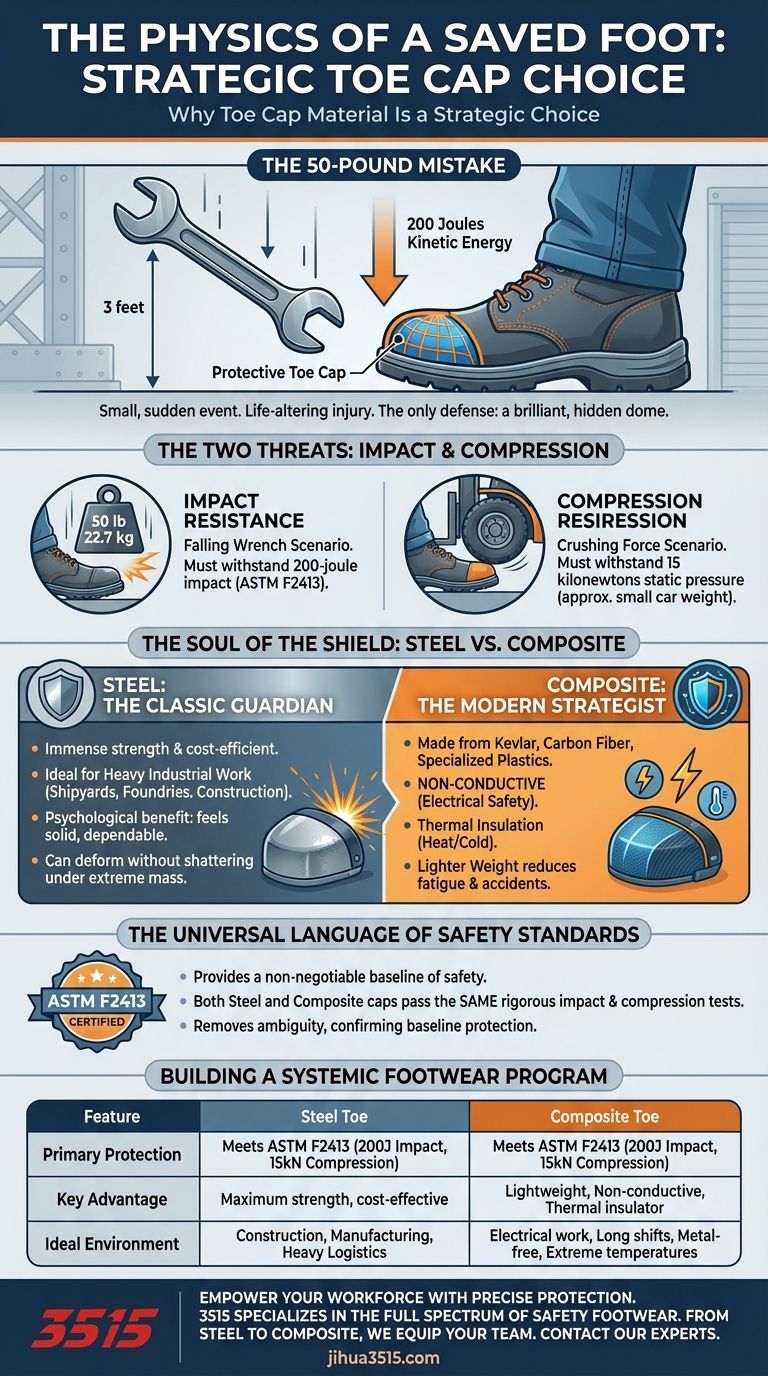
That falling tool carries 200 joules of kinetic energy. It's a small, sudden event that can cause a life-altering injury. The only thing standing between the worker's foot and the crushing force of that impact is a small, brilliantly engineered dome hidden inside their boot: the protective toe cap.
We often misjudge the physics of everyday risks. A safety boot isn't just footwear; it's a piece of personal protective equipment engineered to absorb and deflect forces that the human body simply cannot.
The Two Threats: Impact and Compression
A certified safety toe cap is designed to defeat two specific, brutal forces common in industrial environments. It's not just a hard piece of plastic; it's a structural shield that has passed rigorous, standardized tests.
- Impact Resistance: This is the falling wrench scenario. To meet global standards like ASTM F2413, a toe cap must withstand a 200-joule impact. It's the physical equivalent of a 50-pound (22.7 kg) object dropped from three feet onto your toes.
- Compression Resistance: This is the threat of a slow, crushing force, like the wheel of a heavy cart or forklift rolling onto your foot. A certified cap must withstand 15 kilonewtons of static pressure—comparable to the weight of a small car—without collapsing.
The standard creates a non-negotiable baseline of safety. The material used to achieve that standard, however, introduces critical variables that affect performance in different environments.
The Soul of the Shield: Steel vs. Composite
The choice between steel and composite toe caps is not about which is "stronger" in a general sense. Both meet the same core safety requirements. The real decision is about matching the material's secondary properties to the specific hazards and demands of a job.
H3: Steel: The Classic Guardian
Steel is the traditional material for a reason. Its immense strength and ability to be formed into a protective shape make it an incredibly effective and cost-efficient solution.
For heavy industrial work—shipyards, foundries, major construction sites—steel is a time-tested champion. Its psychological benefit is also powerful; it feels solid, robust, and dependable. In scenarios involving extreme mass, steel's ability to bend and deform without shattering can provide a crucial margin of safety.
H3: Composite: The Modern Strategist
Composite toe caps, made from materials like Kevlar, carbon fiber, or specialized plastics, represent a more modern, tailored approach to safety. They achieve the same impact and compression standards as steel, but with a different set of strategic advantages.
The most significant benefit is their lack of conductivity. For electricians or anyone working near live circuits, a composite toe is not a preference; it's a necessity. Metal conducts electricity, turning a standard safety boot into a dangerous liability.
Furthermore, composites don't conduct heat or cold like metal does, providing better insulation in extreme temperature environments. Their lighter weight also reduces physical fatigue over a long shift, which in turn reduces the risk of errors and accidents. This isn't just a matter of comfort; it's a component of systemic safety.
The Universal Language of Safety Standards
Workplace safety standards like ASTM F2413 provide a universal guarantee. They create a foundation of trust, assuring employers and workers that the equipment they rely on has been proven to perform under duress.
When a boot is certified, it means the toe cap has passed the required impact and compression tests, regardless of whether it's made of steel or composite. The standard removes the ambiguity. It confirms that the baseline protection is there.
This allows organizations to make procurement decisions based on the other critical factors: electrical hazards, weight, temperature, and specific job functions.
Building a Systemic Footwear Program
Choosing the right footwear is a systemic decision, not just a line item in a budget. A large workforce rarely faces a single, uniform risk. Electricians, mechanics, warehouse staff, and machine operators all work in the same facility but require different types of protection.
| Feature | Steel Toe | Composite Toe |
|---|---|---|
| Primary Protection | Meets ASTM F2413 (200J Impact, 15kN Compression) | Meets ASTM F2413 (200J Impact, 15kN Compression) |
| Key Advantage | Maximum strength for heavy industry, cost-effective | Lightweight, non-conductive (electrical safety), thermal insulator |
| Ideal Environment | Construction, manufacturing, heavy logistics | Electrical work, long shifts, metal-free zones, extreme temperatures |
Sourcing footwear that meets these varied needs requires a manufacturing partner with a comprehensive understanding of materials science and production capability. As a large-scale producer, 3515 specializes in manufacturing the full spectrum of safety footwear. Our expertise covers everything from classic steel-toe boots for maximum impact resistance to advanced, lightweight composite boots for specialized technical roles. We empower distributors and brand owners to equip entire workforces with the precise protection each individual needs.
Ensuring every team member has the right tool for the job is the foundation of a true safety culture. To build that foundation with footwear engineered for every hazard, Contact Our Experts.
Visual Guide
Related Products
- Premium Suede Sport Safety Shoes for Wholesale & Bulk Orders
- Premium Lightweight Safety Shoes for Wholesale & Bulk Orders
- Wholesale Anti-Smash & Puncture-Proof Safety Shoes Custom Manufacturing for Brands
- Premium KPU Injection Athletic Style Safety Shoes
- Premium Safety Shoes with Rotating Buckle Safety Sneakers
Related Articles
- The Ghost in the Machine: Why an Obsolete Footwear Standard Creates Modern Risk
- Beyond the Steel Toe: The Hidden Ergonomics of Workplace Safety
- Why Traditional Laces Are a Hidden Safety Risk—And What to Do About It
- The True Cost of Skipping Safety Shoes: Long-Term Risks and Smart Protection
- How Safety Shoe Engineering Prevents Workplace Injuries Across Industries