A Design Forged by Fear
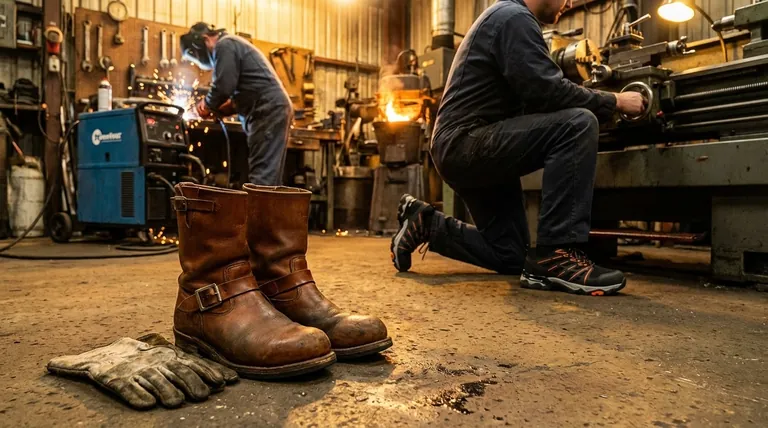
Imagine the floor of a 1930s railroad workshop or steel foundry. The air is thick with heat and the deafening sound of machinery. For the workers—the firemen, the welders, the machinists—danger wasn't an abstract concept. It was a constant, physical presence.
In this environment, equipment wasn't just about function; it was about survival. And the engineer boot emerged not as a fashion statement, but as a direct response to the visceral fears of the industrial age. Its design genius is not just in what it includes, but in what it strategically, brilliantly, omits.
The Calculus of Subtraction
Great design often solves problems by adding features. The engineer boot achieved safety by taking them away. It was an exercise in intentional minimalism, where every removed element eliminated a specific, catastrophic risk.
Eliminating the Entanglement Variable
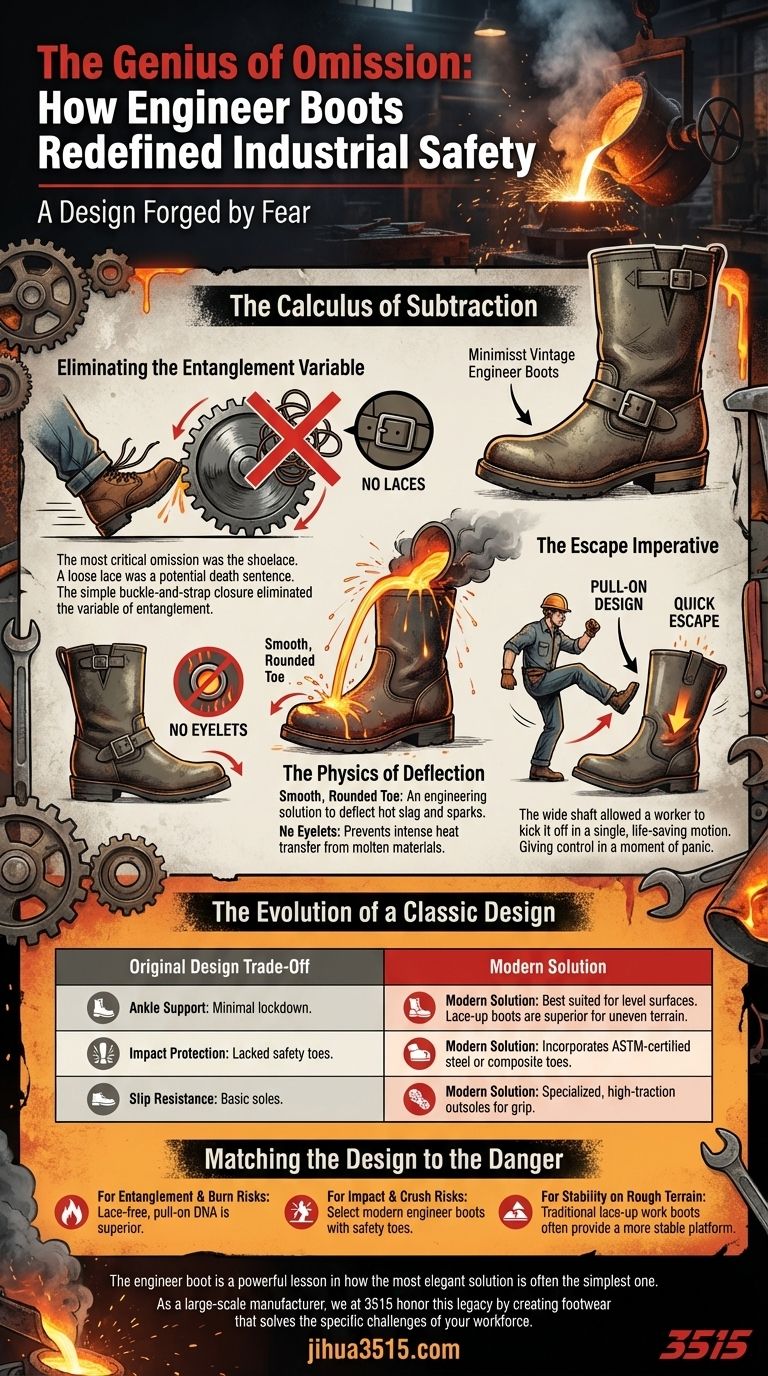
The most critical omission was the shoelace.
To a machinist working on a lathe, a loose lace wasn't an inconvenience. It was a potential death sentence. The physics are terrifying: a single dangling string caught in a rotating shaft could pull a worker into the machine in a fraction of a second.
The engineer boot’s simple buckle-and-strap closure was a revolutionary act of subtraction. By removing laces, it completely eliminated the variable of entanglement, creating a smooth, safe profile for anyone working near the unforgiving power of moving parts.
The Physics of Deflection
Burns from molten metal and hot sparks were another daily reality. Here, the boot's silhouette became a shield.
- Smooth, Rounded Toe: This wasn't an aesthetic choice. It was an engineering solution designed to use gravity and physics to its advantage. Hot slag or sparks landing on the boot would roll off immediately, with no stitched seam or crevice to catch them and allow them to burn through the leather.
- No Eyelets: Metal eyelets conduct heat rapidly. A single spark landing on an eyelet could transfer intense heat directly to the foot. Removing them, along with the laces they support, fortified the boot's defense against thermal hazards.
The Escape Imperative
Perhaps the most psychologically astute feature was the pull-on design.
Consider a welder who feels a piece of hot slag fall inside their boot. The pain is immediate and intense. With a traditional lace-up boot, panic sets in; unlacing it takes a desperate eternity.
The engineer boot's wide shaft allowed a worker to kick it off in a single, life-saving motion. This wasn't about convenience. It was about giving a worker control in a moment of pure, unadulterated panic, transforming a severe burn into a minor incident.
The Evolution of a Classic Design
A design perfected for the hazards of one era must adapt to the standards of the next. While the original engineer boot was revolutionary, modern industrial environments present a different set of challenges that have driven its evolution.
| Feature | Original Design Trade-Off | Modern Solution |
|---|---|---|
| Ankle Support | Minimal lockdown due to pull-on style. | While the design remains, it's best suited for level surfaces. Lace-up boots are superior for uneven terrain. |
| Impact Protection | Lacked reinforced safety toes. | Modern engineer boots incorporate ASTM-certified steel or composite toes to protect against crushing injuries. |
| Slip Resistance | Basic leather or rubber soles. | Specialized, high-traction outsoles are now standard to provide grip on oily, wet, or slippery surfaces. |
This evolution doesn't diminish the original design's brilliance. It highlights how the core principles of purpose-built safety can be enhanced with modern materials and a deeper understanding of occupational hazards.
Matching the Design to the Danger
Understanding the "why" behind a boot's design empowers procurement managers and safety officers to make the right choice. The selection process becomes a risk assessment.
- For Entanglement & Burn Risks: The lace-free, pull-on DNA of the engineer boot remains the superior choice for welders, mechanics, and machine operators.
- For Impact & Crush Risks: The mandate is clear—select a modern engineer boot that incorporates a certified safety toe. The classic form must be paired with modern protection.
- For Stability on Rough Terrain: The trade-off for quick removal is ankle support. In environments like construction sites with uneven ground, a traditional lace-up work boot often provides a more stable platform.
The engineer boot is a powerful lesson in how the most elegant solution is often the simplest one. It’s a piece of engineering history, born from the simple, romantic idea that the right tool can protect a life.
As a large-scale manufacturer, we at 3515 honor this legacy by creating footwear that solves the specific challenges of your workforce. We produce a comprehensive range of boots, including modern engineer styles updated with critical safety features, all built to meet the rigorous demands of industrial use.
If your organization requires footwear that is purpose-built for specific industrial hazards, we can help you engineer the perfect solution. Contact Our Experts
Visual Guide
Related Products
- Durable Leather Work Boots Wholesale Manufacturer & Custom Factory
- Durable Leather Work Boots for Wholesale & Custom OEM Manufacturing
- Durable Leather Work Boots for Wholesale & Custom Manufacturing
- Premium Waterproof High-Cut Industrial Safety Boots for Wholesale and Bulk Orders
- Wholesale Customizable Safety Boots Durable & Protective Footwear Manufacturing
Related Articles
- The Unseen Physics of Failure: Why Work Boots Are Your Most Critical PPE
- How Work Boots Engineer Safety: The Science Behind Impact and Compression Protection
- How Job-Specific Work Boot Designs Enhance Safety and Efficiency
- How to Choose Work Boots That Prevent Injuries in High-Risk Jobs
- How Work Boot Components Address Safety and Comfort in High-Risk Jobs