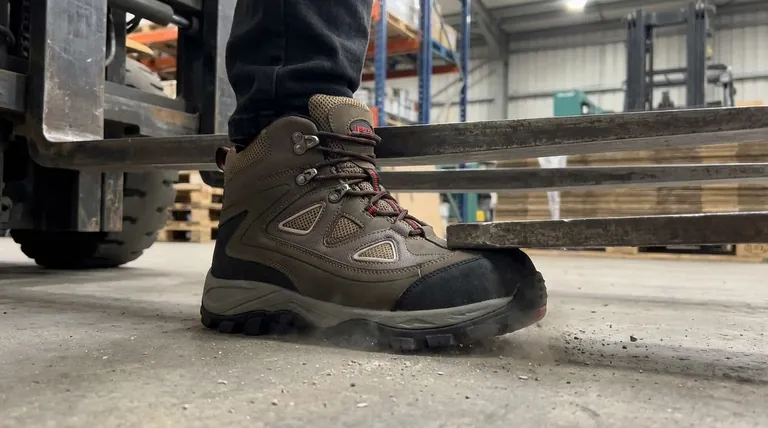
The Psychology of a Near Miss
Picture a warehouse. A forklift, heavy with pallets, pivots in a tight aisle. The operator misjudges the turn. The immense weight of the machine doesn't strike the worker's foot—it slowly, deliberately rolls onto it.
This is not a sudden, violent impact. It is a quiet, creeping catastrophe. A scenario governed by the physics of pressure, not momentum.
Our minds tend to simplify safety into a binary of "strong" or "weak." We see a steel-toed boot and assume it's an impenetrable fortress. But the engineers who design and certify these boots are not concerned with the fortress. They are obsessed with the space inside it.
The Anatomy of a Controlled Crush
The critical question in a compression event is not "Did the toe cap break?" The question is, "How much safe space was left for the human foot?"
This is the principle behind the ASTM F2413 standard for compression resistance. It’s a test designed to simulate a slow-moving, high-pressure event.
Simulating a Slow Catastrophe
During testing, a boot's safety toe is placed in a machine that applies a steady compressive force. It squeezes. It doesn't strike.
This force escalates until it reaches a designated load, simulating the immense pressure of rolling equipment or a crushing weight settling onto the foot.
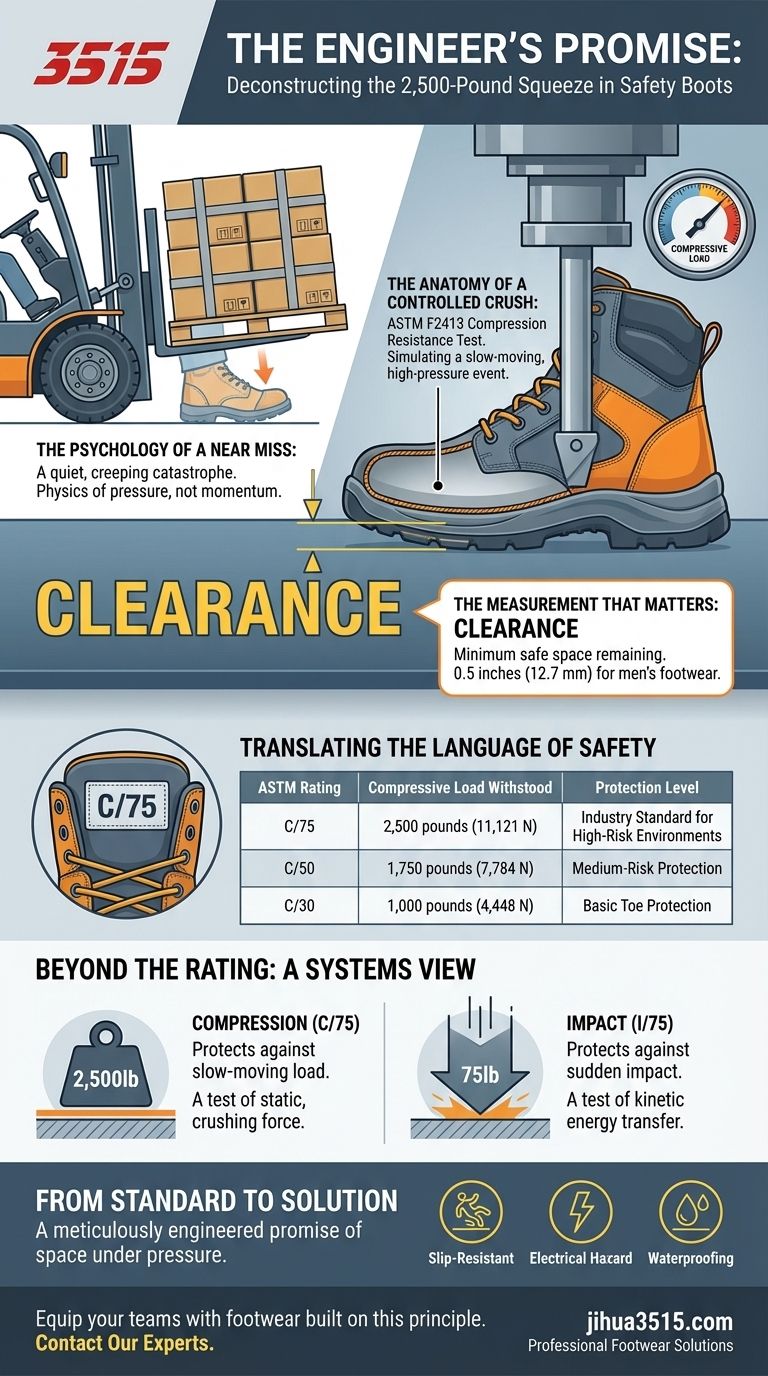
The Measurement That Matters: Clearance
The true goal of the test is measured by what happens inside the toe cap. A small clay cylinder or sensor records the minimum interior height remaining at the moment of maximum compression.
To pass, this "clearance" must not fall below a specific minimum, typically 0.5 inches (12.7 mm) for men's footwear. This tiny pocket of space is the entire point. It is the engineered difference between a painful incident and a life-altering injury.
Translating the Language of Safety
The results of these tests are codified into a simple, powerful language printed on the boot's tongue. Understanding this code is essential for anyone responsible for occupational safety.
The letter 'C' stands for Compression. It confirms the boot has been certified against crushing forces.
The number that follows indicates the class of protection.
| ASTM Rating | Compressive Load Withstood | Protection Level |
|---|---|---|
| C/75 | 2,500 pounds (11,121 N) | Industry Standard for High-Risk Environments |
| C/50 | 1,750 pounds (7,784 N) | Medium-Risk Protection |
| C/30 | 1,000 pounds (4,448 N) | Basic Toe Protection |
A C/75 rating is the promise. It signifies that the boot's toe box will not only withstand a 2,500-pound load but, more importantly, will preserve that critical half-inch of clearance for the wearer's toes. For most construction, manufacturing, and logistics environments, this is the non-negotiable standard.
Beyond the Rating: A Systems View of Foot Protection
Relying on a single rating, however, introduces cognitive traps. True safety requires a systems approach.
The Fallacy of Interchangeability: Compression vs. Impact
Compression ('C') and Impact ('I') are often found together on a rating (e.g., I/75 C/75), but they test for fundamentally different hazards.
- Impact (I/75): Protects against a 75-pound object dropped from a height. A test of sudden, kinetic energy transfer.
- Compression (C/75): Protects against a 2,500-pound slow-moving load. A test of static, crushing force.
Assuming protection from one implies protection from the other is a dangerous mistake.
Tunnel Vision on the Toe Cap
A C/75 rating is a vital data point, but it's not the whole story. The work environment dictates the need for other features: slip-resistant soles, electrical hazard protection, waterproofing, or chemical resistance. The toe cap is one component in an integrated system designed to protect a person.
From Standard to Solution
The compression rating on a safety boot is more than a specification; it is a meticulously engineered promise of space under pressure.
For distributors, brand owners, and organizations responsible for worker safety, upholding this promise is paramount. This requires sourcing from a manufacturer that has mastered the science and scale of producing consistently reliable, certified footwear. As a large-scale producer of a comprehensive range of boots, we build our products around the integrity of these standards.
Ensuring every boot meets these life-saving criteria is our core mission. To equip your teams with footwear built on this principle, Contact Our Experts.
Visual Guide
Related Products
- High Performance Fire-Retardant Waterproof Safety Boots
- Premium Wholesale Wheat Nubuck Safety Boot with Rapid Lacing System
- Premium Wholesale Waterproof Safety Boots High Performance Protection for Industrial Markets
- Premium Grain Leather Safety Boots for Bulk Supply
- Heavy-Duty Waterproof Nubuck Safety Boots Safety Shoes for Bulk Supply
Related Articles
- How to Choose Safety Boots That Reduce Fatigue Without Sacrificing Protection
- How Industrial Professionals Can Balance Safety Boot Requirements with Professional Appearance
- The Anatomy of Trust: A Systems Approach to Workplace Foot Protection
- The Lacing Paradox: Why the Safest Boots Contain Their Own Greatest Risk
- How to Choose Waterproof Boots That Actually Work for Your Needs