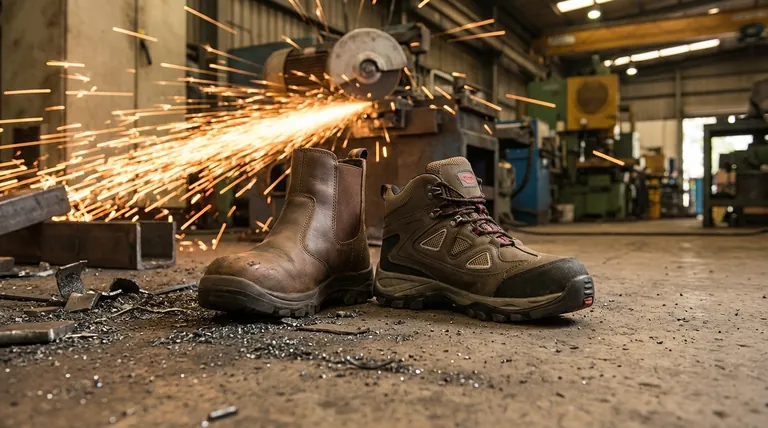
The Illusion of a Simple Choice
We are psychologically wired to prefer the path of least resistance. We choose the app with the cleaner interface, the tool with the fewest buttons, and the route with the least traffic. This bias for simplicity and convenience extends to the equipment we wear every day.
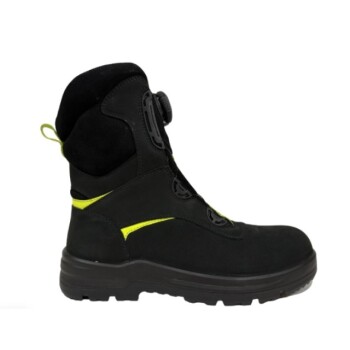
When choosing safety footwear, the slip-on boot presents itself as the obvious "easy" choice. No lacing, no knots, no fuss. But in an industrial environment, this simple design choice is not a matter of preference; it is a critical engineering decision with profound safety trade-offs. The choice between a slip-on and a lace-up is a calculated risk assessment, disguised as a matter of comfort.
Engineered for the Worst-Case Scenario
The most compelling argument for a slip-on boot isn't found in the daily routine of putting it on. It's found in the split seconds of a crisis.
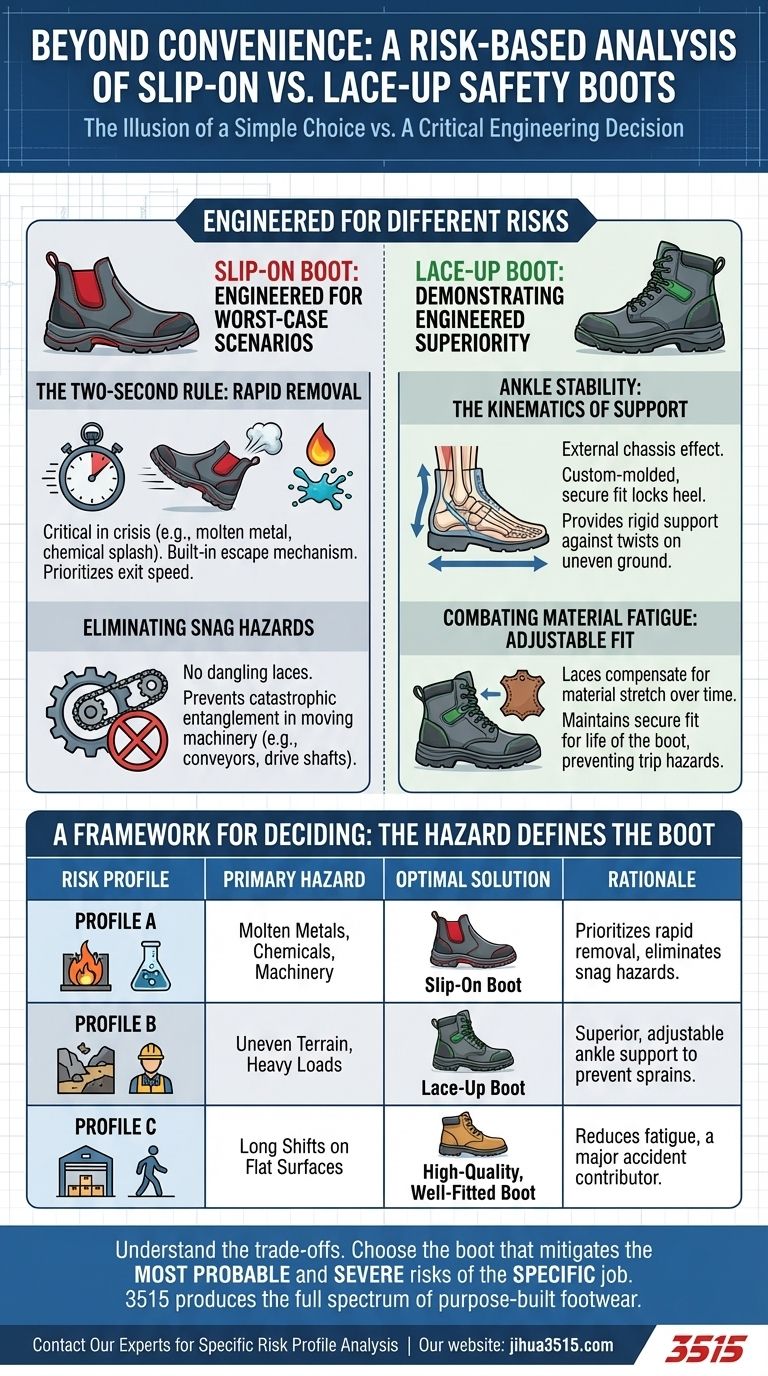
The Two-Second Rule: When Rapid Removal is Life-Saving
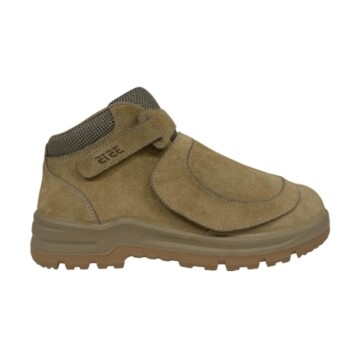
Imagine a welder on a platform. A stray glob of molten metal falls, finding its way inside the top of their boot. The searing heat is instantaneous. In this moment, the ability to kick off the boot in two seconds is not convenience; it's the difference between a minor burn and a life-altering injury.
The same logic applies in a chemical plant where a corrosive liquid splashes. The slip-on design is a built-in escape mechanism, an intentional feature for environments where hazardous substances are a constant threat. It's a design that prioritizes exit speed over all else.
Eliminating the Unforced Error: The Snag Hazard
Complex systems often fail because of the smallest, most overlooked variable. In a workplace filled with rotating machinery, conveyors, or moving parts, a loose shoelace is exactly that kind of variable. It’s an unforced error waiting to happen.
A dangling lace can catch on a drive shaft or get pulled into a chain, leading to catastrophic entanglement. Slip-on boots completely engineer this risk out of the system. By removing the laces, they remove the possibility of this specific, and devastating, human-factor failure.
The Inescapable Laws of Physics
While slip-ons excel in specific emergencies, their design must contend with the fundamental principles of biomechanics and material science. This is where the lace-up boot demonstrates its own engineered superiority.
Ankle Stability: The Kinematics of Support
The human ankle is a complex marvel of engineering, but it's vulnerable to torsional forces, especially on uneven ground or when carrying heavy loads.
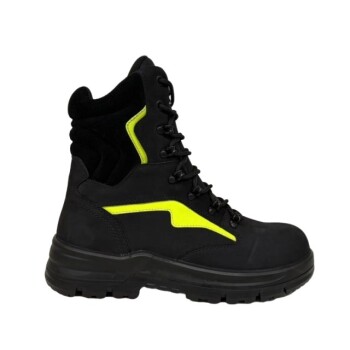
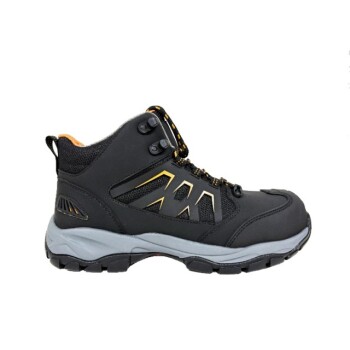
A lace-up boot acts as an external chassis. The laces allow a worker to create a custom-molded, secure fit that locks the heel in place and provides rigid support against twists and sprains. A slip-on, by its very nature, must have a wider opening to allow the foot to enter, creating a small but significant gap in support. Over a long day of walking on gravel, scaffolding, or rough terrain, that small gap makes a world of difference.
The Slow Loosening: A Story of Material Fatigue
Every boot, particularly one made of leather, stretches and conforms to the wearer's foot over time. This is a sign of a good break-in, but it also introduces a new variable.
With a lace-up, the wearer can simply tighten the laces to compensate for the material stretching, maintaining a secure fit for the life of the boot. A slip-on that has stretched can become loose. What was once a comfortable boot can become a trip hazard, turning its primary advantage into a liability.
A Framework for Deciding: The Hazard Defines the Boot
The "safest boot" is a myth. The right boot is the one that correctly mitigates the most probable and severe risks of a specific job. The decision should be a deliberate, risk-based analysis.
| Risk Profile | Primary Hazard | Optimal Engineering Solution | Rationale |
|---|---|---|---|
| Profile A | Molten Metals, Chemicals, Machinery | Slip-On Boot | Prioritizes rapid removal and eliminates snag hazards. |
| Profile B | Uneven Terrain, Heavy Loads | Lace-Up Boot | Provides superior, adjustable ankle support to prevent sprains. |
| Profile C | Long Shifts on Flat Surfaces | High-Quality, Well-Fitted Boot | Reduces fatigue, which is a major contributor to accidents. |
This systematic approach moves the conversation from "what's easier?" to "what's safer for this specific task?"
Understanding these nuanced trade-offs is crucial for any organization committed to true workplace safety. It requires a manufacturing partner who sees footwear not as a commodity, but as a critical piece of personal protective equipment. As a large-scale manufacturer, 3515 produces the full spectrum of footwear—from specialized slip-ons for foundries to rugged lace-ups for construction—ensuring that every design is purpose-built for the hazards at hand.
We can help you analyze your team's specific risk profiles to equip them with the correctly engineered solution. Contact Our Experts
Visual Guide
Related Products
- Puncture-Resistant Velcro Safety Boots for Wholesale & Custom Manufacturing
- Wholesale Durable Safety Boots | Custom Steel Toe & Puncture-Resistant Manufacturing
- Premium Grain Leather Safety Boots for Bulk Supply
- Heavy-Duty Waterproof Nubuck Safety Boots Safety Shoes for Bulk Supply
- Premium High-Cut Waterproof Safety Boots Manufacturing & Wholesale Solutions
Related Articles
- The Unseen Engineering: Why Steel Toes Succeed or Fail in Oily Environments
- The Anatomy of Trust: A Systems Approach to Workplace Foot Protection
- The Lacing Paradox: Why the Safest Boots Contain Their Own Greatest Risk
- How Industrial Professionals Can Balance Safety Boot Requirements with Professional Appearance
- How to Choose Safety Boots That Reduce Fatigue Without Sacrificing Protection