The Ground Truth an Engineer Forgets
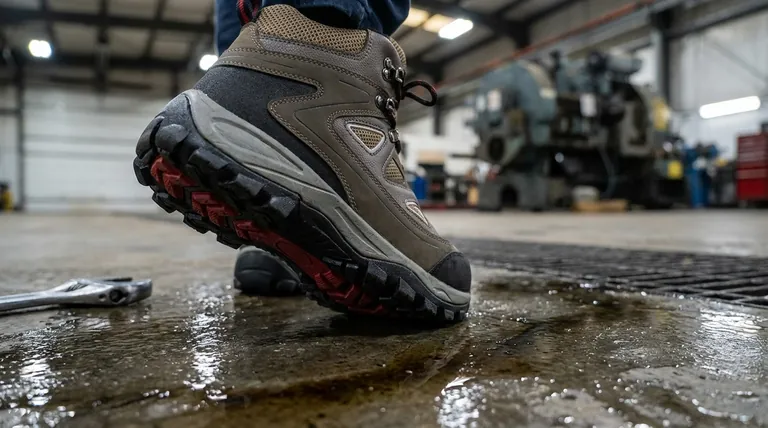
Picture an aircraft mechanic on a hangar floor, a landscape of concrete slick with hydraulic fluid. Every step is a calculation of risk. Now, picture a warehouse logistics manager walking twelve miles a day on polished concrete. Their enemy isn't a sudden slip, but the slow, grinding fatigue that accumulates with each of their 25,000 steps.
Both need "oil-resistant safety boots," but this single label hides a complex engineering reality. The choice of a sole material isn't just a technical specification; it's a decision about physics, endurance, and the psychology of work. It addresses the fundamental trade-offs between absolute grip, long-term durability, and human fatigue.
The Trilemma: Rubber, TPU, and EVA
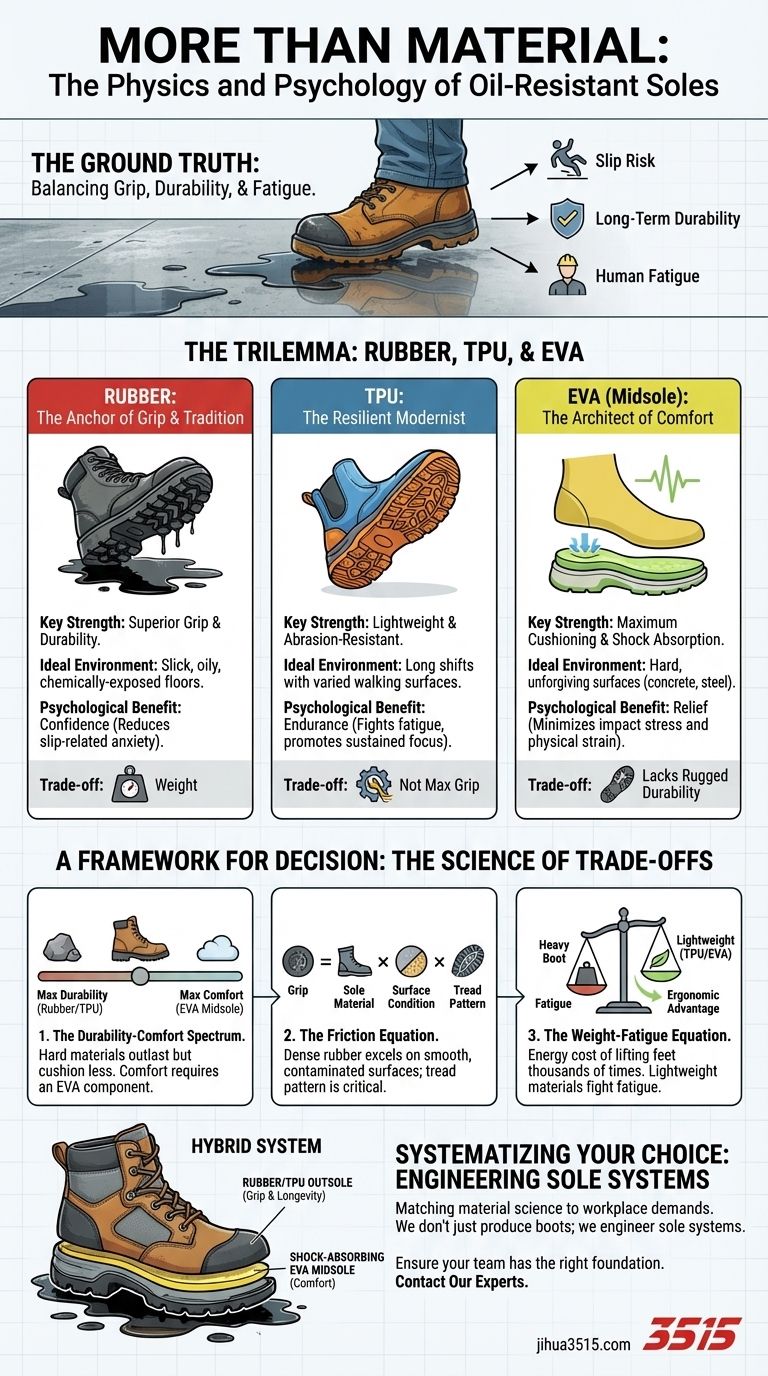
At the heart of sole design for hazardous environments lies a choice between three core materials: Rubber, Thermoplastic Polyurethane (TPU), and Ethylene-Vinyl Acetate (EVA).
Viewing them as simple alternatives is a mistake. Instead, they represent three distinct philosophies of how to solve the problem of keeping a worker safe, comfortable, and productive on their feet.
Rubber: The Anchor of Grip and Tradition
Rubber is the classic, time-tested solution for outsoles. Its high coefficient of friction provides an unparalleled grip on oily and wet surfaces. This is the material you trust when a single slip could be catastrophic.
High-performance vulcanized rubber compounds, like those famously produced by Vibram, represent the pinnacle of this approach. They are dense, durable, and highly resistant to chemicals and abrasion. From a psychological perspective, a solid rubber sole provides confidence. It feels anchored and secure, removing the subconscious hesitation that comes with walking on treacherous ground. Its trade-off? Weight.
TPU: The Resilient Modernist
Thermoplastic Polyurethane is the engineer's answer to rubber's limitations. It’s a modern polymer that offers exceptional abrasion, oil, and chemical resistance in a profile that is significantly lighter and more flexible than dense rubber.
TPU is the workhorse. It may not have the same superlative grip as the best nitrile rubber compounds on sheer oil, but it provides a fantastic, durable balance for mixed-use environments. Think of it as the lightweight composite that replaced heavy steel. It reduces the cumulative energy expenditure of a worker over a long day, fighting fatigue without compromising on toughness.
EVA: The Architect of Comfort
EVA is a foam-like copolymer, and its superpower is energy absorption. It's incredibly light and provides excellent cushioning, which is why it's the undisputed champion of midsole materials.
While some tough EVA formulations exist, it is rarely the primary outsole material in demanding environments because it lacks the rugged durability of rubber or TPU. Its role is architectural. EVA is the boot's suspension system, absorbing the constant, punishing impacts of walking on hard surfaces. It’s the material that addresses the slow-burn threat of musculoskeletal strain and fatigue.
The Science of Trade-offs: A Framework for Decision
There is no "best" material. There is only the best material for a specific context. The decision hinges on understanding three fundamental compromises.
1. The Durability-Comfort Spectrum
The hardest, most indestructible materials are rarely the most comfortable. A dense, vulcanized rubber outsole will outlast almost anything but offers little in the way of cushioning. An EVA midsole provides cloud-like comfort but would be shredded quickly if used as the primary contact point on rough terrain.
- Maximum Durability: Leans toward dense Rubber or TPU.
- Maximum Comfort: Requires an EVA midsole component.
2. The Friction Equation
Grip is not a single value; it's an interaction between a sole and a surface. Dense rubber excels at creating friction on smooth, contaminated surfaces. However, a boot's tread pattern is equally critical. Deeper, wider-spaced lugs are better for shedding debris, while smaller, intricate patterns maximize surface contact on flat floors.
3. The Weight-Fatigue Equation
The energy cost of lifting your feet thousands of times a day is real. A pound of weight on your feet is equivalent to five pounds in a backpack. This is where lightweight materials like TPU and EVA provide a massive ergonomic advantage. A heavier rubber boot might offer maximum protection, but it can also be a direct contributor to end-of-shift fatigue, which itself leads to mistakes and accidents.
Systematizing Your Choice
To select the right sole, you must diagnose your primary challenge.
| Material | Key Strength | Ideal Environment | Psychological Benefit |
|---|---|---|---|
| Rubber | Superior Grip & Durability | Slick, oily, or chemically-exposed floors | Confidence: Reduces slip-related anxiety. |
| TPU | Lightweight & Abrasion-Resistant | Long shifts with varied walking surfaces | Endurance: Fights fatigue, promotes sustained focus. |
| EVA (Midsole) | Maximum Cushioning & Shock Absorption | Hard, unforgiving surfaces (concrete, steel) | Relief: Minimizes impact stress and physical strain. |
The optimal safety boot is often a hybrid—a system engineered to deliver the right benefits. It might feature a rugged rubber or TPU outsole for grip and longevity, bonded to a shock-absorbing EVA midsole for comfort.
This level of specification—matching material science directly to workplace demands—is the difference between adequate footwear and a genuine tool for safety and productivity. As a large-scale footwear manufacturer, we specialize in this process. We don't just produce boots; we engineer sole systems—whether high-grip rubber, resilient TPU, or comfort-focused EVA—to meet the precise challenges your team faces every day.
To ensure your team has the right foundation for their work, you need more than a product; you need a manufacturing partner who understands the science. Contact Our Experts
Visual Guide
Related Products
- Heavy-Duty Goodyear Welted Pull-On Safety Rigger Boot
- Premium Oil Wax Leather Safety Boots for Bulk Purchase
- Wholesale Waterproof Tactical Boots Custom Suede & High-Traction Soles
- Premium Wholesale Waterproof Safety Boots High Performance Protection for Industrial Markets
- Premium Waterproof High-Cut Industrial Safety Boots for Wholesale and Bulk Orders
Related Articles
- Beyond the Tread: The Molecular Battle for Grip on Oily Surfaces
- How to Choose Safety Boot Certifications for Your Industry's Hazards
- How Safety Boot Features Address Industry-Specific Workplace Hazards
- The True Cost of a Safety Boot: Why Your Footwear Budget Is Breaking
- How Safety Boot Engineering Protects Against Workplace Hazards: A Buyer's Guide