The Illusion of Invulnerability
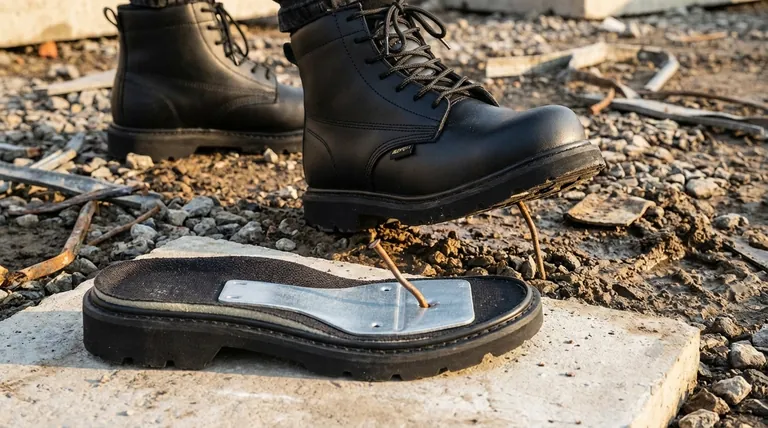
Imagine a construction site. The ground is a landscape of hidden threats: a dropped screw, a shard of rebar, a nail pointing skyward from a discarded piece of wood.
Our instinct for safety is often visual. We see a thick, heavy rubber sole on a work boot and our mind makes a simple calculation: thick equals strong, strong equals safe.
This is a dangerous mental shortcut.
The true protection against a nail underfoot has almost nothing to do with the thickness of the rubber. It comes from a thin, engineered shield hidden inside the boot—a piece of technology that functions as the last line of defense for your foot. Understanding this invisible component is the first step toward genuine workplace safety.
The Anatomy of a Shield
At the heart of any puncture-resistant boot is a specialized protective plate. It is not an insert you can add or remove; it is an integral part of the shoe's architecture.
Strategic Placement
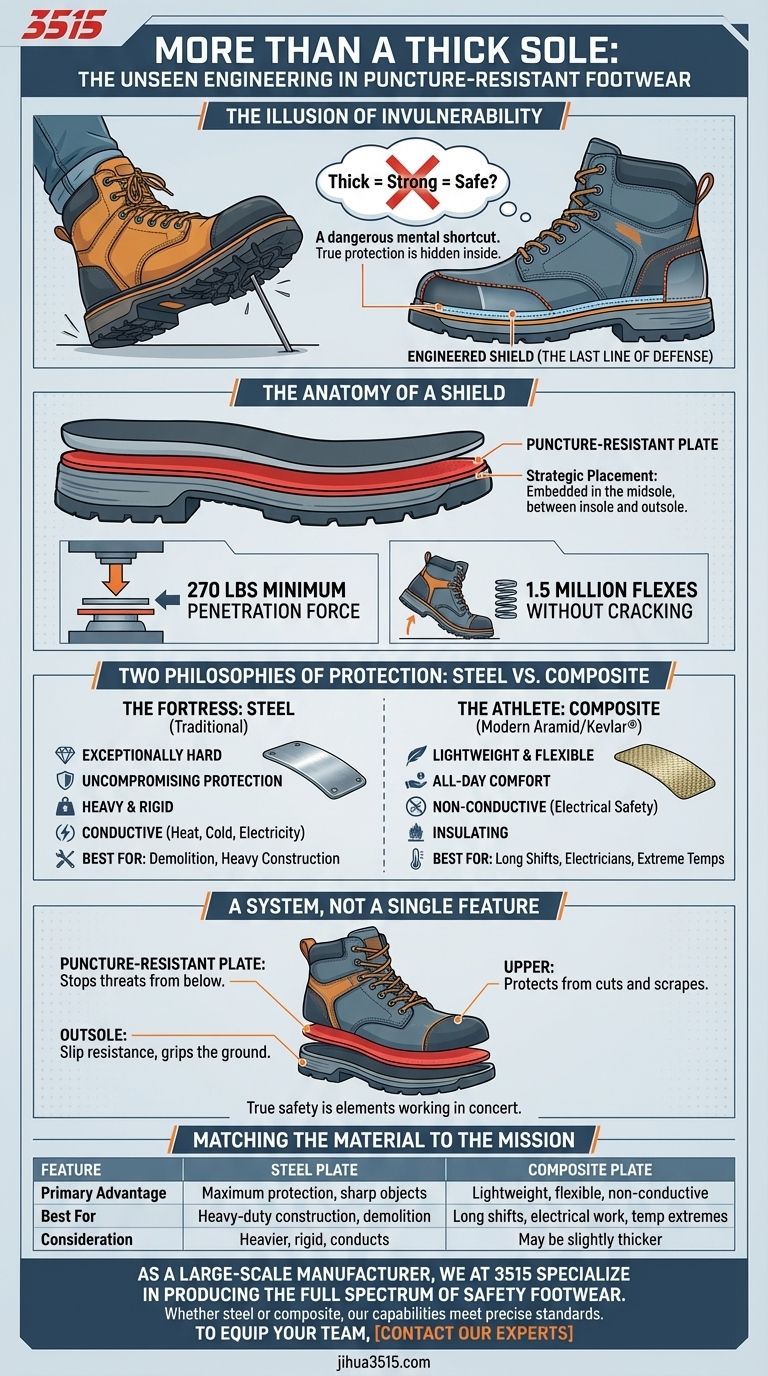
This plate is strategically embedded in the midsole, sandwiched between the insole your foot rests on and the outsole that grips the ground. This placement is a marvel of functional design. It allows the plate to intercept a sharp object that has already pierced the outer sole, stopping it before it can cause a serious injury, all without compromising the boot's traction or comfort.
Engineered to a Standard
To earn a "puncture-resistant" certification, this internal plate isn't just strong—it's tested to a rigorous scientific standard. It must withstand a minimum penetration force of 270 pounds.
More impressively, it must survive up to 1.5 million flexes without cracking. This ensures the shield doesn't fail from the cumulative stress of walking, crouching, and climbing over the lifetime of the boot.
Two Philosophies of Protection: Steel vs. Composite
The choice of material for this protective plate represents two different engineering philosophies, each with distinct advantages based on the intended environment.
The Fortress: The Case for Steel
Steel is the traditional, time-tested material for puncture resistance. It is exceptionally hard and offers uncompromising protection against penetration from sharp, ragged objects.
- Its strength is its defining feature. A relatively thin steel plate can provide an incredible level of security, making it the default choice for the most hazardous environments like demolition and heavy construction.
- But this strength comes with trade-offs. Steel is heavy, which can contribute to foot fatigue over a long shift. It's also rigid, reducing the boot's flexibility. Critically, steel is an excellent conductor of heat, cold, and electricity, making it unsuitable for certain specialized work conditions.
The Athlete: The Rise of Composite
Modern safety footwear increasingly uses composite plates made from advanced materials like Aramid fibers (the same family as Kevlar®). This represents a different approach to safety—one that balances protection with ergonomics.
- Its advantage is versatility. Composite plates are significantly lighter and more flexible than steel, dramatically improving all-day comfort.
- They are also non-conductive. This makes them the only choice for electricians or anyone working in environments with a risk of electrical shock. They don't transfer heat or cold, keeping feet more comfortable in extreme temperatures.
- The trade-off is subtle. To achieve the same puncture-resistance rating as steel, a composite plate may need to be slightly thicker.
A System, Not a Single Feature
Relying on one safety feature is like having a strong front door but leaving the windows open. A truly safe boot is an integrated system where each component has a distinct role.
- The Puncture-Resistant Plate: Protects the sole of the foot from threats coming up from the ground.
- The Outsole: Protects you from the ground itself, with tread patterns designed for slip resistance on wet or oily surfaces.
- The Upper: Protects the rest of your foot from cuts, scrapes, and abrasion.
True safety is born when these elements work in concert, a result of deliberate and thoughtful design.
Matching the Material to the Mission
Choosing the right boot isn't about finding the "best" material, but the right material for the specific hazards of your job. The decision between steel and composite is a strategic one.
| Feature | Steel Plate | Composite Plate |
|---|---|---|
| Primary Advantage | Maximum protection against large, sharp objects | Lightweight, flexible, and non-conductive |
| Best For | Heavy-duty construction, demolition, scrap yards | Long shifts, electrical work, temperature extremes |
| Consideration | Heavier, rigid, conducts heat/cold/electricity | May be slightly thicker for equivalent strength |
Ultimately, understanding the unseen technology beneath your feet is what separates a feeling of safety from the reality of it.
As a large-scale manufacturer, we at 3515 specialize in producing the full spectrum of safety footwear. Whether your clients need the uncompromising shield of steel or the advanced, lightweight comfort of composite, our production capabilities are designed to meet the precise engineering and safety standards your market demands.
To equip your team with footwear built on the right protective philosophy, Contact Our Experts.
Visual Guide
Related Products
- Wholesale Durable Safety Boots | Custom Steel Toe & Puncture-Resistant Manufacturing
- Wholesale Anti-Smash & Puncture-Proof Safety Shoes Custom Manufacturing for Brands
- Athletic Safety Shoes with Dial Closure & Steel Toe for Wholesale & Custom Manufacturing
- Wholesale Durable Breathable Safety Boots Custom OEM Manufacturer
- Premium High-Cut Waterproof Safety Boots Manufacturing & Wholesale Solutions
Related Articles
- How Industrial Professionals Can Balance Safety Boot Requirements with Professional Appearance
- How to Choose Safety Boots That Reduce Fatigue Without Sacrificing Protection
- The Lacing Paradox: Why the Safest Boots Contain Their Own Greatest Risk
- The Anatomy of Trust: A Systems Approach to Workplace Foot Protection
- How to Decode Safety Labels for Boots That Truly Protect Against Workplace Hazards