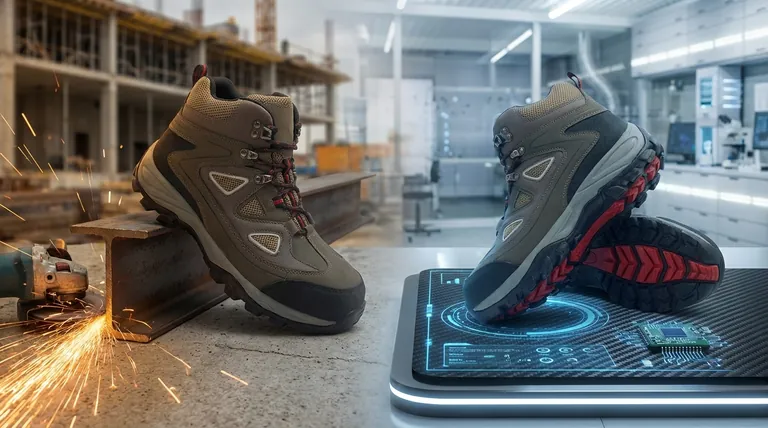
A Story Told in Kilograms
Consider the last hour of a ten-hour shift. For a construction worker, an electrician, or a factory technician, physical exhaustion is a given. But a subtle, more insidious drain on performance is the mental fatigue that comes from sheer physical drag. For decades, a significant part of that drag came from their boots.
The story of safety footwear is not just about stronger materials. It's a psychological evolution in how we define "safety." It's the journey from a simple, brute-force shield against a single catastrophic event to a sophisticated performance tool designed to protect a worker from the cumulative burden of the entire workday.
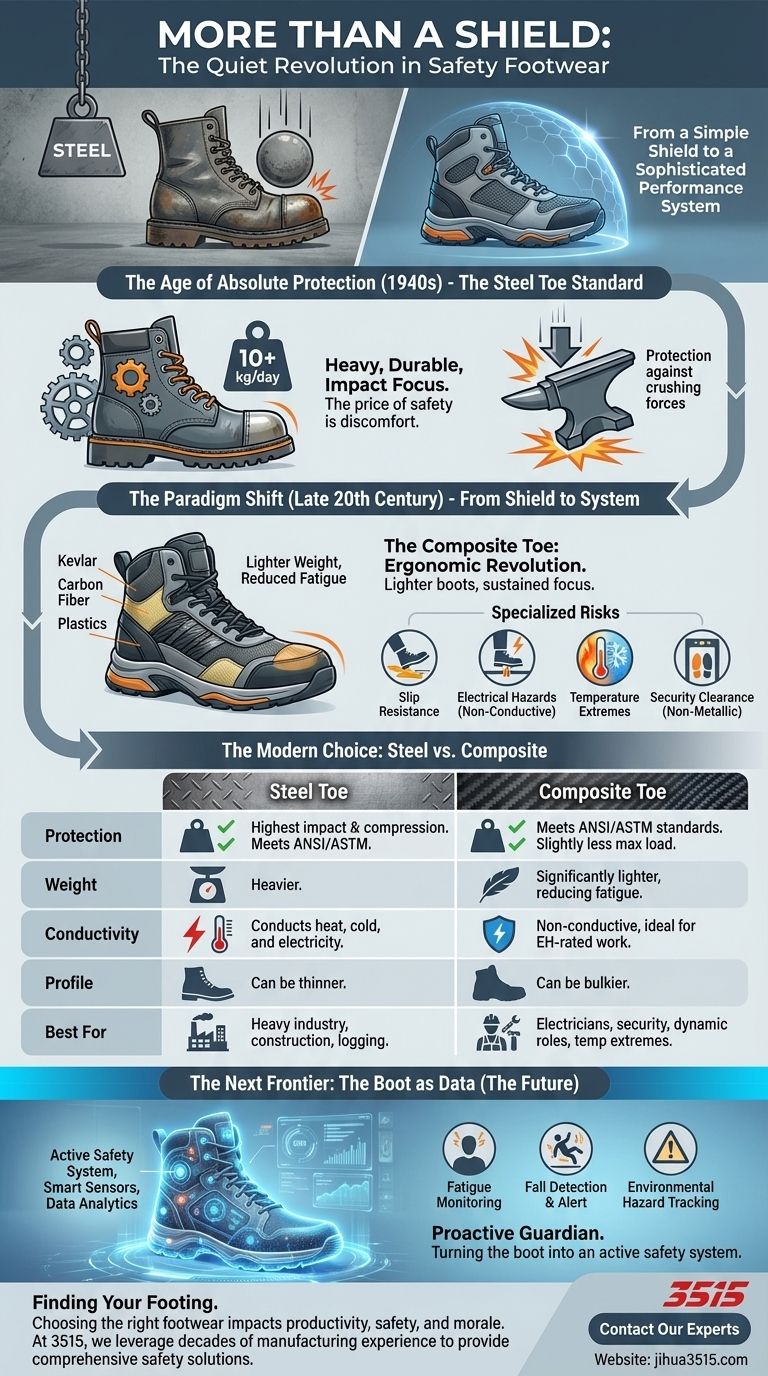
The Age of Absolute Protection
Early industrial worksites were governed by a straightforward and terrifying risk: gravity. Heavy things fell. The solution was equally straightforward.
The Steel Toe Standard
First came crude wooden sabots, but the true icon of the era was the steel toe cap, introduced in the 1940s. It was a brilliant, simple solution to a clear problem. The philosophy was singular: place an unbreakable barrier between the foot and a crushing force.
These boots were built for durability above all else. Thick leather and rugged soles were prized. Comfort was a luxury, and the weight was simply the price of safety. The psychological contract was clear: we will prevent your foot from being crushed, and in return, you will endure the discomfort.
The Paradigm Shift: From Shield to System
The late 20th century introduced a new understanding of workplace safety. The enemy was no longer just a single, high-impact event. It was also the thousand tiny stressors that accumulate over a day, a week, a career.
Defeating the Unseen Enemy: Fatigue
The single greatest innovation in this new era was the composite toe. Made from materials like Kevlar, carbon fiber, or specialized plastics, it offered comparable impact protection to steel at a fraction of the weight.
This wasn't just a material upgrade; it was an ergonomic revolution. Lighter boots mean thousands of fewer kilograms lifted by a worker's legs over a shift. The result is not just less end-of-day soreness, but sustained focus, quicker reaction times, and fewer mistakes. It was the first time footwear design actively fought fatigue, not just impact.
A World of Specialized Risks
The modern workplace presents a far more complex risk profile than the factory floors of the past. The one-size-fits-all steel toe was no longer sufficient. Footwear had to specialize.
- Slip Resistance: For mechanics on greasy floors or food service workers on wet tiles, an advanced anti-slip outsole is more critical than impact resistance.
- Electrical Hazards: For electricians and utility workers, a non-conductive composite material isn't a feature; it's a lifeline.
- Temperature Extremes: In cold storage or foundries, composite materials provide crucial insulation against heat and cold that steel, a natural conductor, cannot.
- Security Clearance: For workers in airports or secure facilities, non-metallic footwear that doesn't trigger metal detectors eliminates a daily friction point.
The Modern Choice: Steel vs. Composite
Choosing the right toe cap is now a strategic decision, not a default. The best choice depends entirely on the job's unique demands.
| Feature | Steel Toe | Composite Toe |
|---|---|---|
| Protection | Highest impact & compression resistance. | Meets ANSI/ASTM standards, slightly less max load. |
| Weight | Heavier. | Significantly lighter, reducing fatigue. |
| Conductivity | Conducts heat, cold, and electricity. | Non-conductive, ideal for EH-rated work. |
| Profile | Can be made thinner for a less bulky boot. | Can be bulkier to achieve the same strength. |
| Best For | Heavy industry, construction, logging. | Electricians, security, dynamic roles, temp extremes. |
The Next Frontier: The Boot as Data
The evolution is accelerating. The future lies in turning the boot from a passive piece of equipment into an active safety system. Advanced materials are creating soles with unprecedented traction, but the real revolution is in data.
Future footwear will likely feature integrated smart sensors. These could monitor a worker for signs of fatigue, detect a fall and automatically send an alert, or track environmental hazards. The boot will become a proactive guardian, not just a reactive shield.
Finding Your Footing in a Complex World
This journey from wooden clogs to smart systems highlights a fundamental truth: choosing the right footwear is a critical operational decision that impacts productivity, safety, and employee morale. Equipping a team requires access to the full spectrum of modern solutions.
Navigating this evolution—from time-tested steel-toe workhorses to specialized composite-toe performance boots—requires a manufacturing partner who masters the entire range. At 3515, we leverage decades of large-scale manufacturing experience to produce a comprehensive portfolio of safety footwear, ensuring our clients can find the perfect, optimized solution for any environment or role.
Let us help you build a safer, more productive foundation from the ground up. Contact Our Experts
Visual Guide
Related Products
- Safety Footwear Wholesale Manufacturer for Custom OEM/ODM Production
- Premium Suede Sport Safety Shoes for Wholesale & Bulk Orders
- Premium Safety Shoes with Rotating Buckle Safety Sneakers
- Premium Lightweight Safety Shoes for Wholesale & Bulk Orders
- Puncture-Resistant Velcro Safety Boots for Wholesale & Custom Manufacturing
Related Articles
- How Safety Footwear Materials Dictate Workplace Protection and Long-Term Value
- How to Match Safety Footwear Features to Workplace Hazards: A Risk-Based Guide
- How Safety Footwear Engineering Solves Industry-Specific Environmental Hazards
- Beyond the Logo: Decoding the Critical Shift from ANSI to ASTM in Safety Footwear
- More Than a Mandate: The Engineering and Psychology of Safety Footwear


















