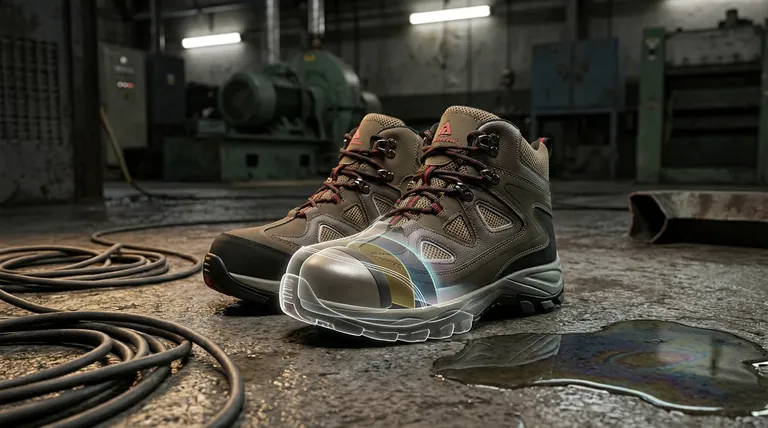
The Cognitive Shortcut of "Just a Rubber Boot"
Our brains love simplification. We see a rubber boot, and we think "waterproof." It's a useful cognitive shortcut that saves mental energy. But in an industrial environment, this shortcut is a dangerous oversimplification.
Imagine a maintenance technician on a damp concrete floor, working near a faulty power conduit. Or a HazMat specialist wading through an unidentified chemical spill. In both scenarios, the worker is wearing "rubber boots." Yet, one boot is a life-saving piece of engineered equipment, and the other is just a useless barrier against puddles.
The difference is invisible. It exists in the material compounds, the integrated components, and the certifications earned through rigorous testing. The value of modern safety footwear has evolved far beyond keeping feet dry; it’s about mitigating specific, life-threatening risks.
An Anatomy of Purpose-Built Protection
A modern safety boot is not a single object. It's a system of components, each engineered to defeat a different type of hazard. To choose the right boot, you must understand this anatomy.
H3: Impact and Compression: The Physics of a Crushing Force
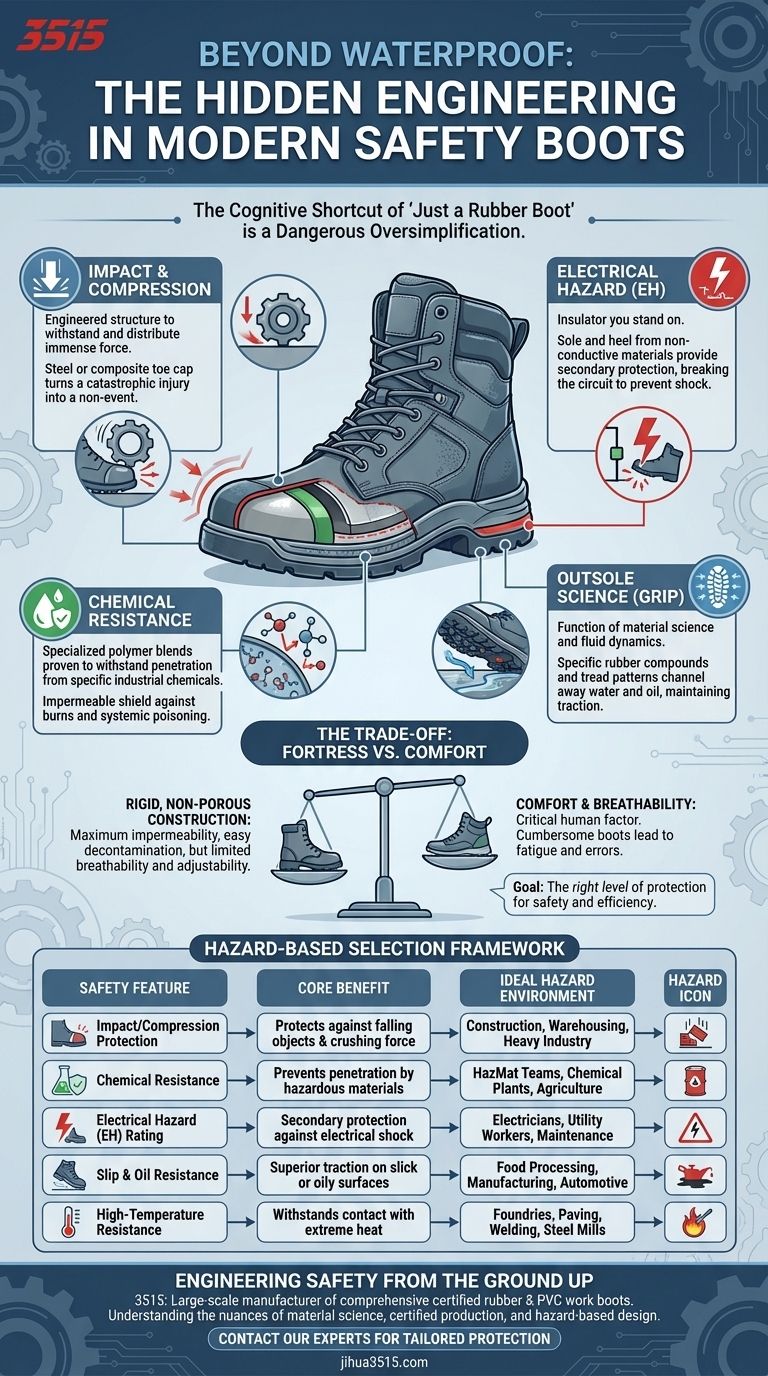
A steel or composite toe cap is the most familiar safety feature. But its function is more than just blocking an impact. It's an engineered structure designed to withstand and distribute the immense force of a falling object (impact) or a rolling piece of heavy machinery (compression). It turns a catastrophic injury into a non-event.
H3: Chemical Resistance: The Impermeable Shield
Standard rubber or PVC is water-resistant, but it can degrade, swell, or become permeable when exposed to aggressive chemicals.
Boots with a formal chemical-resistance certification use specialized polymer blends proven to withstand penetration from a specific list of industrial chemicals. For workers in chemical plants or emergency response, this invisible shield is their most critical line of defense against burns and systemic poisoning.
H3: Electrical Hazard (EH): The Insulator You Stand On
An Electrical Hazard (EH) rating signifies that the boot's sole and heel are constructed from non-conductive, shock-resistant materials.
These boots provide a secondary source of protection, insulating the wearer from the ground and breaking the circuit in case of accidental contact with a live electrical current. It’s a feature that remains unnoticed until the moment it saves a life.
H3: Outsole Science: The Engineering of Grip
"Slip-resistant" is not a marketing term; it's a function of material science and fluid dynamics.
High-performance outsoles use specific rubber compounds and carefully designed tread patterns that channel away liquids like water and oil. This engineering maximizes the surface area in contact with the ground, maintaining traction on surfaces where a standard boot would fail.
The Inevitable Trade-Off: A Fortress vs. a Running Shoe
No piece of equipment is perfect for every task. The design of a safety boot represents a series of deliberate compromises.
Its greatest strength—a rigid, non-porous, molded construction—is also the source of its primary limitations. This "fortress" design provides maximum impermeability and is easy to decontaminate, but it cannot be adjusted with laces and offers limited breathability.
This is a critical human factor. A cumbersome, uncomfortable boot leads to fatigue, and fatigue leads to errors. The goal isn't just protection; it's choosing the right level of protection that allows a worker to perform their job safely and efficiently for an entire shift.
A Framework for Hazard-Based Selection
Choosing the right boot isn't about features; it's about hazards. The process should begin not with a catalog, but with a risk assessment. Ask: "What is the most severe and probable hazard my team will face?"
This table provides a simple decision-making framework:
| Safety Feature | Core Benefit | Ideal Hazard Environment |
|---|---|---|
| Impact/Compression Protection (Safety Toes) | Protects against falling objects & crushing force | Construction, Warehousing, Heavy Industry |
| Chemical Resistance | Prevents penetration by hazardous materials | HazMat Teams, Chemical Plants, Agriculture |
| Electrical Hazard (EH) Rating | Secondary protection against electrical shock | Electricians, Utility Workers, Maintenance |
| Slip & Oil Resistance | Superior traction on slick or oily surfaces | Food Processing, Manufacturing, Automotive |
| High-Temperature Resistance | Withstands contact with extreme heat | Foundries, Paving, Welding, Steel Mills |
Engineering Safety from the Ground Up
A safety boot is a piece of specialized equipment, not a commodity. Understanding the engineering that differentiates a simple waterproof boot from a certified, hazard-specific tool is fundamental to creating a safe work environment.
This level of specificity is why one-size-fits-all procurement often fails. It requires a manufacturing partner who understands the nuances of material science, certified production, and hazard-based design. As a large-scale manufacturer, 3515 produces a comprehensive range of certified rubber and PVC work boots for distributors, brand owners, and bulk clients. Our production capabilities cover the full spectrum of safety footwear, from boots with steel toes and EH ratings to those with specialized chemical-resistant certifications.
Ensuring your team has the right protection for their specific role is a critical responsibility. If you need to source durable, reliable footwear tailored to your unique hazard profile, Contact Our Experts.
Visual Guide
Related Products
- Puncture-Resistant Velcro Safety Boots for Wholesale & Custom Manufacturing
- Wholesale Durable Safety Boots | Custom Steel Toe & Puncture-Resistant Manufacturing
- Premium Grain Leather Safety Boots for Bulk Supply
- Heavy-Duty Waterproof Nubuck Safety Boots Safety Shoes for Bulk Supply
- Premium High-Cut Waterproof Safety Boots Manufacturing & Wholesale Solutions
Related Articles
- The Unseen Engineering: Why Steel Toes Succeed or Fail in Oily Environments
- The Anatomy of Trust: A Systems Approach to Workplace Foot Protection
- The Lacing Paradox: Why the Safest Boots Contain Their Own Greatest Risk
- How Industrial Professionals Can Balance Safety Boot Requirements with Professional Appearance
- How to Choose Safety Boots That Reduce Fatigue Without Sacrificing Protection