A Dangerous Assumption
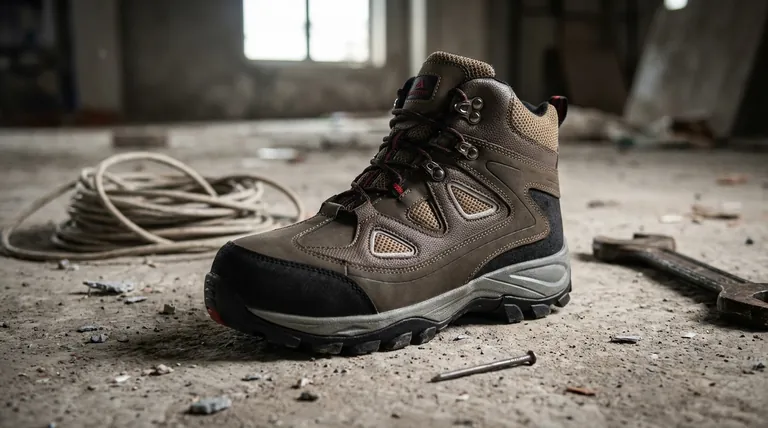
An electrician steps onto a damp concrete floor. A carpenter walks across a subfloor littered with discarded nails. A warehouse operator pivots as a forklift navigates a tight corner.
In each scenario, the worker is protected by their boots. Or so they assume.
The human mind seeks simple assurances. We see a thick sole and a reinforced toe and conclude we are "safe." But this feeling can be a dangerous cognitive shortcut. True safety isn't found in the appearance of a boot, but in a small, dense code printed on its tongue: the ASTM F2413 label. This isn't just a certification; it's a precise language describing a boot's specific capabilities and, more importantly, its limitations.
The Grammar of Protection
ASTM F2413 is the foundational standard for safety footwear in the United States. To view it as a simple pass/fail grade is to miss its elegant design. It’s a coding system, a grammar for communicating protection against specific, quantifiable workplace hazards.
Understanding this grammar transforms how you procure and deploy safety equipment. You move from guessing to knowing.
Line 1: The Standard of Trust
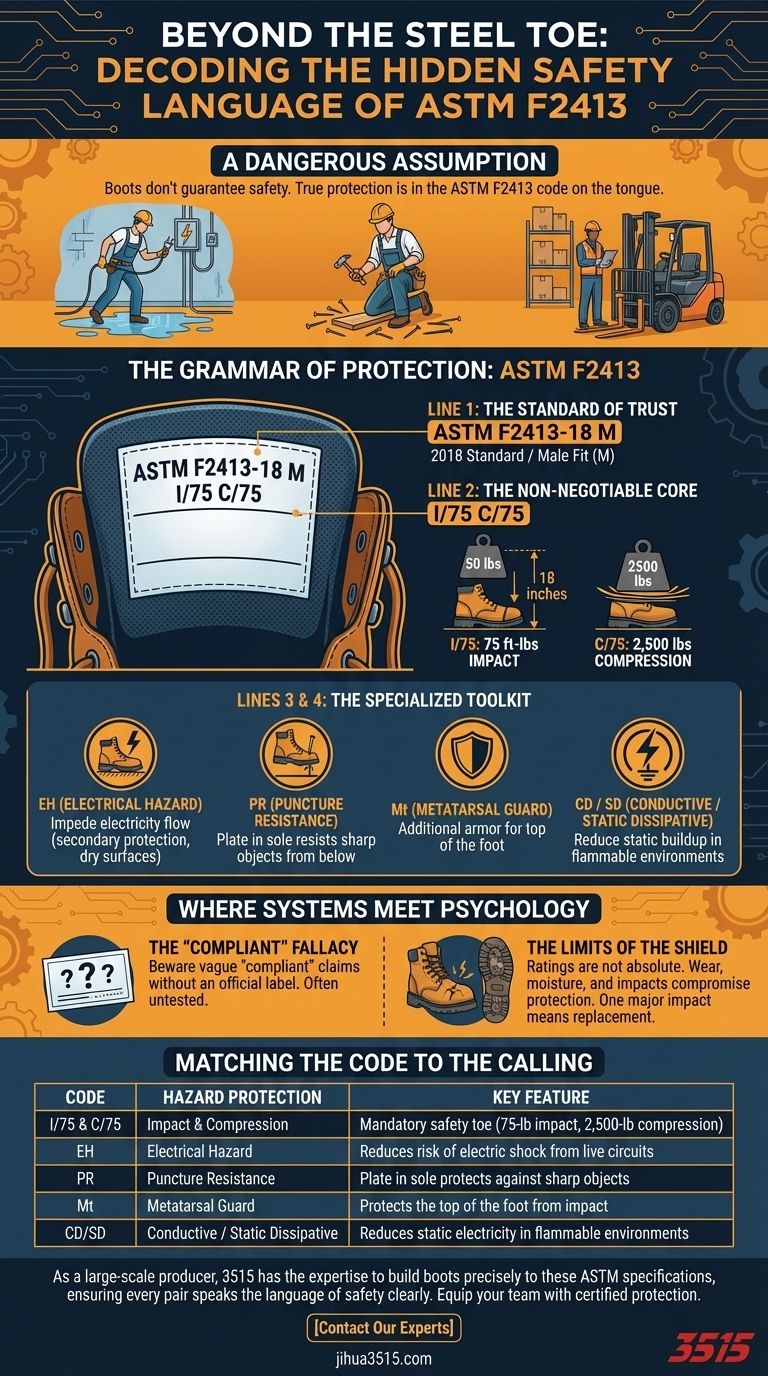
The first line is a simple declaration: ASTM F2413-18 M.
This confirms the boot was tested against the 2018 version of the standard (-18) and is designed for a male fit (M). It's the baseline of credibility, assuring the boot has been subjected to independent, third-party testing.
Line 2: The Non-Negotiable Core
The second line is the most critical: I/75 C/75.
This is the very definition of a "safety-toe" boot. It’s not a vague promise of strength; it’s a quantified guarantee.
- I/75: The toe box can withstand an impact of 75 foot-pounds (a 50-pound weight dropped from about 18 inches).
- C/75: The toe box can withstand a compressive load of 2,500 pounds.
If a boot doesn't have this line, it is not a true safety-toe boot, no matter how rugged it looks. This is the foundation upon which all other protections are built.
Lines 3 & 4: The Specialized Toolkit
Subsequent lines detail protections against specific environmental hazards. These are not universal features; they are specialized tools for specific jobs.
- EH (Electrical Hazard): The soles are designed to impede the flow of electricity, providing a secondary source of protection on dry surfaces. For an electrician, this isn't a feature; it's a vital layer of insulation against a fatal mistake.
- PR (Puncture Resistance): A plate is embedded in the sole to resist punctures from below. For a construction or demolition worker, this is the shield against the unseen nail.
- Mt (Metatarsal Guard): Additional armor protects the delicate bones on the top of the foot. It's essential in environments with a high risk of falling objects.
- CD / SD (Conductive / Static Dissipative): These boots reduce the buildup of static electricity, a critical function in flammable or explosive atmospheres.
Where Systems Meet Psychology
A certification label is a statement of a product's capability in a controlled environment. Real-world safety, however, is far messier. This is where the system's logic can be undermined by human psychology.
The "Compliant" Fallacy
Be deeply skeptical of boots marketed as "ASTM compliant" or "meets ASTM standards" without an official label sewn inside. True certification is expensive and rigorous. A vague claim of compliance without a label is often a sign that the boot has not passed third-party testing. It preys on our desire to trust the marketing over the data.
The Limits of the Shield
A rating is not absolute immunity. An EH rating is compromised by excessive wear or moisture. A PR plate can be defeated by extreme force or an object striking at a strange angle. The certification describes the boot when it's new. It's up to us to understand that daily wear and tear actively degrades these protections.
A boot that has sustained one significant impact to its safety toe is no longer certified. The composite or steel structure is now compromised. Yet, because the damage may be invisible, many workers will continue to wear it, attached to their broken-in gear. This is a failure to see a tool not as a familiar object, but as a piece of equipment with a finite service life.
Matching the Code to the Calling
The goal is not to find the boot with the most codes, but the one with the right codes for the hazards your team faces every day.
| ASTM F2413 Code | Hazard Protection | Key Feature |
|---|---|---|
| I/75 & C/75 | Impact & Compression | Mandatory safety toe (75-lb impact, 2,500-lb compression) |
| EH | Electrical Hazard | Reduces risk of electric shock from live circuits |
| PR | Puncture Resistance | Plate in sole protects against sharp objects |
| Mt | Metatarsal Guard | Protects the top of the foot from impact |
| CD/SD | Conductive / Static Dissipative | Reduces static electricity in flammable environments |
Understanding this system is the first step. The second is sourcing footwear from a manufacturer that treats these standards not as a bureaucratic hurdle, but as a core design principle. As a large-scale producer of all types of footwear, 3515 has the manufacturing expertise to build boots precisely to these ASTM specifications. We provide distributors, brands, and large-scale clients with the assurance that every pair is built not just for comfort, but to speak the language of safety clearly and reliably.
Equip your team with footwear that offers quantified, certified protection against their specific daily risks. Contact Our Experts
Visual Guide
Related Products
- Wholesale Safety Footwear Manufacturer for Bulk & Custom OEM Orders
- Premium Lightweight Safety Shoes for Wholesale & Bulk Orders
- Premium Suede Sport Safety Shoes for Wholesale & Bulk Orders
- Premium Safety Shoes with Rotating Buckle Safety Sneakers
- Premium Wholesale Tactical Style Safety Shoes Boots with Quick Lacing
Related Articles
- The Unseen Engineering: Why Steel Toes Succeed or Fail in Oily Environments
- How to Choose Steel Toe Shoes That Balance Safety and Comfort
- How Steel Toe Shoes Meet Safety Standards and Prevent Workplace Injuries
- How Steel Toe Shoes Prevent Injuries: The Science Behind Workplace Safety
- How to Choose Between Steel and Composite Toes for Optimal Safety & Comfort