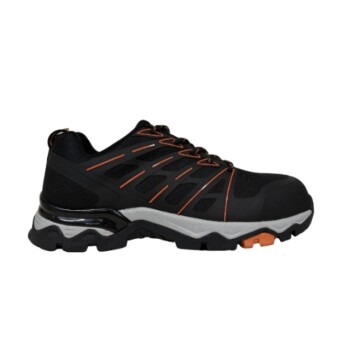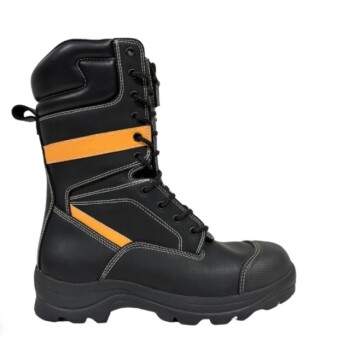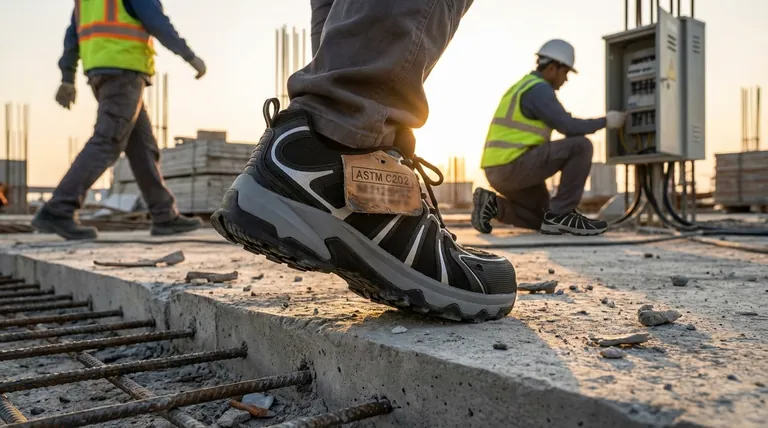
An experienced safety manager walks the floor. He sees an electrician near a high-voltage panel and a technician assembling sensitive microchips. Both are wearing new, sturdy-looking "safety boots."
On the surface, all is well. Compliance boxes are checked.
But the manager knows the real question isn't if they are wearing safety boots, but if they are wearing the right ones. This distinction is the difference between genuine protection and a dangerous illusion of safety. The answer is written in a quiet, standardized language printed on the boot's tag.
The Anatomy of a Safety Specification
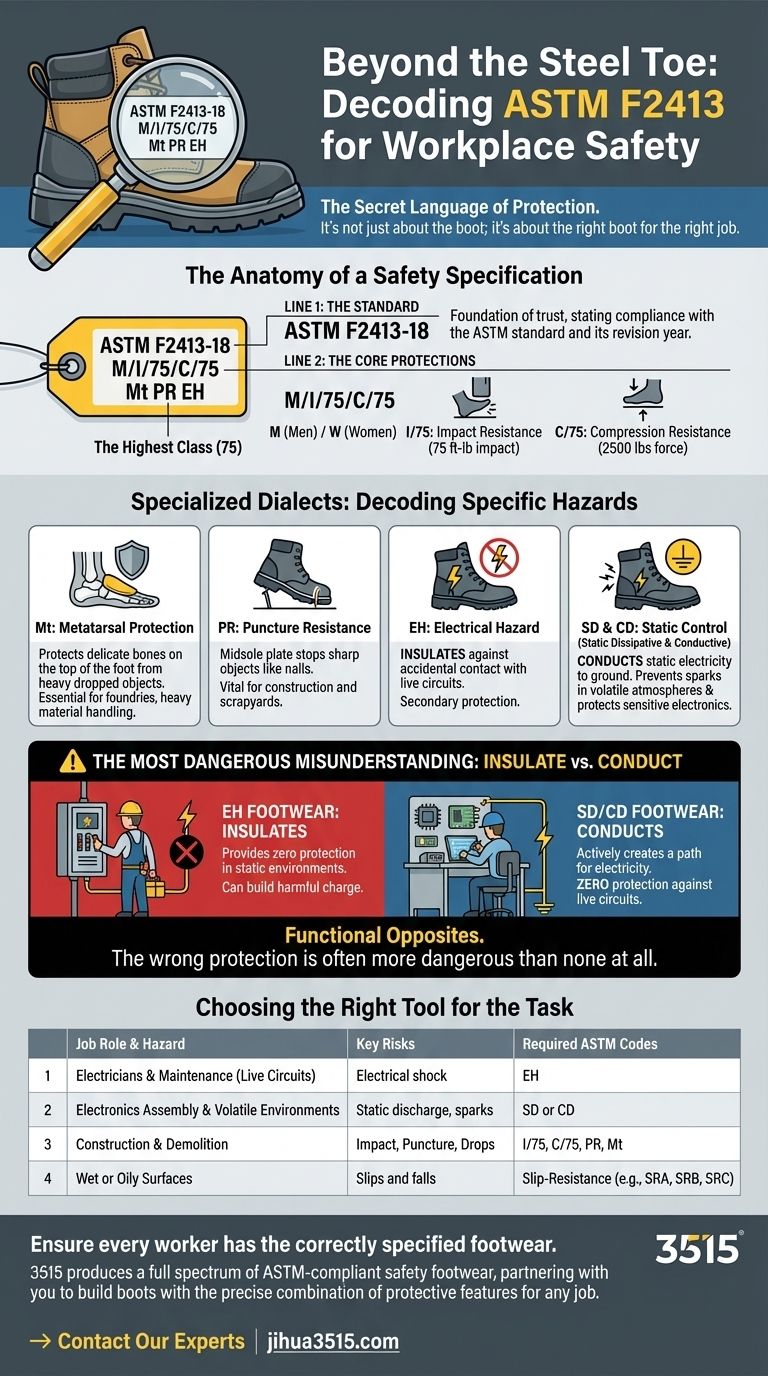
That small tag inside a work boot contains a precise code governed by the ASTM F2413 standard. It’s not a list of features; it's a performance summary. Understanding this code is like learning the grammar of workplace safety.
The code is structured in clear, sequential lines.
Line 1: The Standard
ASTM F2413-18
This line simply states the boot complies with the ASTM standard and the year of its last revision. It's the foundation of trust.
Line 2: The Core Protections
M/I/75/C/75
This is the baseline for most safety footwear. It tells you the gender it's designed for (Men/Women), its Impact resistance rating (I/75), and its Compression resistance rating (C/75). The "75" rating is the highest class, capable of withstanding a 75 foot-pound impact and 2,500 pounds of compressive force.
This is the protection everyone thinks of: the classic steel toe. But the most critical information often comes next.
The Specialized Dialects: Decoding Specific Hazards
Subsequent lines on the tag denote protection against specialized hazards. These codes transform a generic boot into a purpose-built tool for a specific environment.
Mt: Metatarsal Protection
If you work where heavy objects can be dropped—not just rolled—the Mt rating is non-negotiable. It signifies a guard that protects the delicate bones on the top of the foot. It's the language of foundries and heavy material handling.
PR: Puncture Resistance
The PR rating indicates a puncture-resistant plate in the midsole. For construction sites, scrapyards, or any environment littered with nails and sharp metal, this feature is the barrier between a normal step and a trip to the emergency room.
EH: Electrical Hazard
This is one of the most vital—and misunderstood—ratings. EH footwear is designed with non-conductive soles to provide a secondary source of protection against accidental contact with live electrical circuits. It insulates the wearer.
SD & CD: Static Control
Conversely, SD (Static Dissipative) and CD (Conductive) footwear is engineered to reduce the buildup of static electricity. These boots safely channel static from the body to the ground, protecting sensitive electronics or preventing sparks in volatile atmospheres.
The Most Dangerous Misunderstanding: Insulate vs. Conduct
The psychological trap of safety equipment is assuming "more is better." But in footwear, the wrong protection is often more dangerous than none at all.
The most critical distinction is between Electrical Hazard (EH) and Static Dissipative (SD/CD) footwear. They are functional opposites.
An electrician wearing SD boots while working on a live circuit has zero protection. His footwear is actively creating a path for electricity to travel through his body.
An electronics technician wearing EH boots in a static-sensitive environment is a walking risk to the product. Her body can build up a static charge that could destroy thousands of dollars of components with a single touch.
Wearing the wrong boot provides a false sense of security, which encourages risk-taking in people who believe they are protected.
Choosing the Right Tool for the Task
Matching the boot to the environment is not just about compliance; it's about mitigating specific, predictable risks. The ASTM code is your guide.
- For Electricians & Maintenance near live circuits: Your primary need is insulation. Look for EH.
- For Electronics Assembly & Volatile Environments: Your priority is preventing static discharge. You need SD or CD.
- For Construction & Demolition: You face impact and puncture risks. I/75, C/75, and PR are essential. Mt is often crucial.
- For Wet or Oily Surfaces: Look for slip-resistance ratings like SRA, SRB, or the combined SRC.
For large organizations, ensuring every single worker has the correctly specified footwear is a massive logistical challenge. Sourcing a boot that is, for example, Mt, PR, and EH rated requires a manufacturing partner who understands this complex language of safety.
As a large-scale manufacturer, 3515 produces the full spectrum of ASTM-compliant safety footwear. We work with distributors and large clients to build boots with the precise combination of protective features required for any job, ensuring your workforce is not just equipped, but correctly protected.
| ASTM Code | Hazard Protection | Key Feature |
|---|---|---|
| I/75 & C/75 | Impact & Compression | Resists 75 ft-lbs impact & 2,500 lbs compression |
| Mt | Metatarsal | Protects top of foot from heavy impacts |
| PR | Puncture | Midsole plate stops sharp objects |
| EH | Electrical Hazard | Insulates against live electrical circuits |
| SD/CD | Static Dissipative / Conductive | Conducts static electricity to ground |
Ensuring every worker has the correct, precisely specified footwear is a foundational pillar of a true safety culture. To equip your teams with footwear that speaks the right language of protection, Contact Our Experts.
Visual Guide
Related Products
- Wholesale Safety Footwear Manufacturer for Bulk & Custom OEM Orders
- Premium Lightweight Safety Shoes for Wholesale & Bulk Orders
- Premium Suede Sport Safety Shoes for Wholesale & Bulk Orders
- Premium Safety Shoes with Rotating Buckle Safety Sneakers
- Premium Wholesale Tactical Style Safety Shoes Boots with Quick Lacing
Related Articles
- The Unseen Engineering: Why Steel Toes Succeed or Fail in Oily Environments
- How to Choose Steel Toe Shoes That Balance Safety and Comfort
- How Steel Toe Shoes Meet Safety Standards and Prevent Workplace Injuries
- How Steel Toe Shoes Prevent Injuries: The Science Behind Workplace Safety
- How to Choose Between Steel and Composite Toes for Optimal Safety & Comfort