The Illusion of Universal Safety
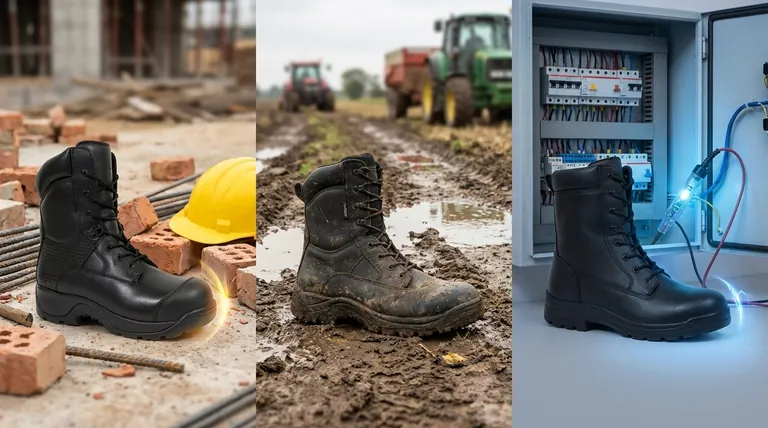
An electrician and a construction worker might both wear boots that look remarkably similar. Both are heavy, reinforced, and appear "safe."
Yet, for the electrician standing near a live panel, the steel toe that protects the construction worker from a falling brick becomes a potentially fatal conductor. His safety depends not on what the boot stops, but on what it doesn't do: conduct electricity.
This highlights a dangerous psychological bias. We see a "safety boot" and our brain files it under the general category of "protection." But in reality, there is no such thing as a universally safe boot. There are only specific tools designed for specific threats.
Choosing the wrong one isn't just ineffective; it creates a false sense of security, which is often more dangerous than no protection at all.
Matching the Engineering to the Hazard
The mandate for safety footwear isn't about bureaucratic compliance. It's a rational response to predictable, high-impact risks that are mathematically certain to occur over time in certain environments.
The core principle is simple: the features of the boot must be a direct countermeasure to the primary hazards of the job. It's a system of risk mitigation where the footwear is a critical component.
The Kinetic Threat: Impact and Puncture
This is the classic scenario: a construction site. The dangers are visceral and easy to imagine—a dropped tool, a misplaced beam, a scattered pile of nails.
The engineering solution is equally direct.
- Safety Toe Caps (Steel/Composite): A shield designed to withstand specific, tested levels of impact and compression.
- Puncture-Resistant Midsoles: A barrier woven into the sole to stop sharp objects from below.
In these environments, the boot functions as armor against the laws of gravity and simple probability.
The Environmental Threat: Fatigue and Instability
The risks in agriculture are less about a single, catastrophic event and more about a slow, grinding battle against the environment.
Workers spend all day on uneven, wet, and muddy terrain. Here, the threats are instability, water intrusion, and the sheer physical toll of standing for hours. The right boot provides:
- Durability and Water Resistance: To keep the foot dry and protected from the elements.
- Superior Traction and Ankle Support: To prevent slips and sprains on unpredictable ground.
- Cushioned Midsoles: To absorb impact and reduce the cumulative fatigue that leads to long-term injury.
Safety here is about endurance and stability, not just impact resistance.
The Invisible Threat: Electrical Current
For electricians and utility workers, the greatest danger is one they cannot see. A single accidental contact with a live circuit can be lethal.
Their footwear is a piece of insulation. An Electrical Hazard (EH) rated boot is engineered with non-conductive materials—from the sole to the laces—to interrupt the path of electricity to the ground. This feature is invisible, confirmed only by a small tag on the boot. Trusting that certification is a matter of life and death.
The Inescapable Trade-Offs
Selecting the right footwear is an exercise in managing competing priorities. Every design choice is a trade-off.
Protection vs. Mobility
The most protective boot is often the heaviest. A thick steel plate and a rugged outsole provide maximum security, but they also add weight and reduce flexibility. Over a ten-hour shift, that extra weight translates directly into fatigue.
Modern composite materials have eased this trade-off, offering comparable protection at a lower weight. But the fundamental balance remains: a fortress is harder to move around in than a running shoe.
Specialization vs. Versatility
A welder's boot, designed to resist extreme heat and sparks, is a poor choice for a linesman who needs EH protection.
While some boots offer a good mix of features, high-risk, specialized jobs demand specialized tools. Assuming one "tough boot" can do it all is a critical error in risk assessment.
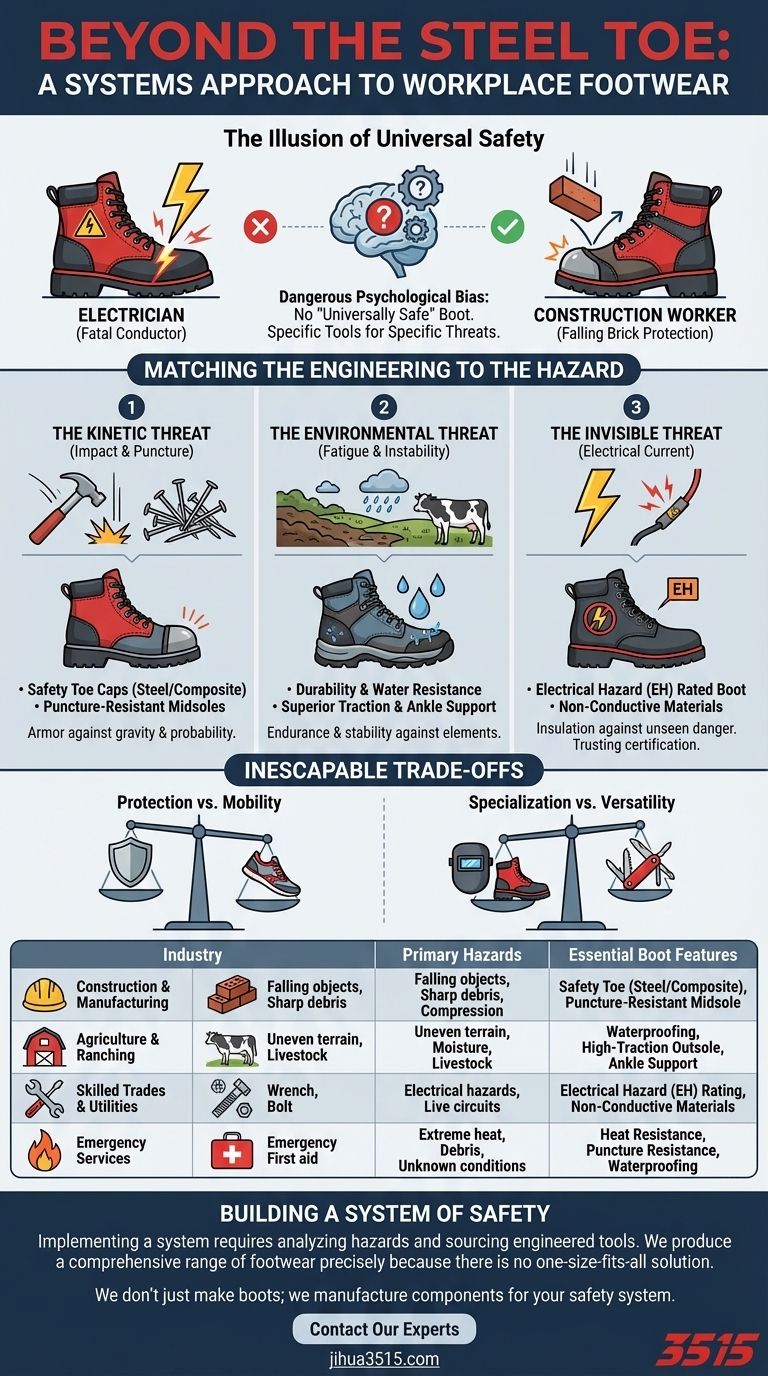
| Industry | Primary Hazards | Essential Boot Features |
|---|---|---|
| Construction & Manufacturing | Falling objects, sharp debris, compression | Safety Toe (Steel/Composite), Puncture-Resistant Midsole |
| Agriculture & Ranching | Uneven terrain, moisture, livestock | Waterproofing, High-Traction Outsole, Ankle Support |
| Skilled Trades & Utilities | Electrical hazards, live circuits | Electrical Hazard (EH) Rating, Non-Conductive Materials |
| Emergency Services | Extreme heat, debris, unknown conditions | Heat Resistance, Puncture Resistance, Waterproofing |
Building a System of Safety
Ultimately, ensuring worker safety isn't about buying a single product; it's about implementing a system. It requires analyzing the specific hazards of each role and sourcing the precisely engineered tool to counter them. For large organizations, this complexity represents a significant logistical and procurement challenge.
As a large-scale manufacturer, we at 3515 understand this complexity. We produce a comprehensive range of footwear precisely because there is no one-size-fits-all solution. Our capability extends across all types of shoes and boots, allowing us to provide distributors, brand owners, and bulk clients with the specific, certified solutions needed for every unique work environment. We don't just make boots; we manufacture components for your safety system.
To build a footwear program that truly mitigates risk and enhances performance, you need a partner who understands the deep connection between hazard and design. Contact Our Experts
Visual Guide
Related Products
- Premium Suede Sport Safety Shoes for Wholesale & Bulk Orders
- Premium Lightweight Safety Shoes for Wholesale & Bulk Orders
- Wholesale Anti-Smash & Puncture-Proof Safety Shoes Custom Manufacturing for Brands
- Premium KPU Injection Athletic Style Safety Shoes
- Premium Safety Shoes with Rotating Buckle Safety Sneakers
Related Articles
- The Ghost in the Machine: Why an Obsolete Footwear Standard Creates Modern Risk
- Beyond the Steel Toe: The Hidden Ergonomics of Workplace Safety
- Why Traditional Laces Are a Hidden Safety Risk—And What to Do About It
- The True Cost of Skipping Safety Shoes: Long-Term Risks and Smart Protection
- How Safety Shoe Engineering Prevents Workplace Injuries Across Industries