The Weight of a Long Day
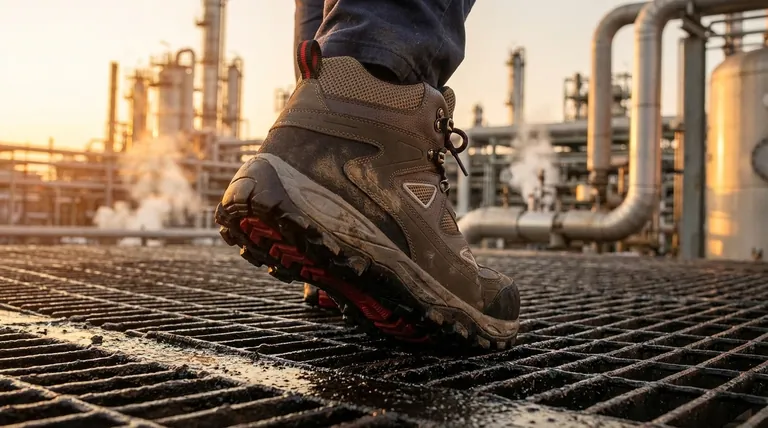
Imagine an electrician on a sprawling oil refinery, twelve hours into a shift. Every step carries the weight of the day's labor. But there's another, less obvious weight: the psychological burden of a hazardous environment. A dropped tool, a puddle of oil, an unseen electrical current—these are constant, low-level threats.
For decades, the answer to the first threat was simple: a heavy steel cap in the boot. It was a straightforward solution to a straightforward problem.
But the other risks—electrical shock, slips, extreme temperatures, and sheer fatigue—demand a more sophisticated answer. The modern safety boot isn't just a piece of armor; it's a piece of engineered equipment. And at its heart is the composite toe, a component often misunderstood.
A System, Not a Single Material
The word "composite" is misleading. It doesn't describe a single substance, but an engineering philosophy. It’s the deliberate fusion of several materials, each chosen to solve a different part of the safety puzzle.
A composite toe isn't made; it's architected.
The Key Ingredients
Each component plays a specific role, working in concert:
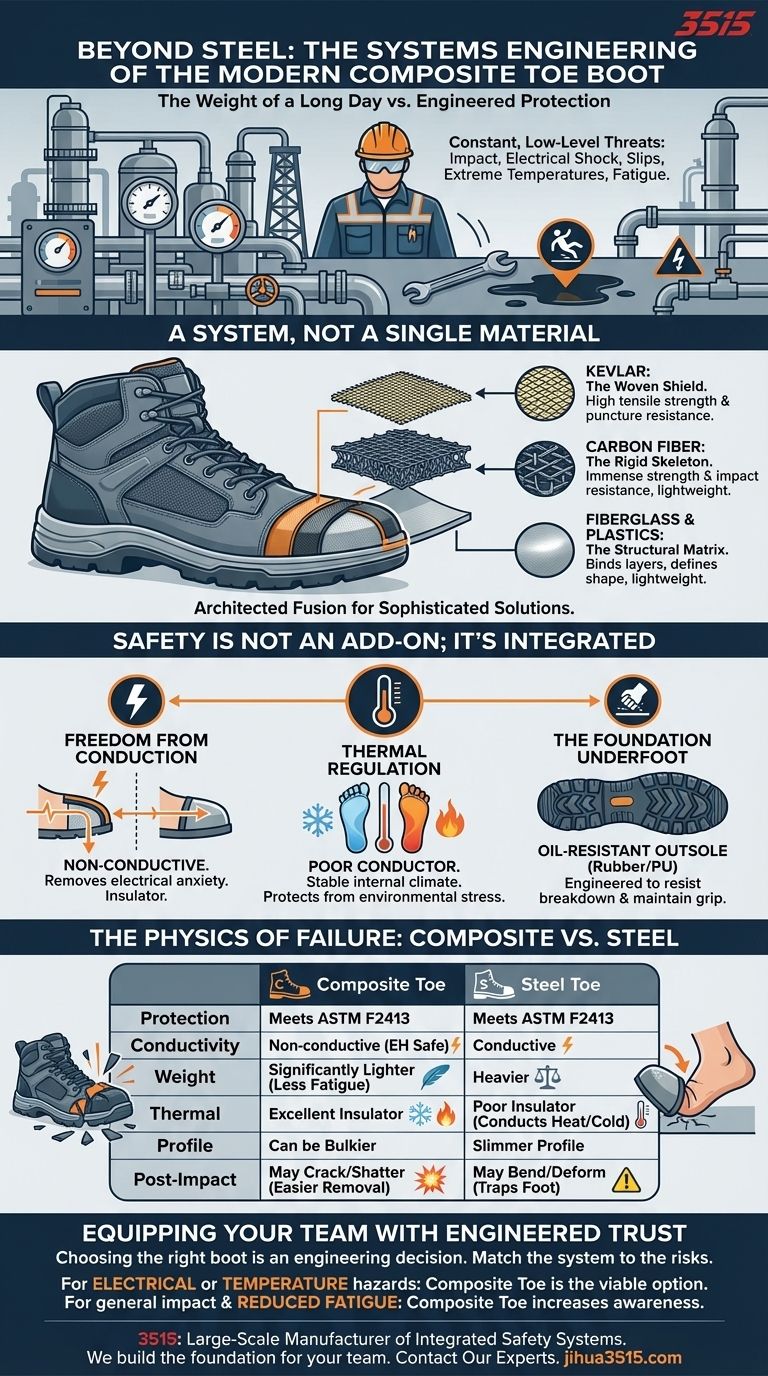
- Carbon Fiber: Provides the rigid skeleton. It delivers immense strength and impact resistance without the weight of metal.
- Kevlar: Acts as a woven shield. Known for its use in ballistic vests, it provides high tensile strength and puncture resistance.
- Fiberglass & Plastics: Form the structural matrix. They bind the layers together, giving the cap its shape while keeping it exceptionally light.
This is not a simple replacement for steel. It is a fundamental rethinking of how to achieve protection.
Safety Is Not an Add-On; It's Integrated
The true advantage of a composite toe isn't just what it's made of, but what it isn't made of: metal. This single distinction radiates benefits throughout the entire system.
Freedom from Conduction
For anyone working near live circuits, a steel toe is a liability. It conducts electricity. A composite toe is an insulator. This feature doesn't just protect against a specific type of accident; it removes a layer of constant, background anxiety, allowing a worker to focus more fully on the task at hand.
Thermal Regulation
Steel is also an excellent thermal conductor. In freezing weather, it pulls warmth from the toes. In extreme heat, it absorbs and holds it. Composite materials are poor conductors, meaning the internal climate of the boot remains stable, protecting the wearer from environmental stress and distraction.
The Foundation Underfoot
Of course, the toe cap only solves one problem. In an oil-rich environment, the "oil-resistant" quality comes from the outsole, typically made of specialized rubber or polyurethane (PU). This compound is engineered to resist chemical breakdown and maintain its grip on slick surfaces.
The composite toe and the oil-resistant outsole are two subsystems working toward a single goal: keeping the worker upright, protected, and focused.
The Physics of Failure: Composite vs. Steel
A common myth is that composite toes are weaker than steel. This is false. To be sold as safety footwear, both must pass the exact same ASTM F2413 standard for impact and compression. The difference isn't in the level of protection, but in the trade-offs and the behavior at the point of failure.
| Feature | Composite Toe | Steel Toe |
|---|---|---|
| Protection | Meets ASTM F2413 standard | Meets ASTM F2413 standard |
| Conductivity | Non-conductive (Electrical Hazard safe) | Conductive |
| Weight | Significantly lighter, reducing fatigue | Heavier |
| Thermal | Excellent insulator (comfort in heat/cold) | Poor insulator (conducts heat/cold) |
| Profile | Can be bulkier to achieve the same strength | Slimmer profile |
| Post-Impact | May crack/shatter, often allowing easier removal | May bend/deform, potentially trapping the foot |
The most crucial difference is what happens after an impact that exceeds the safety rating. A steel toe can bend and trap the foot. A composite toe is designed to fracture under such extreme force, which can make removing the boot—and providing medical aid—far easier. It's a calculated choice in failure mechanics.
Equipping Your Team with Engineered Trust
Choosing the right boot is an engineering decision, not just a procurement one. It requires matching the material system to the specific system of risks your team faces every day.
- For electrical hazards or extreme temperatures, the choice is clear: a composite toe is the only viable option.
- For general impact protection where weight is a primary concern, a composite toe reduces fatigue, which itself is a safety benefit. Less fatigue means greater awareness over a long shift.
Ultimately, the goal is to provide footwear that feels less like a burden and more like a trusted tool. It’s about building a foundation of safety so effective it becomes invisible to the person wearing it. As a large-scale manufacturer, we at 3515 specialize in producing this kind of integrated safety system, creating comprehensive footwear solutions—including oil-resistant, composite-toe boots—for distributors, brand owners, and bulk clients.
We understand the complex interplay of materials, compliance, and human factors. Let us help you build the right foundation for your team. Contact Our Experts
Visual Guide
Related Products
- Wholesale Durable Safety Boots Manufacturer Customizable Steel Toe Work Boots
- Durable Leather Moc Toe Work Boots for Wholesale & Custom Manufacturing
- Wholesale Mesh Steel Toe Safety Shoes with Dial Closure Factory Production
- Wholesale Durable Breathable Safety Boots Custom OEM Manufacturer
- Wholesale Customizable Safety Boots Durable & Protective Footwear Manufacturing
Related Articles
- Steel Toe Work Boots: Balancing Safety and Comfort for Demanding Jobs
- The Unseen Engineering: Why Steel Toes Succeed or Fail in Oily Environments
- How to Choose Steel Toe Boots: Safety, Comfort, and Job-Specific Features
- How Modern Steel Toe Boots Achieve Safety Without Sacrificing Comfort
- How to Choose Between Steel and Composite Toe Boots for Workplace Safety