At its core, motorcycle boots must cover the ankles to provide structural protection against the four primary injury mechanisms in a crash: impact, abrasion, crushing, and torsion. Your ankle is a complex and fragile joint, and this coverage shields its bones and ligaments from direct contact with the pavement, the immense weight of the motorcycle, and the severe twisting forces that can cause permanent damage.
While casual footwear might offer minimal defense against scrapes, it provides virtually no protection against the crushing weight or torsional forces unique to a motorcycle accident. A proper over-the-ankle motorcycle boot is an engineered piece of safety equipment designed specifically to prevent these complex, life-altering injuries.
The Anatomy of an Ankle Injury in a Crash
To understand why ankle coverage is non-negotiable, you must first understand the specific forces your feet and ankles are subjected to during an accident. They are fundamentally different from what you would experience in almost any other activity.
Impact and Abrasion
This is the most straightforward threat. When you fall, your body will slide across the asphalt, which is an extremely abrasive surface.
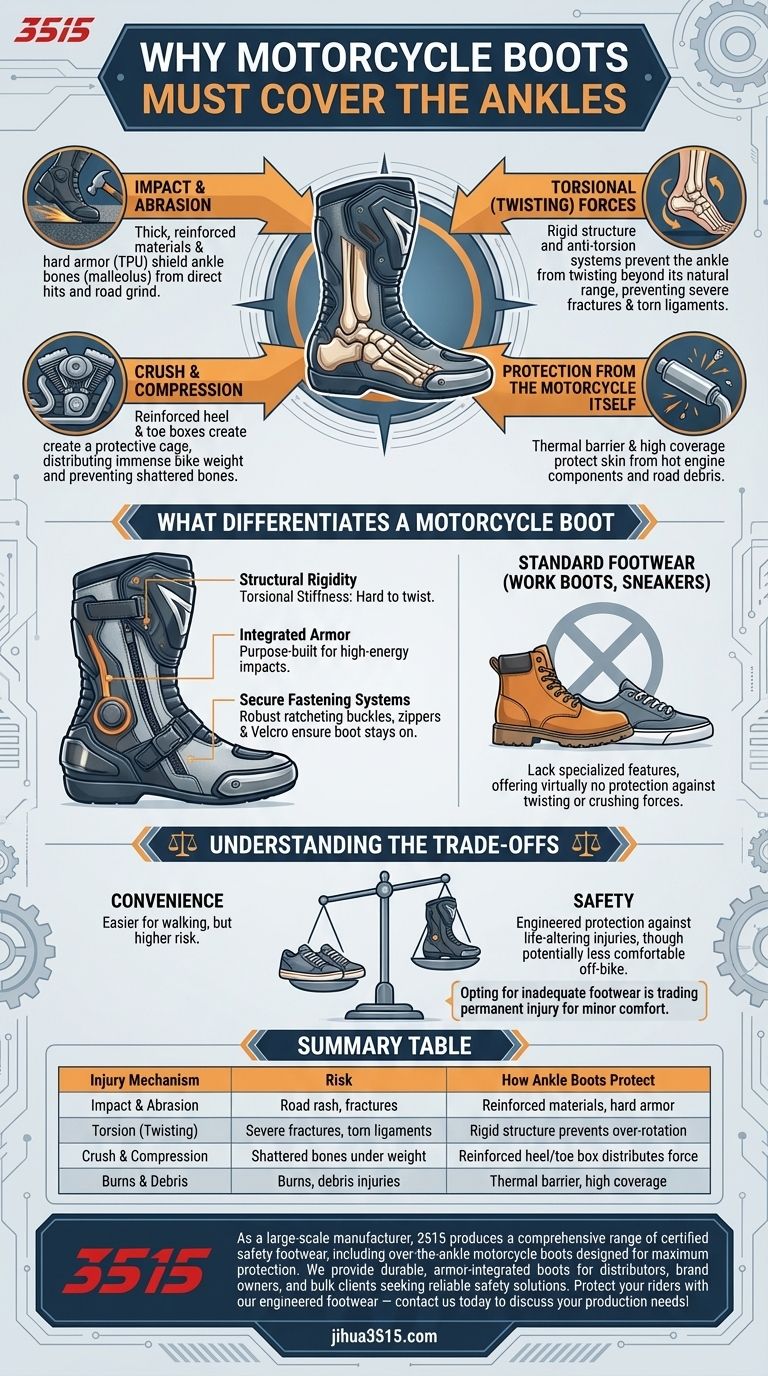
Proper motorcycle boots use thick, reinforced leather or advanced abrasion-resistant textiles to act as a second skin, preventing the road from grinding away your own. They also incorporate hard armor, often made of TPU (thermoplastic polyurethane), directly over the ankle bones (the malleolus) to absorb and distribute the force of a direct impact.
Torsional (Twisting) Forces
This is one of the most dangerous and commonly misunderstood risks. In a fall, your foot can easily get caught under the bike or on the pavement while the rest of your body continues to move.
This creates an extreme twisting force—or torsion—on your ankle joint. A normal shoe or sneaker offers zero resistance to this, allowing your ankle to be twisted far beyond its natural range of motion, resulting in severe fractures and torn ligaments. A rigid, over-the-ankle boot acts as an external skeleton, preventing this catastrophic rotation.
Crush and Compression
A motorcycle can weigh anywhere from 400 to over 900 pounds. During even a simple low-speed tip-over, it's common for the bike to fall onto the rider's leg and foot.
The reinforced structure of a motorcycle boot, particularly in the heel and toe box, is designed to withstand this immense crushing force. It creates a protective cage around your foot, distributing the weight and preventing bones from being shattered under the direct pressure of the engine case or frame.
Protection from the Motorcycle Itself
Even without a crash, the motorcycle presents hazards. The engine and exhaust pipes reach temperatures high enough to cause third-degree burns in seconds.
A boot that covers the ankle provides a critical thermal barrier between your skin and these hot components. This height also helps protect you from road debris kicked up by the front tire and from moving parts like the drive chain.
What Differentiates a Motorcycle Boot from Other Footwear
Many people believe a sturdy pair of work boots offers similar protection. While better than a sneaker, they lack the specific safety features engineered for the physics of a motorcycle crash.
Structural Rigidity
The most important feature is torsional stiffness. You should be able to hold a motorcycle boot by the heel and toe and find it very difficult to twist. This rigidity is what protects you from rotational injuries.
Integrated Armor
Motorcycle boots have purpose-built armor. Hard pucks are placed over the delicate ankle bones, and reinforcement is built into the heel, toe, and often up the shin. This is designed to manage high-energy impacts, a feature absent in all other types of footwear.
Secure Fastening Systems
Laces on regular boots can loosen, get caught on bike parts, or simply allow the boot to be pulled off your foot in a violent tumble. Motorcycle boots use robust systems of zippers, large Velcro panels, and ratcheting buckles designed to ensure the boot stays firmly in place when it matters most.
Understanding the Trade-offs
It's important to acknowledge the reality: dedicated motorcycle boots are often stiffer and less comfortable for walking around than a pair of sneakers or hiking boots.
The Allure of "Easier" Footwear
The convenience of wearing a single pair of shoes for riding and for your destination is tempting. This convenience, however, comes at a direct cost to your safety.
The Hidden Cost of Convenience
Opting for inadequate footwear is a gamble. You are trading engineered protection against severe, permanent injury for a minor increase in off-the-bike comfort. Ankle injuries can require multiple surgeries and months or years of rehabilitation, potentially affecting your mobility for the rest of your life.
Making the Right Choice for Your Ride
Your choice of boot should match your type of riding, but the principle of over-the-ankle protection remains constant.
- If your primary focus is maximum track or aggressive street protection: Full-height race boots with extensive external armor and anti-torsion systems are the only acceptable choice.
- If your primary focus is daily commuting or touring: Look for over-the-ankle boots that are often waterproof and balance certified protection with features for all-day comfort.
- If your primary focus is short, casual urban rides: Consider reinforced riding shoes that look like high-top sneakers but include crucial features like a stiffened sole and integrated, hardened ankle cups.
Choosing footwear that covers and supports your ankles is not about following a rule; it is a conscious decision to protect yourself from the predictable physics of a potential crash.
Summary Table:
| Injury Mechanism | Risk | How Ankle Boots Protect |
|---|---|---|
| Impact & Abrasion | Road rash, bone fractures | Reinforced materials, hard armor over ankle bones |
| Torsion (Twisting) | Severe fractures, torn ligaments | Rigid structure prevents joint over-rotation |
| Crush & Compression | Shattered bones under bike weight | Reinforced heel/toe box distributes crushing force |
| Burns & Debris | Burns from hot parts, debris injuries | Thermal barrier, high coverage protects from hazards |
As a large-scale manufacturer, 3515 produces a comprehensive range of certified safety footwear, including over-the-ankle motorcycle boots designed for maximum protection. We provide durable, armor-integrated boots for distributors, brand owners, and bulk clients seeking reliable safety solutions. Protect your riders with our engineered footwear — contact us today to discuss your production needs!
Visual Guide
Related Products
- Durable High-Ankle Tactical Boots Wholesale Manufacturer for Custom & Bulk Orders
- Durable High-Ankle Tactical Boots for Wholesale & Custom Manufacturing
- Durable Leather High-Ankle Tactical Boots for Wholesale & Custom Manufacturing
- Wholesale High-Traction Camo Boots - Custom Manufacturer for Brands
- Wholesale Classic Leather Lace-Up Ankle Boots for Brand Manufacturing
People Also Ask
- What specialized protections do tactical boots offer? Maximize Endurance with High-Performance Footwear
- How do tactical boots protect against injuries? Discover the Integrated Safety System
- What are the ideal use cases for tactical boots? Empower Your Performance in Demanding Scenarios
- Can tactical boots be stylish for everyday wear? Yes, with the right styling and features.
- What are the primary benefits of wearing tactical boots for everyday use? Get All-Day Comfort & Durability