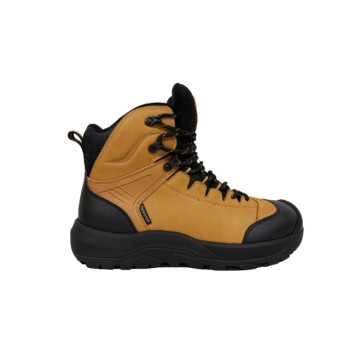
The stability of the insulation layer is critical because strong winds exert physical pressure that can compress soft materials, destroying their ability to trap heat. When insulation is compressed by dynamic wind loads, its thermal resistance drops immediately, leaving extremities like fingers and feet vulnerable to rapid cooling. Research shows that in winds of 7 m/s, finger temperatures can plunge to an average of 12.7°C even inside protective gear if the material lacks structural integrity.
Under strong wind conditions, standard insulation often fails not because it isn't thick enough, but because it collapses under pressure. Effective protection requires rigid or compression-resistant materials that maintain their volume—and therefore their warmth—when subjected to the direct force of the wind.
The Physics of Heat Loss in High Winds
The Vulnerability of Extremities
Fingers and feet are biologically predisposed to lose heat. They possess large surface areas relative to their volume, acting as efficient radiators for heat dissipation.
Because of this anatomical reality, peripheral body parts are significantly more affected by direct wind exposure than the core. Standard insulation levels are often insufficient if the material cannot withstand external forces.
The Problem of Dynamic Wind Loads
Wind does not just strip away the warm layer of air outside your clothing; it applies physical force. At speeds such as 7 m/s, the wind creates a dynamic load against the surface of boots and gloves.
If the gear is soft or purely loft-based, this pressure squeezes the material. This compression reduces the space available to trap warm air, effectively thinning the barrier between your skin and the freezing environment.
Maintaining Thermal Resistance
The primary metric for warmth is thermal resistance. To function correctly, insulation must resist compression to maintain this resistance.
If the insulation layer is unstable, the wind effectively pushes the cold through the material. Specialized gear combats this by using higher-density materials that hold their shape against the wind's push, ensuring the "dead air" space remains intact.
Critical Design Elements
The Necessity of Windproof Layers
Stability starts with the outer shell. Superior windproof layers are essential to deflect the initial force of the wind.
By blocking the airflow, the outer layer prevents the cold air from penetrating the insulation matrix. This allows the inner layers to focus on heat retention rather than blocking air movement.
Multilayered Defense
For harsh environments, a single layer of insulation is rarely enough. Multilayered insulation systems provide a failsafe against thermal bridging.
By using materials of different densities, manufacturers can create a structure where the outer layers resist wind compression while the inner layers maximize soft heat trapping.
Understanding the Trade-offs
Dexterity vs. Warmth
There is an inherent conflict between insulation stability and mobility. Insulation that resists compression is often denser, stiffer, and bulkier.
In gloves, this can significantly reduce fine motor skills and tactile feedback. In boots, it may lead to a stiffer stride, which can be fatiguing over long distances.
Moisture Management
Highly wind-resistant and dense insulation systems can inadvertently trap moisture. If sweat cannot escape, it accumulates within the insulation.
This creates a dangerous cycle: wet insulation conducts heat away from the body 25 times faster than dry insulation. Therefore, stability must be balanced with adequate breathability to prevent internal cooling.
Making the Right Choice for Your Goal
Selecting the right gear requires balancing the wind conditions with your activity level.
- If your primary focus is stationary activity in high winds: Prioritize boots and gloves with high-density, compression-resistant insulation, even if it sacrifices some flexibility.
- If your primary focus is active movement in moderate winds: Look for gear with a dedicated windproof membrane but lighter, loftier insulation to balance warmth with sweat management.
True thermal protection relies on structural integrity; your gear must be strong enough to hold the warm air around you, no matter how hard the wind blows.
Summary Table:
| Feature | Impact of Strong Winds | Solution for Stability |
|---|---|---|
| Insulation Loft | Compresses under dynamic pressure, reducing thermal resistance. | Use high-density, compression-resistant materials. |
| Extremity Temp | Can plunge to 12.7°C in 7 m/s winds without structural integrity. | Multi-layered systems to maintain dead air space. |
| Outer Shell | Wind penetrates soft fabrics, stripping away warm air. | Integrate windproof membranes to deflect air pressure. |
| Moisture Control | Trapped sweat conducts heat 25x faster than dry air. | Balanced breathability to manage internal condensation. |
As a large-scale manufacturer serving distributors and brand owners, 3515 offers comprehensive production capabilities for all footwear types, anchored by our flagship Safety Shoes series. Our extensive portfolio covers work and tactical boots, outdoor shoes, training shoes, and sneakers, as well as Dress & Formal shoes to meet diverse bulk requirements. Ensure your customers stay protected in the harshest conditions with our structurally stable insulation designs—Contact us today to explore our bulk manufacturing solutions!
References
- Do‐Hee Kim, Joo‐Young Lee. Thermoregulatory Responses to Air Temperature of −5 o C at Different Wind Speeds: Significance of Strong Wind in a Mild Cold Environment. DOI: 10.21203/rs.3.rs-7284826/v1
This article is also based on technical information from 3515 Knowledge Base .
Related Products
- Premium Insulated Safety Boots and Shoes for Wholesale & Bulk Orders
- Durable Waterproof Rain Boots | Custom Manufacturer for Wholesale & Brands
- Factory Direct Wholesale Rain Boots Durable Waterproof & Fully Customizable
- Wholesale Waterproof Tactical Boots Custom Suede & High-Traction Soles
- Wholesale Lightweight Tactical Boots Custom Manufacturer for Desert & Combat Use
People Also Ask
- What are the recommended insulation ratings for mild winter conditions? A Guide for Active & Stationary Workers
- How does insulation thickness correlate with temperature ranges? A Guide to Choosing the Right Warmth
- What insulation level is needed for severe cold and stationary work? 1200g or Higher is Essential
- What safety advantages do insulated boots offer beyond warmth? Dielectric Protection & Superior Grip
- How does fleece lining contribute to the warmth of insulated boots? Trapping Air for Superior Cold Protection