At its core, using the right leather conditioner is the difference between preserving a valuable item for a lifetime and watching it degrade prematurely. A proper conditioner works with the leather's natural structure, replenishing essential oils lost to time and exposure, which keeps the material flexible, strong, and resistant to cracking.
The central goal of a leather conditioner is not merely to clean the surface, but to replenish the internal lubrication between the leather's microscopic protein fibers. Using the wrong product can do more harm than good, either by failing to penetrate or by sealing the leather, preventing it from breathing.
What Leather Is and Why It Degrades
The Microscopic Fiber Structure
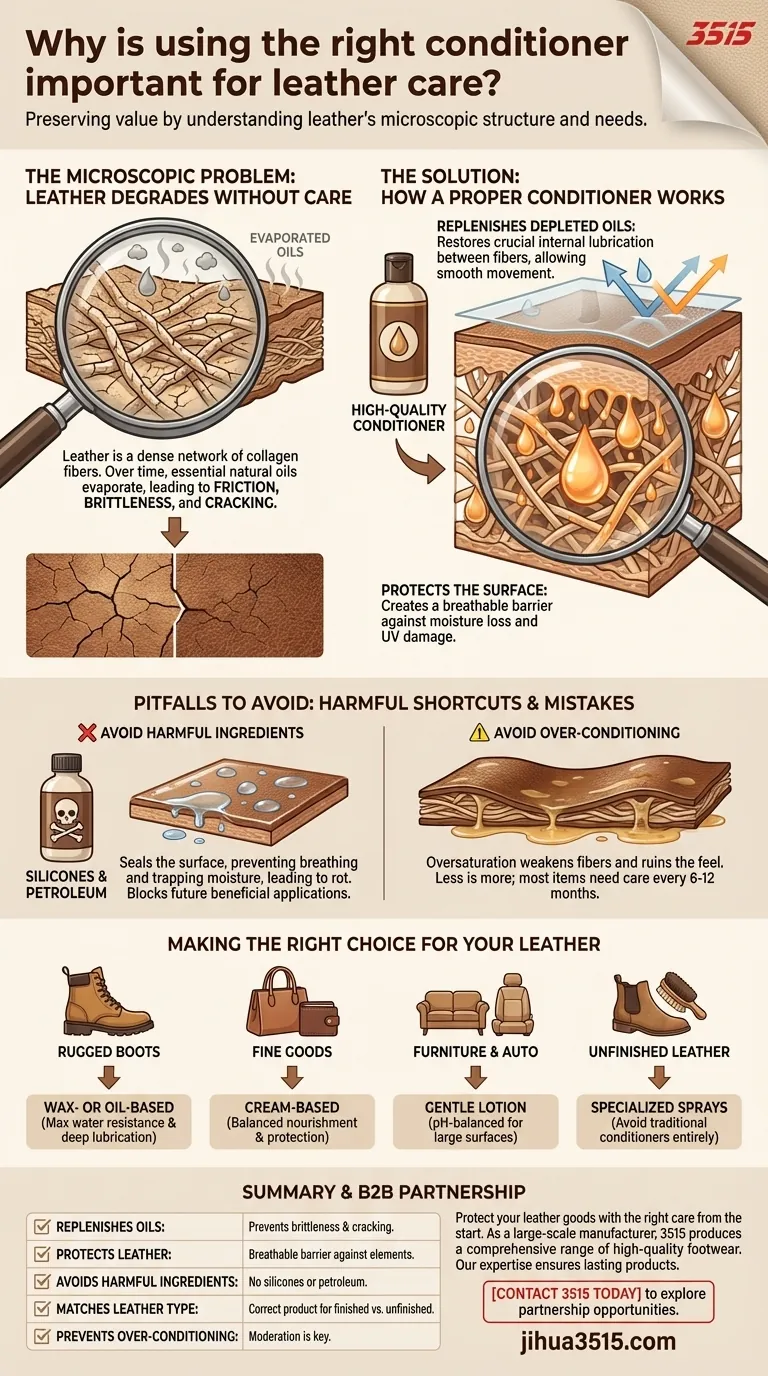
Leather is not a uniform material; it's a complex, three-dimensional weave of millions of tiny protein fibers, primarily collagen. Think of it like a dense, fibrous sponge.
When leather is tanned, the natural oils and fats within this fiber network are preserved, giving the material its initial strength and flexibility.
How Leather Loses Its Vital Oils
Over time, these essential oils are lost. Flexing and use cause friction between the fibers, while heat and dry air cause the oils to simply evaporate out of the material.
As the oils deplete, the fibers begin to rub directly against each other. This friction causes them to become brittle, stiff, and eventually break, leading to visible cracks and weakness in the leather.
The Role of a Proper Conditioner
Replenishing Essential Lubrication
A high-quality conditioner is formulated to penetrate deep into leather's fibrous structure. Its purpose is to replenish the depleted oils, restoring the crucial lubrication between the collagen fibers.
This restored lubrication allows the fibers to slide past one another smoothly without abrasion. The result is a return to the leather's supple, flexible, and strong state.
Protecting from Environmental Damage
Beyond internal lubrication, the right conditioner provides a breathable barrier on the surface. This helps to slow down moisture evaporation and offers a degree of protection against minor spills and UV damage, which can fade and dry out the leather.
Understanding the Trade-offs and Pitfalls
The Dangers of Low-Quality Ingredients
Many mass-market "conditioners" use harmful shortcuts. Products containing silicones or petroleum distillates create a superficially shiny seal on the surface.
This seal prevents the leather from breathing and can trap moisture, leading to rot. Worse, it blocks future applications of beneficial conditioners from ever penetrating the material.
Matching the Conditioner to the Leather Type
Different types of leather require different care. A heavy, oil-based conditioner that works wonders on a rugged boot could permanently darken and stain a delicate calfskin handbag.
Finished leather (the most common type, with a pigmented surface coating) is less porous and requires a cream-based conditioner that can be worked into the surface. Unfinished leather (like aniline or nubuck) is highly absorbent and needs specialized products to avoid discoloration.
The Risk of Over-Conditioning
More is not always better. Applying conditioner too heavily or too frequently can oversaturate the fibers, making the leather feel greasy or overly soft and compromising its structural integrity. Most items only need conditioning once every 6-12 months.
Making the Right Choice for Your Leather
To select the correct product, you must first identify your leather type and your primary goal for its care.
- If your primary focus is rugged boots or outdoor gear: A wax- or oil-based conditioner provides maximum water resistance and deep lubrication for thick, hardworking leather.
- If your primary focus is fine leather goods (bags, wallets, shoes): A high-quality cream-based conditioner offers a balanced blend of nourishment and protection without oversaturating or excessively darkening the leather.
- If your primary focus is furniture or car upholstery: Use a gentle, pH-balanced cream or lotion specifically designed for large surfaces of finished leather to avoid greasy residue.
- If your primary focus is unfinished leather (suede, nubuck, aniline): Avoid traditional conditioners entirely and use specialized sprays and brushes designed for these highly absorbent and delicate materials.
Ultimately, choosing the right conditioner is an act of understanding the material you are caring for.
Summary Table:
| Key Consideration | Why It Matters |
|---|---|
| Replenishes Oils | Restores lubrication between leather fibers, preventing brittleness and cracking. |
| Protects Leather | Creates a breathable barrier against moisture loss, UV damage, and minor spills. |
| Avoids Harmful Ingredients | Prevents damage from silicones or petroleum distillates that seal and rot leather. |
| Matches Leather Type | Using the wrong product for finished vs. unfinished leather can cause staining or damage. |
| Prevents Over-Conditioning | Oversaturation can weaken leather; most items only need care every 6-12 months. |
Protect your leather goods with the right care from the start. As a large-scale manufacturer, 3515 produces a comprehensive range of footwear for distributors, brand owners, and bulk clients. Our expertise in leather and production ensures your products are built to last. Let's discuss how we can support your business with high-quality leather footwear.
Contact 3515 today to explore partnership opportunities.
Visual Guide
Related Products
- Dial Closure Leather Business Casual Shoes for Wholesale & Private Label
- Wholesale Comfort Leather Business Shoes with Dial Lacing System
- Wholesale Leather Apron Toe Derby Shoes Custom Factory Production
- Wholesale Classic Leather Lace-Up Ankle Boots for Brand Manufacturing
- Factory Direct Wholesale Leather Comfort Shoes with Dial Closure
People Also Ask
- What are the top three recommended business casual shoes? Build a Polished, Versatile Wardrobe
- Why is choosing the right shoes important for a business casual look? Elevate Your Professional Image
- What materials are commonly used in business casual shoes? A Guide to Leather, Suede & More
- What factors should be considered when choosing business casual shoes? Find the Perfect Balance of Style & Comfort
- Are black or brown shoes better for business casual? Master the Versatile Choice for Your Wardrobe