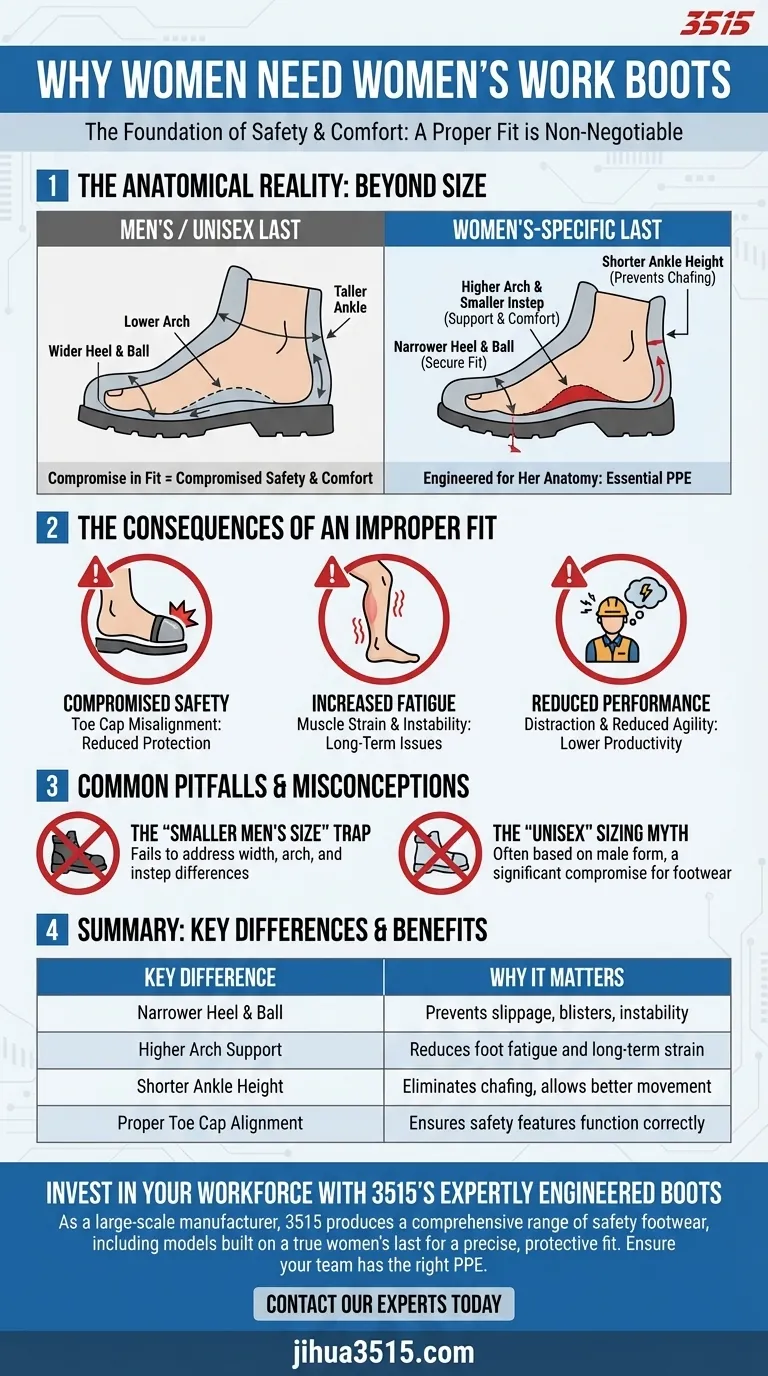
The single most important reason for women to wear work boots designed for them is that a proper fit is the foundation of both safety and comfort. Women's feet are not just smaller versions of men's feet; they have distinct anatomical differences in shape, proportion, and biomechanics. A boot that fails to account for this is a compromise in every critical category.
A work boot designed for a woman is not a matter of aesthetics or marketing; it is a fundamental piece of personal protective equipment engineered for a different anatomy. Choosing a "unisex" or a smaller men's boot inevitably compromises the fit, which in turn compromises safety, comfort, and performance.
Beyond Size: The Anatomical Reality
The assumption that a smaller men's boot will suffice for a woman ignores key structural differences. True women's-specific footwear is built on a different last—the three-dimensional model of a foot that a boot is constructed around.
A Narrower Foot Shape
Women's feet are typically narrower than men's, particularly in the heel and across the ball of the foot. A boot built on a male last will be too wide, allowing the foot to slide internally.
This movement causes heel slippage, which leads to painful blisters and instability, increasing the risk of slips, trips, and falls.
A Higher Arch and Smaller Instep
Women generally have higher, more flexible arches and a smaller instep (the bony structure at the top of the foot) than men.
A men's boot often provides inadequate arch support, leading to foot fatigue and long-term strain. The excessive volume around the instep also contributes to a sloppy, unsecure fit.
A Shorter Ankle Length
The anatomical design of women's-specific boots often includes a shorter ankle height and a more contoured opening.
This small adjustment is critical for preventing the boot collar from chafing against the calf muscle, which can cause significant discomfort and restrict movement throughout a workday.
The Consequences of an Improper Fit
Wearing improperly fitted boots is not a minor inconvenience; it has direct and serious consequences for a worker's well-being and effectiveness on the job.
Compromised Safety Features
Safety elements like steel or composite toe caps are designed to sit in a precise location over the toes. In a boot that is too large or ill-fitting, the foot can slide forward, misaligning the protective cap and rendering it less effective during an impact.
Increased Fatigue and Discomfort
When a boot doesn't fit securely, the muscles in the feet and lower legs must constantly work overtime to stabilize the body. This leads to premature fatigue, soreness, and an increased risk of musculoskeletal issues.
Reduced Performance
A worker who is distracted by pain from blisters, arch strain, or an unstable footing cannot be fully focused on their task. Proper-fitting footwear is a direct contributor to agility, confidence, and overall productivity.
Common Pitfalls to Avoid
Navigating the market for work boots can be confusing, but understanding these common misconceptions is crucial for making the right choice.
The "Smaller Men's Size" Trap
Simply sizing down a men's boot is the most common mistake. This approach completely fails to address the proportional differences in width, arch support, and instep volume, guaranteeing a poor fit.
The "Unisex" Sizing Myth
In the world of personal protective equipment, "unisex" sizing is almost always based on a male form factor. While functional for some gear, it is a significant compromise for footwear, where a precise fit is paramount for safety.
Making the Right Choice for Your Goal
Your choice should be guided by the specific demands of your job and the primary function the boot must serve.
- If your primary focus is hazard protection: Ensure the boot has a certified safety toe and that it fits snugly, so your toes are always in the correct position behind the protective cap.
- If your primary focus is all-day comfort: Prioritize a boot built on a true women's last to get the specific arch support and heel lockdown needed to fight fatigue over long hours.
- If your primary focus is agility and movement: Select a boot that offers a secure fit around the ankle and instep to prevent internal foot slippage and ensure stability.
Ultimately, investing in work boots designed for your anatomy is a direct investment in your personal safety and daily well-being.
Summary Table:
| Key Difference | Why It Matters |
|---|---|
| Narrower Heel & Ball | Prevents foot slippage, blisters, and instability. |
| Higher Arch Support | Reduces foot fatigue and long-term strain. |
| Shorter Ankle Height | Eliminates chafing and allows for better movement. |
| Proper Toe Cap Alignment | Ensures safety features function correctly during impact. |
Invest in the safety and productivity of your workforce with 3515's expertly engineered women's work boots.
As a large-scale manufacturer, 3515 produces a comprehensive range of footwear for distributors, brand owners, and bulk clients. Our production capabilities encompass all types of safety shoes and boots, including models built on a true women's last for a precise, protective, and comfortable fit.
Ensure your team has the right PPE for the job. Contact our experts today to discuss your specific needs and discover our full catalog.
Visual Guide
Related Products
- Wholesale Leather Work Boots with Customizable Wedge Sole for Brands
- Durable Leather Moc Toe Work Boots for Wholesale & Custom Manufacturing
- Durable Leather Work Boots for Wholesale & Custom Manufacturing
- Durable Leather Work Boots for Wholesale & Custom OEM Manufacturing
- Durable Moc Toe Wedge Sole Work Boots for Wholesale and Private Label
People Also Ask
- What is the difference between full-grain and top-grain leather? Premium Material Guide for Boot Manufacturers
- What are the advantages of leather as an upper material for work boots? Unmatched Durability & Custom Comfort
- How can leather work boots be protected from environmental elements? A 3-Step Guide to Lasting Durability
- What is the complete process for deep cleaning leather work boots? A Step-by-Step Guide to Preserve Your Investment
- What are the key qualities of leather for work boots? Superior Durability, Breathability & Custom Fit