
In the world of competitive riding, boot durability is a critical factor that directly translates to rider safety, performance consistency, and long-term value. Competition boots are engineered to endure hours of use in demanding outdoor environments—from wet mud to dry heat—while protecting the rider from accidental knocks and providing the structural integrity needed for precise control.
Durability is not simply about how long a boot lasts. It is about the boot's ability to consistently perform its essential safety and performance functions under the intense, unpredictable conditions of competition.

The Core Functions Durability Protects
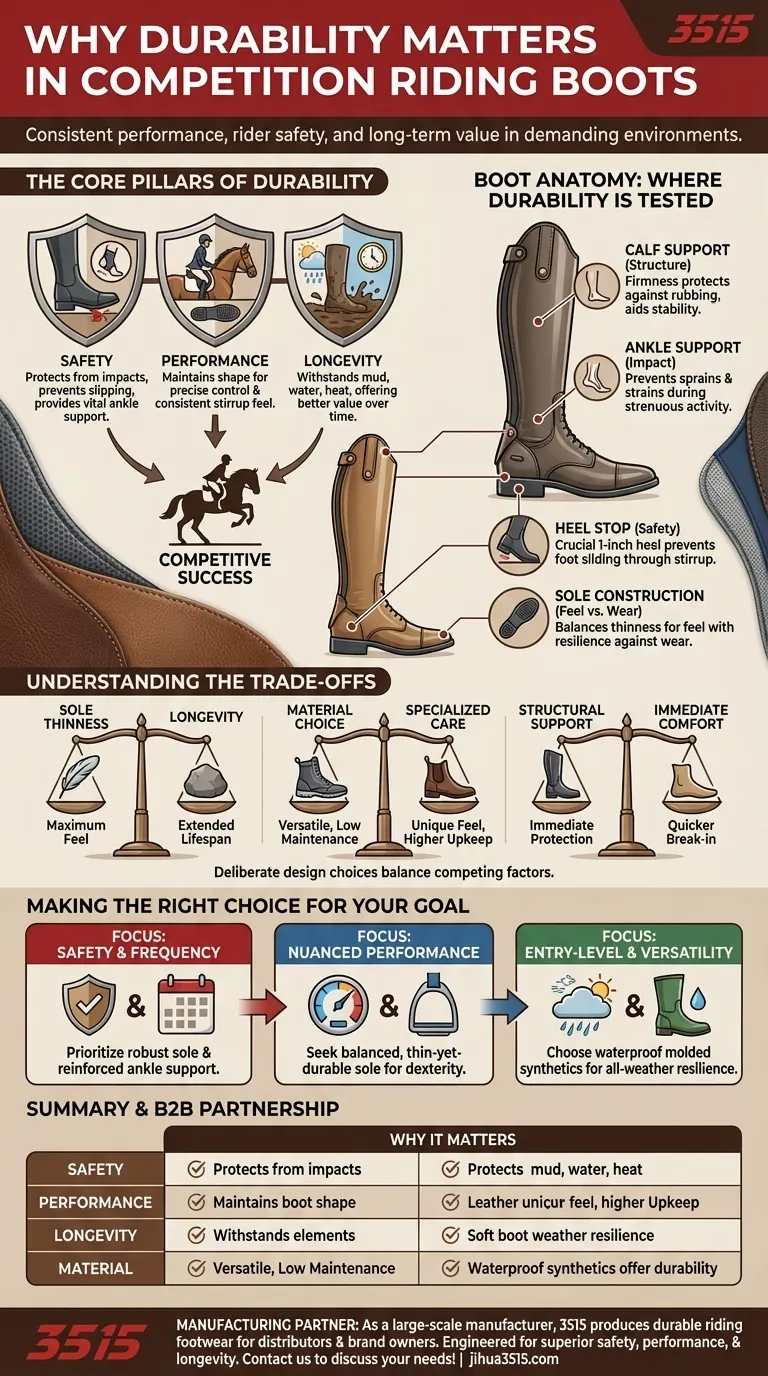
A boot's construction is tested from the moment you put it on. Durability ensures that every component continues to function as intended, from the sole underfoot to the calf support along your leg.
Ensuring Rider Safety
A primary role of any riding boot is protection. Durable materials and construction are essential to shield the rider from the inherent risks of the sport.
Boots must be tough enough to withstand accidental impacts, such as being knocked against an obstacle or stepped on by a misplaced hoof.
Furthermore, the sole's heel—typically about one inch high—is a crucial safety feature that prevents the foot from sliding through the stirrup. Durability ensures this heel does not wear down, maintaining its protective function over time.
Durable construction also provides firm ankle and lower leg support, which is vital for preventing sprains and strains during strenuous activity.
Maintaining Peak Performance
Beyond safety, durability is integral to a rider's performance. A boot that loses its shape or integrity can compromise the subtle communication between rider and horse.
The boot's structure, particularly the inside of the calf, must remain firm to protect against rubbing and aid in stability and control.
The sole presents a unique challenge: it must be thin enough for the rider to feel the stirrup and maintain dexterity, yet durable enough to last. A non-durable sole can wear out quickly, diminishing grip and feel.
Features like waterproofing and breathable linings also rely on durable materials to keep the rider comfortable and focused throughout a long competition day.
Withstanding the Competitive Environment
Equestrian events almost always take place outdoors, exposing gear to a wide range of challenging conditions.
Boots must be able to perform reliably in hot, dry, wet, and muddy environments without degrading.
For many riders, this makes boots made from waterproof molded synthetic materials an excellent choice, as they are built to resist the elements while remaining easy to maintain.
Understanding the Trade-offs
Choosing the right boot involves balancing competing factors. "Durability" is not a single feature but the result of deliberate design choices, each with its own trade-offs.
Sole Thinness vs. Longevity
The sole is where performance and durability intersect most critically. A thick, heavy-duty sole might last forever but would sacrifice the rider's feel and connection through the stirrup.
Conversely, an ultra-thin sole offers maximum feel but may wear out quickly, compromising both safety and the boot's lifespan. The best competition boots find the optimal balance.
Material Choice vs. Versatility
Entry-level competition boots are often made of waterproof molded synthetics with a rubber sole. These materials offer fantastic durability against weather and require minimal upkeep.
This makes them highly versatile for riders participating in lessons and lower-level competitions, where practicality and resilience are key priorities. Higher-end materials may offer a different feel but often require more specialized care.
Structural Support vs. Immediate Comfort
A boot must provide firm support to protect the rider's leg and ankle. This requires a certain level of stiffness and structural integrity that is core to its durability.
However, this necessary firmness can sometimes mean a longer break-in period compared to a softer, less supportive boot. The goal is a boot that becomes comfortable with wear without losing its essential supportive structure.
Making the Right Choice for Your Goal
When selecting your boots, consider how durability aligns with your specific competitive needs.
- If your primary focus is safety and frequent competition: Prioritize boots with a robust sole construction and reinforced ankle support that can withstand constant use across various conditions.
- If your primary focus is nuanced performance and feel: Seek a boot that balances a durable, well-gripped sole with a design that is thin enough to not interfere with foot dexterity.
- If you are an entry-level competitor or need all-weather versatility: A boot made of waterproof molded synthetic material offers excellent durability against the elements and is suitable for a wide range of riding activities.
Ultimately, a durable boot is a reliable partner, giving you the confidence to focus completely on your performance.
Summary Table:
| Aspect | Why Durability Matters |
|---|---|
| Safety | Protects from impacts, prevents foot slipping through stirrups, and provides ankle support. |
| Performance | Maintains boot shape for precise control and ensures a consistent feel for the stirrup. |
| Longevity | Withstands mud, water, and heat, offering better value and reliability over time. |
| Material Choice | Waterproof synthetics offer great durability with low maintenance for versatile use. |
Ready for boots built to compete? As a large-scale manufacturer, 3515 produces a comprehensive range of durable riding footwear for distributors, brand owners, and bulk clients. Our production capabilities ensure your boots are engineered for superior safety, performance, and longevity in any condition. Contact us today to discuss your competitive riding boot needs!
Visual Guide
Related Products
- Durable Leather Tactical Boots Wholesale & Custom Manufacturing for Brands
- Wholesale Tactical Boots High-Traction & Reflective for Bulk & Brand Orders
- High-Traction Suede Tactical Boots Wholesale & Custom Manufacturing
- Durable High-Ankle Tactical Boots Wholesale Manufacturer for Custom & Bulk Orders
- Durable Leather High-Ankle Tactical Boots for Wholesale & Custom Manufacturing
People Also Ask
- What specialized protections do tactical boots offer? Maximize Endurance with High-Performance Footwear
- What features should law enforcement officers look for in tactical boots? Essential Guide for Safety & Performance
- Importance of Professional Tactical Boots in Loess Gully Regions: Ensure Safety and Precision for Field Monitoring
- What is rucking, and why are tactical boots suitable for it? Discover the Ultimate Footwear for Heavy Loads
- What makes the traction of tactical boots superior? Unlock the Science of Unbeatable Grip



















