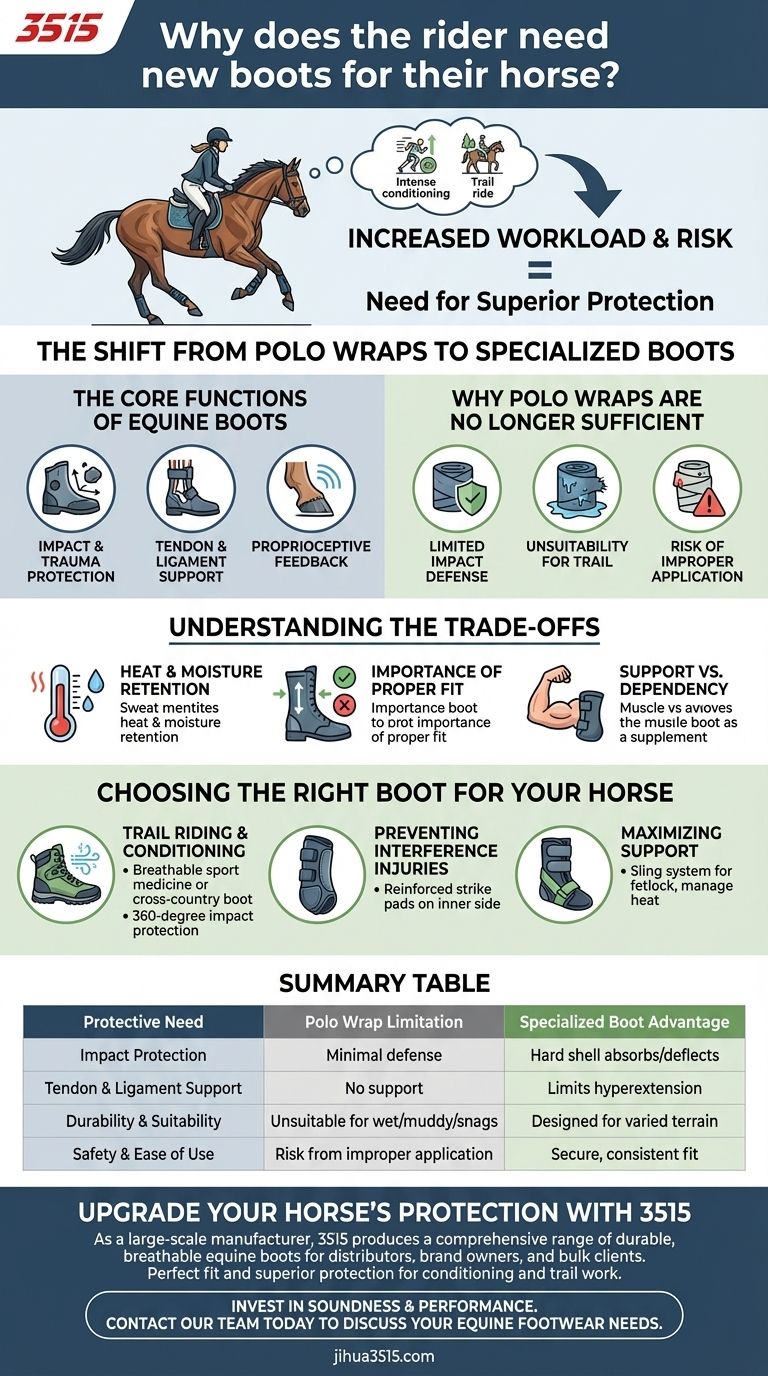
Ultimately, the rider needs new boots because their horse's workload and risk profile have outgrown the minimal protection offered by their current polo wraps. As they begin more intensive conditioning and trail work, the horse requires gear specifically engineered for superior impact absorption and support to prevent injury.
The decision to switch from polo wraps to boots represents a critical shift in risk management. It’s an acknowledgment that as a horse's training intensity increases, its protective equipment must evolve from providing basic shielding to offering specialized defense against the higher-impact forces and environmental hazards of more demanding work.
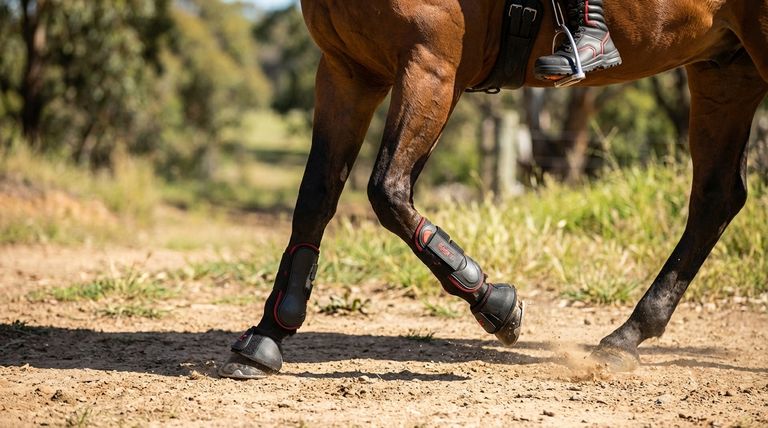
The Core Functions of Equine Boots
To understand the need for an upgrade, we first must clarify what a well-designed horse boot actually does. It's not just a covering; it's a piece of technical equipment that serves distinct protective purposes.
Impact and Trauma Protection
A horse's lower legs are a vulnerable combination of bone, tendon, and ligament with very little muscle or tissue for padding.
Boots with a hard or reinforced outer shell are designed to absorb and deflect energy from direct impacts. This is critical for a horse that "bangs itself up" by interfering (striking one leg with another) or for protecting against rocks, roots, and branches encountered on trails.
Tendon and Ligament Support
While no boot can completely prevent a severe injury, many are designed to limit the range of motion, particularly fetlock hyperextension.
This "support" function helps stabilize the leg during high-exertion movements like sharp turns or navigating uneven terrain, reducing the strain on soft tissues. This is a key consideration when increasing a horse's conditioning workload.
Proprioceptive Feedback
Some boots provide a subtle, consistent pressure on the leg, which can enhance the horse's awareness of its limb placement. This is known as proprioception.
Improved proprioception can lead to better coordination and a more confident stride, reducing the likelihood of a trip or misstep, especially during trot work on varied trail surfaces.
Why Polo Wraps Are No Longer Sufficient
Polo wraps have their place, but they fall short when the demands for protection and durability increase. The rider’s plan to condition and trail ride exposes the inherent limitations of wraps.
Limited Impact Defense
Polos are fabric wraps that offer minimal protection against a hard, direct strike from a hoof or an external object like a rock. Their primary function is to guard against minor scrapes and scuffs in a controlled environment.
Unsuitability for Trail Conditions
Polo wraps are fundamentally incompatible with the challenges of trail work. They can easily absorb water, becoming heavy and sagging. They also readily snag on branches and can collect burrs and other debris, creating irritation or even coming completely undone.
Risk of Improper Application
The safety of a polo wrap is entirely dependent on a perfect application. A wrap that is too tight can damage tendons ("bandage bow"), while one that is too loose can slip down the leg, posing a tripping hazard. This risk is magnified during strenuous, long-duration work.
Understanding the Trade-offs
Moving to a more protective boot is a clear step up, but it is not without its own set of considerations. Being aware of the trade-offs is essential for making an informed choice.
Heat and Moisture Retention
The most significant downside to many protective boots is their tendency to trap heat and moisture. Tendons are sensitive to overheating, which can lead to cellular damage over time.
Prioritizing boots made from modern, breathable materials is crucial, especially for longer conditioning sessions. Boots should always be removed promptly after work.
The Importance of Proper Fit
An ill-fitting boot is worse than no boot at all. A boot that is too large can shift, slide, or fill with debris, while one that is too small can create dangerous pressure points and rubbing.
A correct fit means the boot is snug enough to stay in place without restricting circulation or movement.
Support vs. Dependency
The term "support" can be misleading. Boots do not carry the horse's weight. They work by limiting unsafe ranges of motion.
It's vital to remember that boots are a supplement to, not a replacement for, a proper conditioning program that strengthens the horse's own anatomical structures.
Choosing the Right Boot for Your Horse
Your decision should be guided by the specific demands of your horse's job. There is no single "best" boot, only the best boot for a particular application.
- If your primary focus is trail riding and all-around conditioning: Prioritize a breathable sport medicine boot or a lightweight cross-country boot that offers 360-degree protection from impact.
- If your primary focus is preventing interference injuries: Look for splint boots or brushing boots with reinforced strike pads on the inner side of the cannon bone.
- If your primary focus is maximizing support during high-impact work: Consider boots specifically designed with a sling system for the fetlock, but remain hyper-vigilant about heat management.
Selecting the right boot is a critical investment in your horse's long-term soundness and performance.
Summary Table:
| Protective Need | Polo Wrap Limitation | Specialized Boot Advantage |
|---|---|---|
| Impact Protection | Minimal defense against hard strikes | Hard shell absorbs and deflects energy |
| Tendon & Ligament Support | No support function | Limits hyperextension, stabilizes the leg |
| Durability & Suitability | Unsuitable for wet/muddy trails; snags easily | Designed for varied terrain and conditions |
| Safety & Ease of Use | Risk of injury from improper application | Secure, consistent fit with less risk |
Upgrade Your Horse's Protection with 3515
As your horse's training intensifies, their gear must evolve. As a large-scale manufacturer, 3515 produces a comprehensive range of durable, breathable equine boots for distributors, brand owners, and bulk clients. Our production capabilities ensure the perfect fit and superior protection your customers need for conditioning and trail work.
Invest in soundness and performance. Contact our team today to discuss your equine footwear needs.
Visual Guide
Related Products
- Wholesale High-Traction Camo Boots - Custom Manufacturer for Brands
- Wholesale Lightweight Tactical Boots Custom Manufacturer for Desert & Combat Use
- High-Traction Suede Tactical Boots Wholesale & Custom Manufacturing
- Durable Leather Tactical Boots Wholesale & Custom Manufacturing for Brands
- Wholesale Perforated Comfort Dress Shoes | Custom Derby Shoe Manufacturer
People Also Ask
- What are the key features of the new line of camo boots? Built for Extreme Cold & Rugged Terrain
- Are camo boots necessary for hunting success? Prioritize Performance Over Pattern
- What is the technical logic behind using closed-eye testing for tactical boots? Unlocking Peak Footwear Stability
- How does the Rank Score Test identify the primary causes of premature failure in tactical and work boots? Key Insights
- What shoes to wear for a security job? Durable, Protective Footwear for Long Shifts