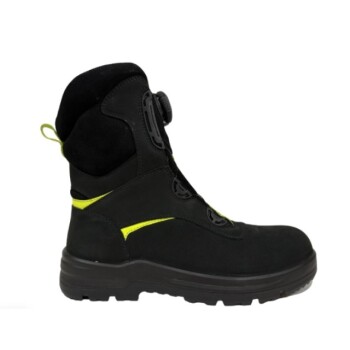
High-top tactical and work boots act as a critical external stabilizer for patients returning to duty following Lisfranc reconstruction. Their primary suitability lies in the mechanical restriction of excessive ankle motion—specifically eversion and inversion—which significantly reduces abnormal stress on the healing midfoot. Furthermore, their rigid sole construction forces the foot to remain in a stress-neutral position, preventing torque and instability when navigating uneven terrain or engaging in high-intensity labor.
Core Takeaway The structural rigidity of high-top boots provides a necessary surrogate for midfoot stability during recovery. By physically limiting rotational forces and providing slip-resistant traction, these boots isolate the injured area from the high-impact shocks and unpredictable shifts inherent in tactical or industrial environments.
Maximizing Midfoot and Ankle Stability
Restricting Rotational Forces
For a recovering Lisfranc patient, rotational forces are the enemy. The high-top design of tactical boots physically restricts excessive eversion (rolling out) or inversion (rolling in) of the foot.
By limiting this range of motion, the boot minimizes torque on the midfoot joints. This creates a controlled environment for the foot, even when the wearer is moving through complex or debris-filled environments.
The Importance of a Rigid Sole
A soft, flexible sneaker allows the foot to bend, which can strain a healing Lisfranc joint. High-top tactical and work boots feature a rigid sole construction that acts similarly to a cast or brace.
This stiffness ensures the midfoot remains in a protected, stress-neutral position. It prevents the arch from collapsing under load and protects the foot from bending awkwardly on uneven surfaces.
Protection in High-Intensity Environments
Impact Absorption and Fatigue Management
High-intensity labor and tactical tasks often involve energy expenditure exceeding 3000 kcal per shift. To support this, high-performance boots utilize advanced cushioning materials that provide critical energy return.
This cushioning mitigates muscle fatigue and reduces the impact of movements—such as chasing or heavy lifting—on the skeletal system. This allows the wearer to maintain physical output without compromising physiological safety.
Dynamic Stability and Traction
Slipping is a major risk factor for re-injury, as it causes sudden, uncontrolled muscle contractions. The slip-resistant grip found in professional tactical boots ensures dynamic stability.
Whether on wet floors or loose gravel, superior traction prevents the foot from sliding. This allows for safer execution of lateral shifts and deep squats by ensuring the outsole absorbs ground impact forces effectively.
Understanding the Trade-offs
Weight vs. Protection
While the reinforced structure protects against external impacts, it often comes with increased weight. Users must adapt to a heavier boot, which can initially alter gait mechanics compared to lighter athletic footwear.
Reduced Agility
The same rigidity that protects the midfoot limits the foot's natural flexibility. Users may find movements requiring extreme foot flexion—such as sprinting or crawling—more difficult, but this limitation is a necessary compromise for structural safety.
Making the Right Choice for Your Goal
- If your primary focus is heavy lifting and static standing: Prioritize a boot with maximum sole rigidity and a reinforced toe to keep the midfoot locked in a stress-neutral position.
- If your primary focus is dynamic tactical movement: Look for a boot that balances high-top ankle support with advanced cushioning materials to reduce skeletal impact during running or lateral shifts.
The right footwear transforms the foot from a vulnerable point of failure into a stable platform, allowing you to return to high-intensity duty with confidence.
Summary Table:
| Feature | Benefit for Lisfranc Recovery | Impact on Performance |
|---|---|---|
| High-Top Design | Restricts inversion/eversion | Minimizes torque on healing midfoot |
| Rigid Sole | Prevents excessive arch flexion | Keeps midfoot in stress-neutral position |
| Slip-Resistance | Prevents uncontrolled muscle shifts | Ensures dynamic stability on uneven terrain |
| Impact Cushioning | Absorbs shock and reduces fatigue | Protects skeletal system during heavy lifting |
| Reinforced Structure | Acts as an external stabilizer | Provides surrogate stability for the foot arch |
Secure Your Recovery with Professional-Grade Footwear
As a large-scale manufacturer serving global distributors and brand owners, 3515 offers comprehensive production capabilities for all footwear types, anchored by our flagship Safety Shoes series. We understand that for Lisfranc recovery and high-intensity labor, compromise isn't an option. Our extensive portfolio—spanning work and tactical boots, outdoor shoes, and sneakers—is engineered for maximum stability, rigid support, and superior impact absorption.
Whether you need bulk supplies of specialized tactical boots or custom safety footwear to meet diverse industrial requirements, 3515 provides the manufacturing excellence and reliability your brand deserves. Contact us today to explore our bulk solutions and footwear series and see how we can add value to your product line.
References
- Noortje Anna Clasina van den Boom, Silvia Evers. Patient experiences and preferences during treatment and recovery of Lisfranc fractures: A qualitative interview study. DOI: 10.1016/j.injury.2022.10.013
This article is also based on technical information from 3515 Knowledge Base .
Related Products
- High-Traction Suede Tactical Boots Wholesale & Custom Manufacturing
- Durable High-Ankle Tactical Boots Wholesale Manufacturer for Custom & Bulk Orders
- Durable High-Ankle Tactical Boots for Wholesale & Custom Manufacturing
- Durable Leather High-Ankle Tactical Boots for Wholesale & Custom Manufacturing
- Wholesale Tactical Boots High-Traction & Reflective for Bulk & Brand Orders
People Also Ask
- Why is sequential analysis utilized to evaluate tactical boots? Master Dynamic Boot Development and Ergonomic Performance
- How does the material of tactical boots affect their performance? Choose the Right Material for Your Mission
- How do tactical boots differ from regular boots? Performance, Durability & Design Explained
- How do military uniforms and tactical boots impact the prediction of thermal risk? Essential Safety Insights
- What are the benefits of integrating FES and sEMG into tactical boots? Safety, Reliability & Field-Ready Performance