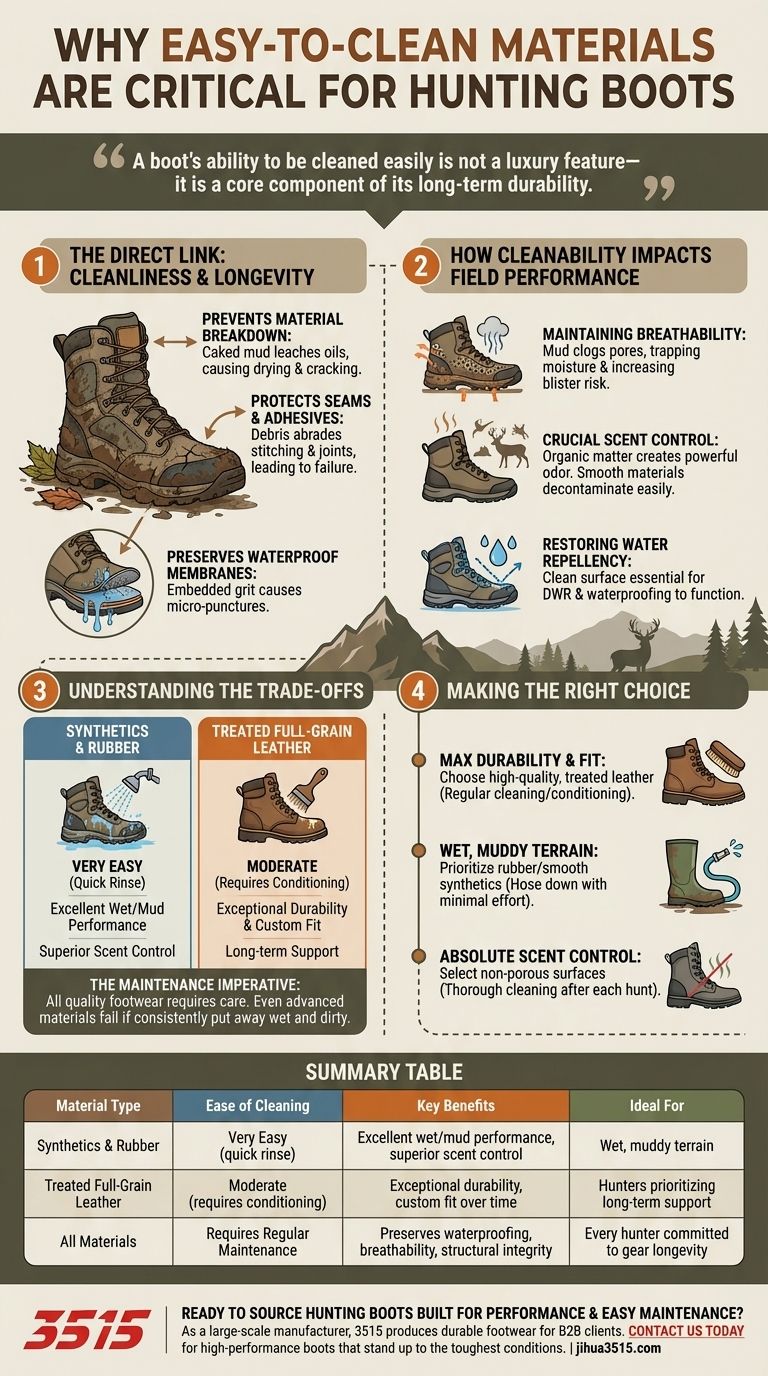
Beyond simple tidiness, the cleanability of your hunting boots is a critical factor that directly impacts their lifespan, performance, and reliability in the field. Materials like treated leather, rubber, and modern synthetics are designed to shed mud and debris easily, which prevents premature wear and preserves the boot's technical features.
A boot's ability to be cleaned easily is not a luxury feature—it is a core component of its long-term durability. Proper maintenance, enabled by the right materials, is what protects your investment and ensures your gear doesn't fail at a critical moment.
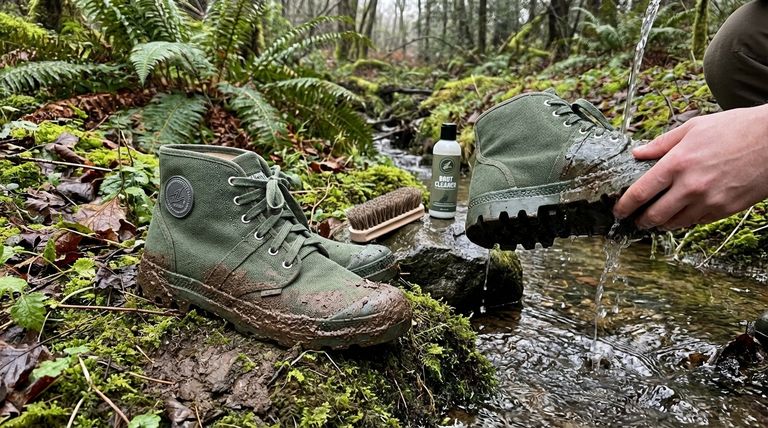
The Direct Link Between Cleanliness and Longevity
A dirty boot is a boot that is actively degrading. The mud, moisture, and organic matter accumulated during a hunt are not passive; they are agents of decay that break down the materials over time.
Preventing Material Breakdown
Caked-on mud slowly leaches conditioning oils and moisture from leather, causing it to dry out, stiffen, and eventually crack. For synthetic fabrics, embedded grit acts like sandpaper, abrading fibers and weakening the material with every step.
Protecting Seams and Adhesives
Debris and dirt are especially damaging to the high-stress areas of a boot, such as the seams and the welt where the sole attaches to the upper. These particles can work their way into stitching and glued joints, accelerating wear and leading to delamination or seam failure.
Preserving Waterproof Membranes
Many hunting boots rely on an internal waterproof-breathable membrane (like Gore-Tex). While protected from the inside, constant grinding from external dirt and sand can abrade these delicate layers, creating micro-punctures that compromise their integrity.
How Cleanability Impacts Field Performance
A clean boot simply works better. From breathability to scent control, the condition of your boot's exterior has a significant effect on its technical capabilities.
Maintaining Breathability
The primary function of breathable materials is to allow sweat vapor to escape, keeping your feet dry and comfortable. A layer of mud clogs the microscopic pores in both leather and synthetic fabrics, effectively suffocating the boot, trapping moisture, and increasing the risk of blisters.
Crucial Scent Control
For a hunter, scent is a liability. Mud, blood, and decaying vegetation clinging to your boots create a powerful and persistent odor that can alert game to your presence. Smooth, non-porous materials like rubber or treated synthetics are far easier to decontaminate than rough, untreated fabrics.
Restoring Water Repellency
The factory-applied Durable Water Repellent (DWR) coating on your boots causes water to bead up and roll off. This coating cannot function when it's covered in dirt. A clean surface is essential for the DWR to work and is a prerequisite for reapplying waterproofing treatments.
Understanding the Trade-offs
Choosing a material for its ease of cleaning involves balancing other important factors. No single material is perfect for every situation.
Synthetics and Rubber
These materials are the easiest to clean, often requiring just a quick rinse. They excel in wet, muddy environments. However, they may offer less breathability and a less customized fit compared to high-quality leather.
Full-Grain Leather
Treated full-grain leather offers exceptional durability, support, and the ability to mold to your foot over time. While highly water-resistant and cleanable when properly maintained, it requires a more involved process of cleaning and conditioning to prevent it from drying out and cracking.
The Maintenance Imperative
"Easy to clean" does not mean "no maintenance." All quality footwear requires care. A boot made from the most advanced synthetic material will still fail if it's consistently put away wet and dirty.
Making the Right Choice for Your Environment
Your decision should be based on the conditions you hunt in most often and your commitment to maintenance.
- If your primary focus is maximum durability and a custom fit: Choose a high-quality, treated leather boot, but be prepared to clean and condition it regularly.
- If your primary focus is hunting in wet, muddy terrain: Prioritize boots with significant rubber or smooth synthetic components that can be hosed down with minimal effort.
- If your primary focus is absolute scent control: Select boots with non-porous surfaces like rubber or treated synthetics that won't retain odors and can be thoroughly cleaned after each hunt.
Ultimately, choosing a boot you can realistically keep clean is the most practical way to ensure it supports you for many seasons to come.
Summary Table:
| Material Type | Ease of Cleaning | Key Benefits | Ideal For |
|---|---|---|---|
| Synthetics & Rubber | Very Easy (quick rinse) | Excellent wet/mud performance, superior scent control | Wet, muddy terrain |
| Treated Full-Grain Leather | Moderate (requires conditioning) | Exceptional durability, custom fit over time | Hunters prioritizing long-term support |
| All Materials | Requires Regular Maintenance | Preserves waterproofing, breathability, and structural integrity | Every hunter committed to gear longevity |
Ready to source hunting boots built for performance and easy maintenance?
As a large-scale manufacturer, 3515 produces a comprehensive range of durable footwear for distributors, brand owners, and bulk clients. Our production capabilities encompass all types of hunting boots designed with easy-to-clean materials that enhance longevity and field reliability.
Contact us today to discuss your specific needs and leverage our expertise in creating high-performance hunting footwear that stands up to the toughest conditions.
Visual Guide
Related Products
- Wholesale Lightweight Tactical Boots Custom Manufacturer for Desert & Combat Use
- High-Traction Suede Tactical Boots Wholesale & Custom Manufacturing
- Durable Leather Tactical Boots Wholesale & Custom Manufacturing for Brands
- Durable Military Combat Boots with Water Drainage for Wholesale & OEM
- Wholesale Waterproof Tactical Boots Custom Suede & High-Traction Soles
People Also Ask
- What are the common types of combat boots? Find the Right Boot for Your Mission
- What specialized protections do tactical boots offer? Maximize Endurance with High-Performance Footwear
- How is the compatibility of polymer materials demonstrated in smart footwear? Enhancing Tactical & Training Performance
- What is the role of high-frequency acquisition hardware in technical skill analysis for outdoor and tactical boots?
- What are the different types of tactical boots available? Find the Right Boot for Your Mission