
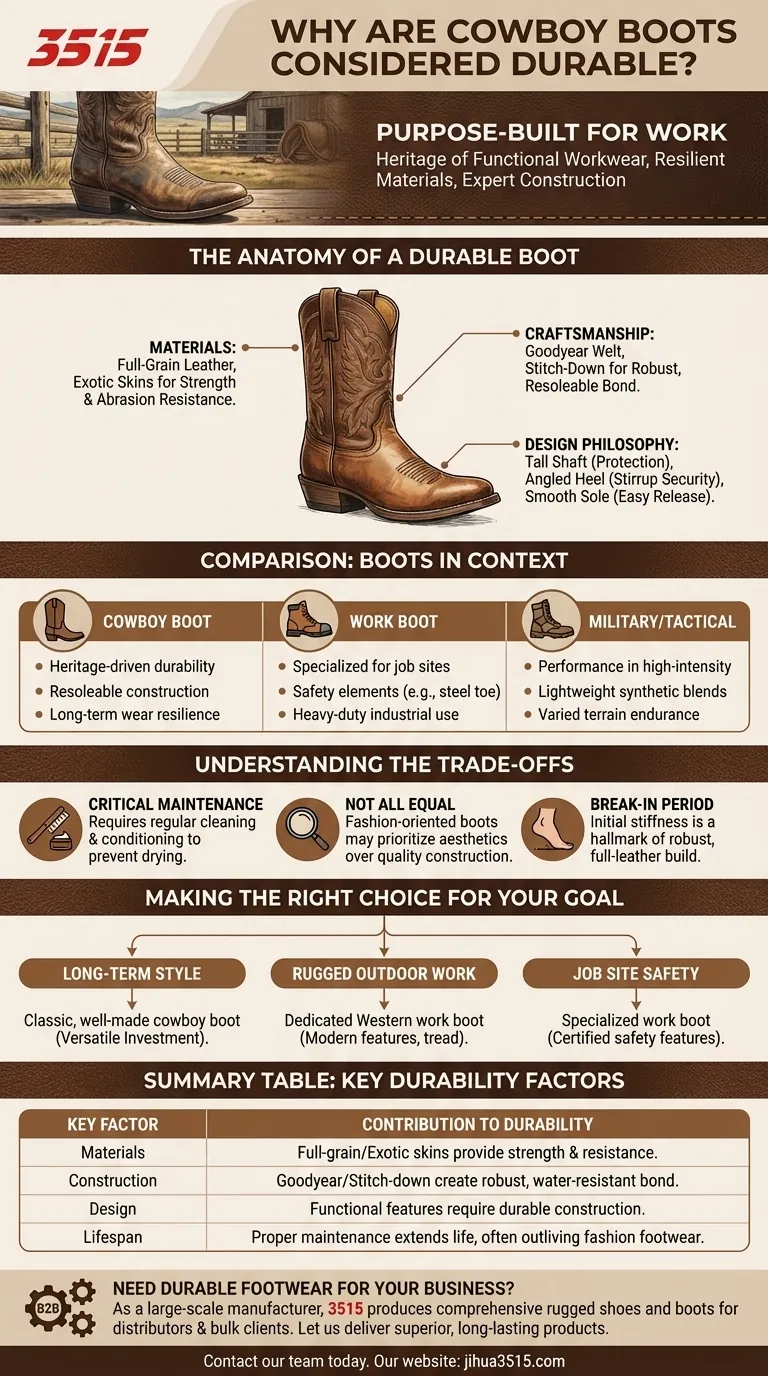
At their core, cowboy boots are considered durable because they are purpose-built. Their longevity stems directly from their original design as functional workwear, combining high-quality, resilient materials with expert construction methods intended to withstand the rigors of ranching and riding.
The durability of a cowboy boot is not just a feature; it is the direct result of its heritage. The materials and craftsmanship were chosen for function first, creating a boot that is inherently built to last far longer than footwear designed primarily for fashion.
The Anatomy of a Durable Boot
True durability isn't a single feature but a combination of carefully chosen elements working together. From the material selection to the way the boot is held together, every component is designed for resilience.
The Foundation: High-Quality Materials
The primary material in a traditional cowboy boot is full-grain leather, typically cowhide. This material is chosen for its exceptional strength, resistance to abrasion, and ability to mold to the wearer's foot over time.
Many boots also feature exotic skins like ostrich, caiman, or snake. While often seen as stylistic, these materials are also selected for their unique durability and tough characteristics.
The Backbone: Expert Craftsmanship
How a boot is constructed is just as important as the materials used. Reputable cowboy boots are not simply glued together; they use methods like Goodyear welting or stitch-down construction.
This involves stitching the sole to the upper part of the boot, creating a mechanical bond that is far more robust and water-resistant than adhesives. This expert craftsmanship also means the boots can often be resoled, dramatically extending their functional lifespan.
The Design Philosophy: Built for Work
The iconic shape of the cowboy boot is rooted in function. The tall shaft protects the rider's legs from brush, fences, and snakebites. The angled heel ensures the foot stays securely in a stirrup, while the smooth sole allows for easy release.
This design, intended for demanding outdoor activity, inherently requires robust construction to perform its job and protect the wearer, day after day.
How Cowboy Boots Compare to Other Footwear
To fully appreciate their durability, it's helpful to place cowboy boots in context with other types of rugged footwear.
vs. Dedicated Work Boots
Modern work boots are engineered for heavy-duty industrial use. They often feature specific safety elements like steel toes, oil-resistant soles, and waterproofing membranes that a traditional cowboy boot may lack. While both are durable, a work boot's toughness is specialized for the job site.
vs. Military & Tactical Boots
Tactical boots are built to endure extreme conditions and varied terrain. They frequently use a combination of leather and rugged synthetic fabrics like nylon to balance durability with lighter weight. Their construction prioritizes performance in high-intensity situations, a different kind of durability than the long-term wear-and-tear resilience of a leather cowboy boot.
Understanding the Trade-offs
No footwear is perfect for every situation. True durability comes with considerations that are important to understand.
The Critical Role of Maintenance
The high-quality leather that makes cowboy boots durable also requires care. Without regular cleaning and conditioning, leather can dry out, crack, and lose its resilience. Their durability is contingent on proper maintenance.
Not All Boots Are Created Equal
The surge in Western fashion means many "cowboy-style" boots are now produced. These fashion-oriented boots may prioritize aesthetics over construction, using cheaper materials or glued soles. A truly durable boot is an investment in craftsmanship, not just a style.
The Break-in Period
A hallmark of robust, full-leather construction is an initial stiffness. A well-made cowboy boot requires a break-in period as the thick leather molds to your foot. This initial discomfort is the trade-off for a customized fit and lasting structure.
Making the Right Choice for Your Goal
Ultimately, the right boot depends entirely on your primary need.
- If your primary focus is versatile, long-term style: A classic, well-made cowboy boot is an excellent investment that will last for years and adapt to many situations.
- If your primary focus is rugged outdoor work: Consider a dedicated Western work boot that combines the classic style with modern features like more aggressive tread and waterproofing.
- If your primary focus is heavy-duty job site safety: A specialized work boot with certified safety features is the most appropriate and protective choice.
By understanding that their durability is a product of their purpose, you can confidently choose a boot that will serve you well for years to come.
Summary Table:
| Key Factor | Contribution to Durability |
|---|---|
| Materials | Full-grain leather and exotic skins provide exceptional strength and abrasion resistance. |
| Construction | Goodyear welting or stitch-down methods create a robust, water-resistant, and resoleable bond. |
| Design | Tall shaft and angled heel are functional features that require durable construction to perform. |
| Lifespan | Proper maintenance allows these boots to last for many years, often outliving fashion footwear. |
Need Durable Footwear for Your Business?
As a large-scale manufacturer, 3515 produces a comprehensive range of durable footwear for distributors, brand owners, and bulk clients. Our production capabilities encompass all types of rugged shoes and boots, built with the same focus on quality materials and expert craftsmanship that makes cowboy boots last.
Let us help you deliver superior, long-lasting products to your market.
Contact our team today to discuss your manufacturing needs and how we can add value to your supply chain.
Visual Guide
Related Products
- High-Traction Suede Tactical Boots Wholesale & Custom Manufacturing
- Wholesale High-Traction Camo Boots - Custom Manufacturer for Brands
- Wholesale Lightweight Tactical Boots Custom Manufacturer for Desert & Combat Use
- Durable Leather Tactical Boots Wholesale & Custom Manufacturing for Brands
- Wholesale Durable Mid-Cut Tactical Boots for Custom & Private Label Brands
People Also Ask
- Why is sequential analysis utilized to evaluate tactical boots? Master Dynamic Boot Development and Ergonomic Performance
- How does the material of tactical boots affect their performance? Choose the Right Material for Your Mission
- How do tactical boots differ from regular boots? Performance, Durability & Design Explained
- How do military uniforms and tactical boots impact the prediction of thermal risk? Essential Safety Insights
- What are the benefits of integrating FES and sEMG into tactical boots? Safety, Reliability & Field-Ready Performance

















