
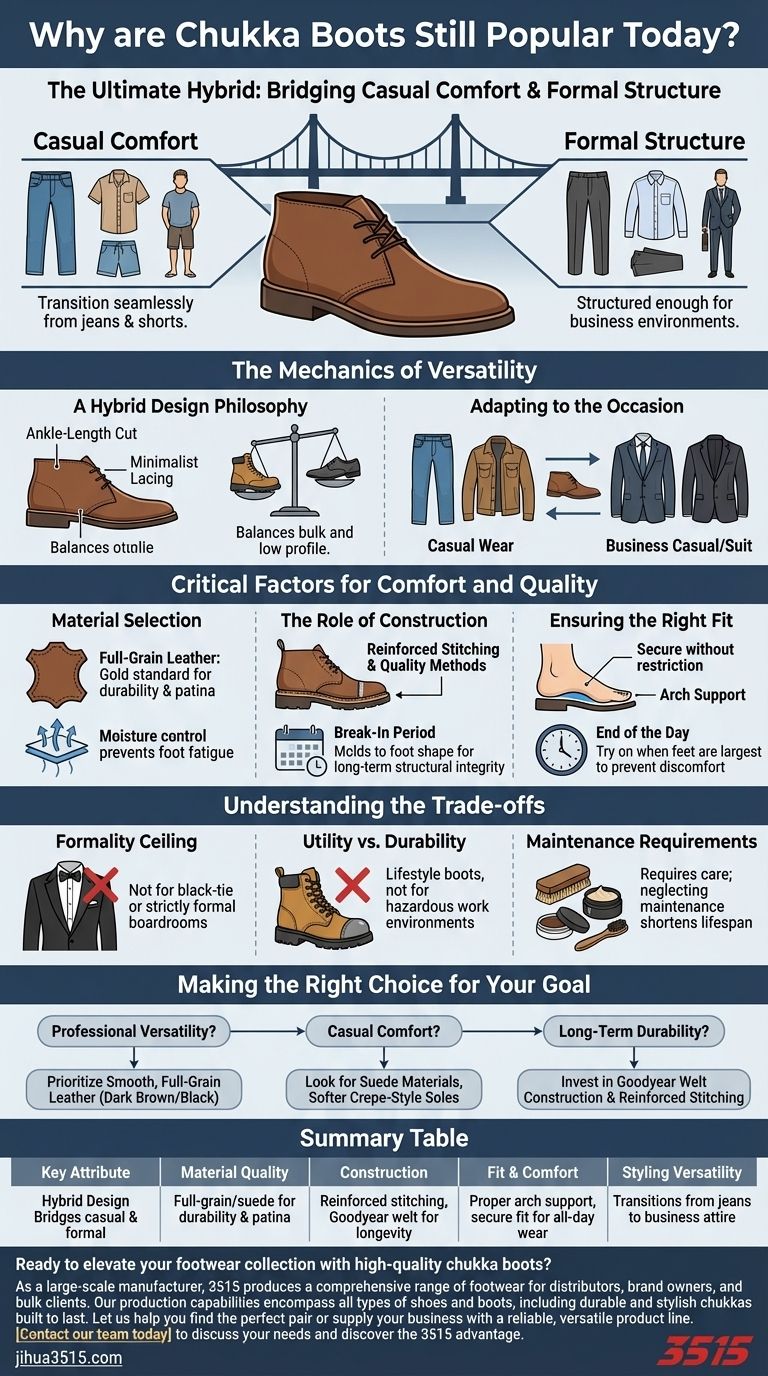
Chukka boots remain a dominant force in modern footwear because they function as the ultimate hybrid, bridging the gap between casual comfort and formal structure. Originating in the 1920s as a cross between ankle boots and riding boots, they offer a unique versatility that allows them to transition seamlessly from jeans and shorts to tailored suits without looking out of place.
The enduring value of the chukka boot lies in its ability to solve the "in-between" wardrobe dilemma. It provides a timeless, single-shoe solution that delivers the durability of a boot with the refined profile of a dress shoe.
The Mechanics of Versatility
A Hybrid Design Philosophy
The chukka is defined by its ankle-length cut and minimalist lacing system. This design strikes a balance between the bulk of a work boot and the low profile of an oxford.
Because of this hybrid nature, it occupies a rare stylistic middle ground. It is structured enough to be professional but relaxed enough to avoid feeling stuffy.
Adapting to the Occasion
Few shoes can cross strictly defined dress codes. The chukka boot, however, can be "dressed up" or "dressed down" based solely on the rest of your outfit.
They pair naturally with casual wear like denim or chinos for weekend activities. Yet, in the correct leather finish, they transition immediately to business casual or even suit-wearing environments.
Critical Factors for Comfort and Quality
Material Selection
The longevity of a chukka boot depends heavily on the materials used. Full-grain leather is the gold standard, offering durability and the ability to develop a patina over time.
Breathability is also essential. High-quality materials allow for moisture control, which is critical for preventing foot fatigue during long periods of wear.
The Role of Construction
Durability is not just about the leather; it is about how the boot is built. Look for reinforced stitching and high-quality construction methods.
A well-made boot will require a break-in period. This is a sign of structural integrity, as the materials mold to your foot shape over time rather than breaking down immediately.
Ensuring the Right Fit
Comfort is subjective but relies on objective metrics. A proper fit should be secure without being restrictive, offering sufficient arch support and room for the toes.
To ensure accuracy, try boots on at the end of the day. Your feet naturally swell during daily activity; fitting them when they are at their largest prevents long-term discomfort.
Understanding the Trade-offs
The Formality Ceiling
While versatile, chukkas have limits. They are generally not appropriate for black-tie events or strictly formal business boardrooms. In these scenarios, a dedicated dress shoe is still required.
Utility vs. Durability
Standard chukkas are lifestyle boots, not heavy-duty work boots. While they offer more protection than a sneaker, they lack the steel toes or aggressive tread patterns required for hazardous work environments.
Maintenance Requirements
Unlike synthetic sneakers, high-quality chukkas require care. Suede variants are susceptible to water damage, and leather requires conditioning. Neglecting maintenance will significantly shorten the lifespan of the boot.
Making the Right Choice for Your Goal
To select the right pair, you must identify the primary gap in your current wardrobe.
- If your primary focus is Professional Versatility: Prioritize smooth, full-grain leather in dark brown or black to maximize compatibility with slacks and suits.
- If your primary focus is Casual Comfort: Look for suede materials and softer, crepe-style soles that offer immediate flexibility and a relaxed aesthetic.
- If your primary focus is Long-Term Durability: Invest in boots with Goodyear welt construction and reinforced stitching, which allow for resoling and heavy usage.
By selecting a chukka boot that aligns with your specific lifestyle needs, you secure a foundational piece of footwear that pays dividends in both style and utility for years.
Summary Table:
| Key Attribute | Why It Matters |
|---|---|
| Hybrid Design | Bridges the gap between casual and formal wear, offering unmatched versatility. |
| Material Quality | Full-grain leather and suede ensure durability and develop a unique patina over time. |
| Construction | Reinforced stitching and quality builds (like Goodyear welt) enable long-term use and resoling. |
| Fit & Comfort | Proper arch support and a secure fit provide all-day comfort for various activities. |
| Styling Versatility | Easily transitions from jeans and chinos to business casual attire with a single shoe. |
Ready to elevate your footwear collection with high-quality chukka boots?
As a large-scale manufacturer, 3515 produces a comprehensive range of footwear for distributors, brand owners, and bulk clients. Our production capabilities encompass all types of shoes and boots, including durable and stylish chukkas built to last.
Let us help you find the perfect pair or supply your business with a reliable, versatile product line. Contact our team today to discuss your needs and discover the 3515 advantage.
Visual Guide
Related Products
- Premium Wholesale Tactical Style Safety Shoes Boots with Quick Lacing
- Wholesale Safety Boots Manufacturer for Custom & Private Label Orders
- Factory Direct Wholesale Rain Boots Durable Waterproof & Fully Customizable
- Wholesale High-Traction Camo Boots - Custom Manufacturer for Brands
- Durable Leather High-Ankle Tactical Boots for Wholesale & Custom Manufacturing
People Also Ask
- How are gait analysis research findings applied to the functional design of safety shoes and tactical boots?
- How can specialized footwear mitigate safety risks? High-Volume OEM/ODM Solutions since 1951
- Why is the synchronization of craftsmanship and UX development emphasized for bulk customization of safety shoes?
- How does anthropomorphic design influence material selection? Enhance Footwear Performance through Biological Alignment
- How do quality certification standards for safety shoes reduce perceived risk? Buy Online with Technical Certainty



















