
At their core, Chelsea boots are fashionable because of their sleek, minimalist, and timeless design that pairs with almost any outfit. They are comfortable due to their soft construction, ankle-height support, and most importantly, their signature elastic side panels that allow them to be slipped on and off with ease, eliminating the need for laces.
The enduring appeal of the Chelsea boot lies in its unique combination of aesthetic versatility and practical convenience. It's a rare piece of footwear that effortlessly bridges the gap between formal and casual, making it a foundational element of a modern wardrobe.

Deconstructing the Chelsea Boot
To understand why this boot has remained a staple for over a century, we need to look at its core components and the distinct advantages they offer.
The Defining Feature: Elastic Side Panels
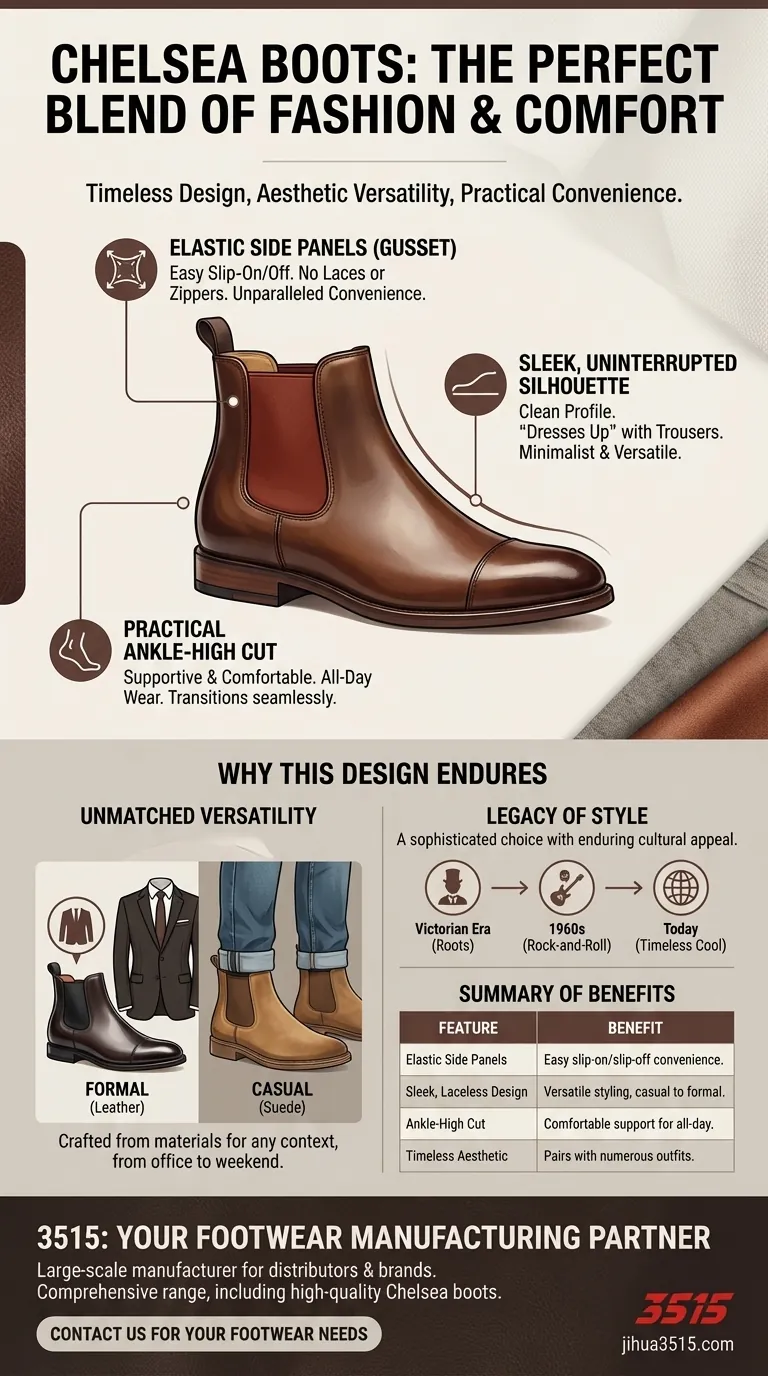
The most recognizable feature of a Chelsea boot is the elasticated side panel, often called the gusset. This was a revolutionary footwear innovation.
This elastic panel is the key to the boot's convenience. It allows you to pull the boot on and kick it off without fumbling with laces or zippers, offering unparalleled ease of use.
The Sleek, Uninterrupted Silhouette
The absence of laces gives the Chelsea boot a clean, uninterrupted profile. This minimalist design is central to its versatility.
This sleekness allows the boot to be "dressed up" with trousers or a suit, where bulkier, laced boots might look out of place. It presents a smooth line from pant leg to toe.
The Practical Ankle-High Cut
Chelsea boots are almost always ankle-height. This specific cut provides support without being restrictive.
It's high enough to work with cuffed jeans or tailored trousers but low enough to remain comfortable for all-day wear, transitioning seamlessly from the office to an evening out.
Why This Design Endures
The Chelsea boot's design isn't just a collection of features; it's a solution to the common wardrobe problem of finding footwear that is both stylish and functional.
Unmatched Versatility
The simple design allows Chelsea boots to be crafted from various materials, each suited for a different context. Leather versions often lean more formal, while suede offers a more relaxed, semi-casual feel.
This adaptability means a single pair of boots can be styled with everything from a casual button-down and chinos to more formal trousers, maximizing its value in any wardrobe.
A Legacy of Style
First popularized in the Victorian era, the boot was adopted by the rock-and-roll culture of 1960s Britain, most famously by bands like The Beatles.
This cultural association cemented its status as a timelessly cool and sophisticated choice, lending it an air of effortless style that persists today.
Understanding the Trade-offs
While exceptionally versatile, the Chelsea boot is not a universal solution for every situation. Understanding its limitations is key to wearing it effectively.
Not a True Dress Boot
While a polished black leather Chelsea can work with a modern suit, it is not a substitute for a traditional Oxford or Derby in highly formal or conservative business environments. The pull-on nature, while convenient, is inherently more casual.
Limited Adjustability
The primary drawback of a laceless design is the lack of adjustability. A proper fit is critical from the start, as you cannot tighten the boot to accommodate variations in foot shape or sock thickness.
Modern Work Boot Hybrids
You may see "Chelsea work boots" that include features like steel toes. While these share the convenient pull-on style, they are built for durability and safety, not fashion. Their bulky construction makes them unsuitable for the stylish applications discussed here.
Making the Right Choice for Your Goal
The best way to incorporate a Chelsea boot depends entirely on the look you want to achieve.
- If your primary focus is a sharp, business-casual look: Opt for a pair in black or dark brown leather to pair with chinos, trousers, and button-down shirts.
- If your primary focus is a relaxed, weekend style: Choose a boot in a lighter suede, like olive, tan, or cream, to wear with quality denim or casual chinos.
- If your primary focus is maximum versatility: A simple, dark brown suede Chelsea boot often provides the most flexibility, easily dressing up or down.
Ultimately, the Chelsea boot's power lies in its elegant simplicity, providing a sophisticated foundation for almost any outfit you choose to build.
Summary Table:
| Feature | Benefit |
|---|---|
| Elastic Side Panels | Easy slip-on/slip-off convenience; no laces needed. |
| Sleek, Laceless Design | Clean silhouette for versatile styling, from casual to formal. |
| Ankle-High Cut | Provides support while remaining comfortable for all-day wear. |
| Timeless Aesthetic | A classic, versatile piece that pairs with numerous outfits. |
Ready to add this timeless staple to your collection?
As a large-scale manufacturer, 3515 produces a comprehensive range of footwear for distributors, brand owners, and bulk clients. Our production capabilities encompass all types of shoes and boots, including high-quality Chelsea boots designed for style, comfort, and durability.
Contact us today to discuss your footwear needs and discover how we can be your reliable manufacturing partner.
Visual Guide
Related Products
- Wholesale Suede Chelsea Safety Boots for Custom & Private Label Manufacturing
- Durable Leather High-Ankle Tactical Boots for Wholesale & Custom Manufacturing
- Durable High-Ankle Tactical Boots Wholesale Manufacturer for Custom & Bulk Orders
- Wholesale Tactical Boots High-Traction & Reflective for Bulk & Brand Orders
- Wholesale Waterproof Tactical Boots Custom Suede & High-Traction Soles
People Also Ask
- Why are chelsea boots considered a versatile style? The Ultimate Wardrobe Foundation
- What makes Chelsea boots a popular choice and how can they be styled? A Guide to Versatile Footwear
- Why are Chelsea boots easy to wear? Slip-On Style & Timeless Versatility
- Why are Chelsea boots so popular? Discover the Secret to Effortless, Timeless Style
- What are the characteristics of Chelsea boots? The Ultimate Guide to Style & Function



















