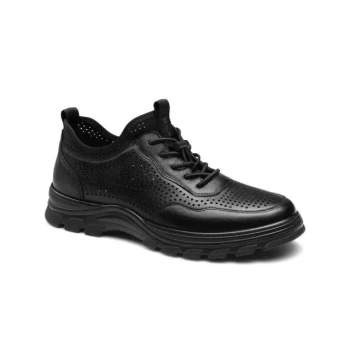
Advanced digital quality control systems are the architectural foundation of the circular economy in footwear. They are necessary because they rigorously verify that products, particularly heavy-duty items like safety shoes and tactical boots, possess the structural integrity required to survive multiple life cycles. Without this high-level validation, footwear cannot withstand the repair, resale, and reuse phases that define a sustainable model.
In a circular economy, the primary goal is to maximize the utility of every product; digital inspection systems make this possible by establishing a "quality baseline" that ensures shoes are built to last, thereby preventing resource waste caused by premature product failure.
Ensuring Structural Integrity for Extended Use
Testing for Real-World Resilience
For a shoe to enter a circular loop, it must be durable enough to be worn, repaired, and worn again.
Advanced inspection systems accurately test critical material properties such as tear resistance and abrasion resistance. This data confirms that the materials can withstand the rigors of long-term use without degrading beyond the point of repair.
Validating Bond Strength
The most common point of failure in footwear is often the adhesion between the sole and the upper.
Digital quality control systems measure bond strength with precision. Ensuring a robust bond is essential for facilitating subsequent maintenance, as a shoe with a separated sole is often discarded rather than repaired in a linear model.
The Economic and Environmental Case
Reducing Resource Waste
The transition from a linear to a circular economy relies on minimizing the "leakage" of materials out of the system.
By catching defects early and ensuring high durability standards, manufacturers prevent the production of goods that will fail quickly. This directly reduces the volume of shoes ending up in landfills and optimizes the utilization of the raw materials involved.
Enhancing Market Competitiveness
Adopting industrial-grade equipment designed for resource conservation is a critical factor for modern competitiveness.
While the primary focus is quality, these systems support a broader framework of cost reduction. By minimizing raw material loss through precise quality gates, manufacturers of work boots and sneakers can lower the production cost per unit while meeting sustainability targets.
Understanding the Trade-offs
High Upfront Implementation Costs
Transitioning to advanced digital QC systems requires a significant initial capital investment.
Unlike traditional visual inspections, these systems involve sophisticated hardware and software. Manufacturers must be prepared to amortize these costs over the longer term rather than expecting immediate payback in a single quarter.
Potential Throughput Bottlenecks
Rigorous testing can sometimes slow down the production line compared to superficial sampling methods.
If not integrated efficiently, thorough testing of bond strength and material resistance creates friction in high-speed manufacturing environments. Companies must balance the depth of inspection with the required production velocity.
Making the Right Choice for Your Goals
To successfully integrate these systems into your production line, you must align them with your specific strategic objectives.
- If your primary focus is Brand Reputation and Durability: Prioritize systems that specialize in destructive and non-destructive testing of bond strength and abrasion resistance to guarantee a long product lifecycle.
- If your primary focus is Cost Efficiency and Waste Reduction: Focus on inspection technologies that identify material flaws early in the process to minimize scrap and lower the production cost per unit.
Invest in quality control not just as a compliance measure, but as the enabling technology that makes your transition to a circular economy economically viable.
Summary Table:
| Key QC Aspect | Benefit to Circular Economy | Footwear Target |
|---|---|---|
| Tear & Abrasion Testing | Extends product life cycles for reuse/resale | Tactical & Work Boots |
| Bond Strength Validation | Ensures repairability and prevents sole separation | Safety Shoes & Sneakers |
| Early Defect Detection | Minimizes raw material leakage and waste | All Footwear Types |
| Data-Driven QC | Establishes a quality baseline for sustainability | Industrial & Bulk Production |
Elevate Your Production Standards with 3515
Transitioning to a circular economy requires a manufacturing partner that prioritizes durability and precision. As a large-scale manufacturer serving distributors and brand owners worldwide, 3515 offers comprehensive production capabilities for all footwear types. Our flagship Safety Shoes series, along with our tactical boots, outdoor shoes, sneakers, and formal dress shoes, are anchored by advanced quality control systems designed to maximize product utility and minimize environmental impact.
Ready to optimize your supply chain with high-integrity footwear?
Contact Us Today to Discuss Your Bulk Requirements
References
- Joel Millward-Hopkins. The Social Implications of Circular Clothing Economies in the Global North. DOI: 10.3390/su16167094
This article is also based on technical information from 3515 Knowledge Base .
Related Products
- Lightweight Breathable Training Shoes for Wholesale & Custom OEM Manufacturing
- Wholesale Durable Camouflage Canvas Shoes with High-Traction Cleated Rubber Sole
- Wholesale Breathable Training Shoes Custom Athletic Footwear Manufacturer
- Premium Lightweight Safety Shoes for Wholesale & Bulk Orders
- Durable Leather High-Ankle Tactical Boots for Wholesale & Custom Manufacturing
People Also Ask
- Why are lightweight training shoes often preferred over professional hiking boots in urban walking? Maximize City Comfort
- What is the primary role of specialized training or orthopedic shoes? Enhance Safety in Elderly Balance Training
- Why are professional-grade training shoes essential for physical therapy? Ensure Patient Safety and Gait Stability
- Why are the slip-resistance and stability performance of training shoes critical in gait analysis? Ensure Data Accuracy
- Why is the use of flat-soled or professional training shoes essential for WBV? Maximize Vibration Energy Transfer