When you are unsure about necessary safety features in work boots, the definitive sources of guidance are your employer or a designated workplace safety professional. They are responsible for assessing job-site hazards and specifying the exact Personal Protective Equipment (PPE) required to keep you safe.
Your employer dictates the mandatory safety requirements, but understanding the why behind those rules empowers you to be an active, informed participant in your own workplace safety.

Why Your Employer Is the Authoritative Source
Your employer or safety manager isn't just a helpful guide; they are typically bound by regulatory standards to ensure a safe working environment. Their guidance is based on a formal assessment of the specific risks you face daily.
The Role of Hazard Assessment
Every worksite has a unique risk profile. A safety professional conducts a formal hazard assessment to identify potential dangers, such as falling objects, sharp debris on the ground, or live electrical circuits.
The required boot features are a direct result of this assessment. This is why a generic recommendation is insufficient; the protection must match the specific, identified risks of your job.
Legal and Compliance Obligations
Companies have a legal and ethical obligation to protect their workers. This includes specifying, and sometimes providing, the correct PPE.
Following their direction ensures you are not only protected but also in compliance with company policy and broader safety regulations like those from OSHA (Occupational Safety and Health Administration).
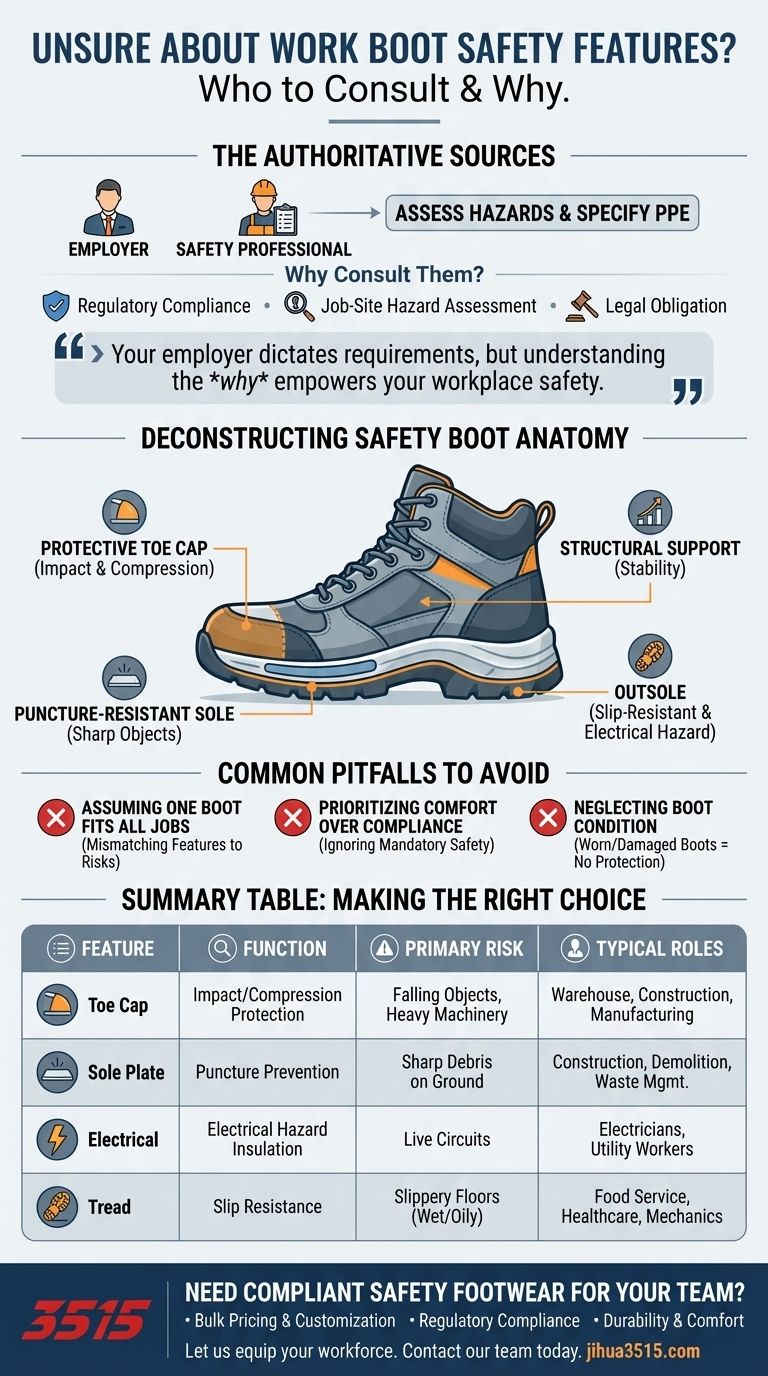
Deconstructing the Anatomy of a Safety Boot
To have a productive conversation with your safety manager, it helps to speak the same language. Understanding the core components of a safety boot allows you to grasp the function behind each requirement.
The Protective Toe Cap
This is the most well-known safety feature. It's a reinforced section at the front of the boot designed to protect your toes from compression and heavy impacts.
While steel toes are the traditional standard, modern boots may also use lighter composite materials.
The Puncture-Resistant Sole
A reinforced plate, often made of steel, is embedded in the midsole. Its sole purpose is to prevent sharp objects like nails or metal shards from piercing through the bottom of the boot and injuring your foot.
The Outsole and its Properties
The outsole is the part of the boot that contacts the ground. Its features are critical for stability and protection.
Key properties include non-slip treads to prevent falls on wet or oily surfaces and specialized rubber compounds that can provide insulation against electrical hazards.
Structural Support
Beyond direct impacts, work boots provide crucial structural support. This includes reinforced arches, which are especially important for stability when climbing ladders or standing for long periods.
Common Pitfalls to Avoid
Choosing the wrong boot, even if it's a "safety" boot, can create a false sense of security. The most common mistake is assuming that all safety features are interchangeable.
Assuming One Boot Fits All Jobs
A boot designed with a steel toe for a warehouse environment offers no protection to an electrician who needs an Electrical Hazard (EH) rating. The features must align with the risk.
Prioritizing Comfort Over Compliance
While a comfortable boot is important for reducing fatigue, comfort can never supersede the required safety specifications. A feature like a puncture-proof sole is non-negotiable if the hazard exists, regardless of how it affects the boot's flexibility.
Neglecting Boot Condition
The protective features of a work boot are only effective if the boot is in good condition. A cracked sole, a dented toe cap, or excessively worn treads mean the boot is no longer providing its intended level of protection and must be replaced.
Making the Right Choice for Your Role
When you consult your employer, use this framework to ensure you get the right protection for your specific tasks.
- If your primary risk is falling objects or heavy machinery: Confirm the required impact and compression rating for the protective toe cap.
- If your primary risk is sharp debris on the ground: Ensure your boot has a certified puncture-resistant sole plate.
- If your primary risk is working around live circuits: Verify the boot has a certified Electrical Hazard (EH) rating and is made from non-conductive materials.
- If your primary risk is slippery floors: Ask about the required slip-resistance rating for the specific surfaces you work on.
By understanding these core components, you can engage in a more informed conversation with your safety manager and take true ownership of your on-the-job protection.
Summary Table:
| Key Safety Feature | Primary Function | Who Needs It Most? |
|---|---|---|
| Protective Toe Cap | Protects toes from heavy impacts/compression | Warehouse, construction, manufacturing workers |
| Puncture-Resistant Sole | Prevents sharp objects from piercing the foot | Construction, demolition, waste management workers |
| EH-Rated Outsole | Insulates against electrical hazards | Electricians, utility workers |
| Slip-Resistant Tread | Prevents falls on wet/oily surfaces | Food service, healthcare, mechanics |
Need Compliant Safety Footwear for Your Team?
As a large-scale manufacturer, 3515 produces a comprehensive range of certified safety footwear for distributors, brand owners, and bulk clients. Our production capabilities encompass all types of safety shoes and boots, designed to meet the specific hazard assessments of various industries.
We provide:
- Bulk Pricing & Customization: Tailored solutions for large orders.
- Regulatory Compliance: Boots that meet or exceed industry safety standards.
- Durability & Comfort: Built to last, reducing long-term costs.
Let us equip your workforce with the right protection. Contact our team today to discuss your requirements and receive a quote.
Visual Guide
Related Products
- Customizable Anti-Smash Safety Boots for Wholesale & Private Label Manufacturing
- Wholesale Durable Safety Boots | Custom Steel Toe & Puncture-Resistant Manufacturing
- Wholesale Customizable Safety Boots Durable & Protective Footwear Manufacturing
- Wholesale Premium Waterproof Nubuck Safety Shoes Boots
- Premium Grain Leather Safety Boots for Bulk Supply
People Also Ask
- What are the requirements of BS EN345 safety regulations for security guard safety boots? | EN ISO 20345 Guide
- What are the key performance benchmarks set by the EN ISO 20345 standard for safety boots? A Guide to Selecting the Right Protection
- What additional protections are defined by the EN ISO 20345 norm? Match Footwear to Specific Hazards
- How is compliance with the EN ISO 20345 standard certified? The Path to Independent Verification
- Why are industrial safety boots with steel toes necessary for machine operators? Essential Foot Protection for Safety