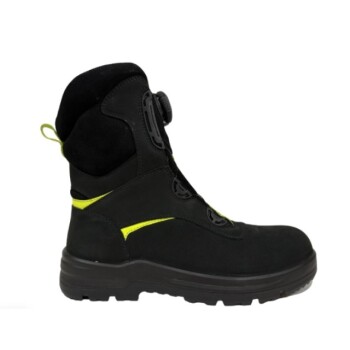
Unlike regular shoes, motorcycle boots are non-negotiable safety equipment. You must replace them not based on a fixed timeline, but when their core protective features show significant degradation. Key failure points include worn-out soles that compromise grip, damage to the upper material that reduces structural integrity, or a loss of the critical ankle support designed to prevent injury in a crash.
Your boots' primary function is to protect your feet and ankles during an impact and slide. Once wear and tear compromises their ability to provide abrasion resistance, impact protection, and torsional rigidity, they have ceased to be effective safety gear and must be replaced immediately.
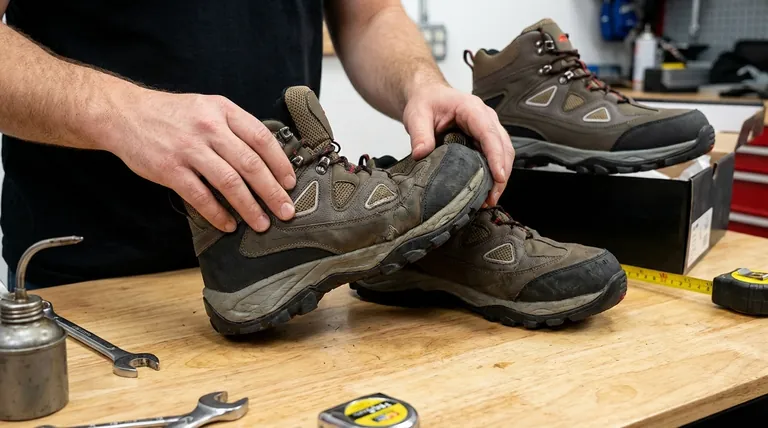
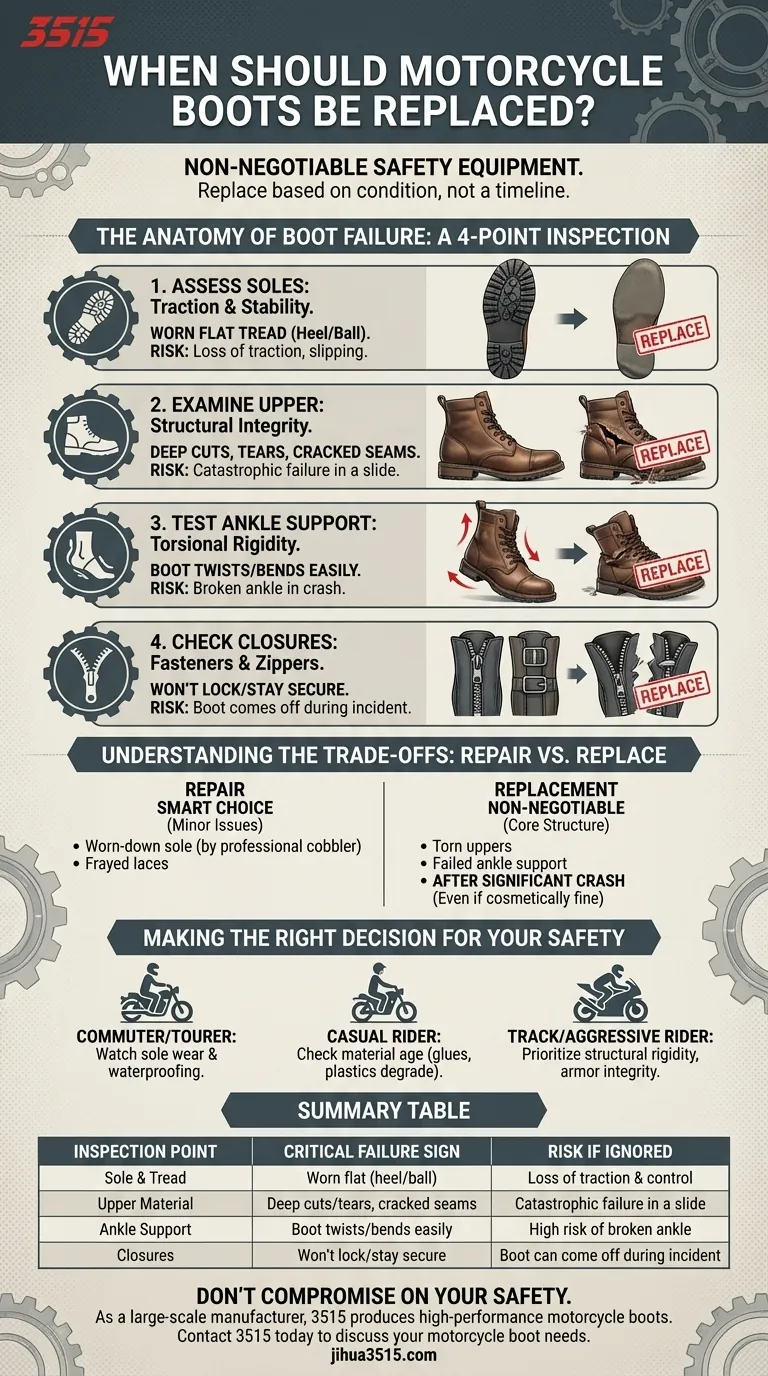
The Anatomy of Boot Failure: A 4-Point Inspection
To determine if your boots are still road-worthy, perform this systematic inspection regularly. Do not wait for them to feel uncomfortable; by then, their protective qualities may have been long gone.
Assess the Soles for Traction and Stability
The sole is your interface with the ground and your bike's footpegs. Its integrity is crucial for control.
Look for areas where the tread pattern has become smooth or worn flat, particularly at the ball of the foot and the heel.
Significant or uneven wear can compromise your footing when you stop, reducing traction on slick surfaces and creating an unstable platform.
Examine the Upper for Structural Integrity
The main body of the boot is your primary defense against abrasion. Its structure must be sound.
Carefully inspect the leather, textile, or synthetic material for deep scuffs, cuts, tears, or cracking. Pay close attention to the stitching along the seams.
Any breach in this outer layer means the boot will fail catastrophically when sliding on pavement, offering little to no protection.
Test for Ankle Support and Torsional Rigidity
This is arguably the most important function of a motorcycle boot. It is designed to prevent your ankle from twisting and breaking.
Hold the boot firmly and try to bend it side-to-side and twist it. A good boot will resist these forces significantly. If it collapses or twists easily, the internal support structure has failed.
Worn-out padding can also lead to a loose fit, reducing support and allowing your foot to move dangerously inside the boot during an incident.
Check Fasteners and Closures
A boot cannot protect you if it doesn't stay on your foot.
Ensure all zippers, buckles, velcro, and laces are fully functional. A zipper that won't stay up or a buckle that won't lock securely renders the boot useless.
Frayed laces or damaged closures should be addressed immediately, as they can fail when you need them most.
Understanding the Trade-offs: Repair vs. Replace
Knowing when a simple fix is sufficient versus when the entire boot is compromised is key to both safety and economy.
When a Repair Is a Smart Choice
Minor issues on an otherwise solid boot can often be addressed.
A worn-down sole can sometimes be replaced by a professional cobbler, extending the life of a high-quality pair of boots. Replacing frayed laces is a simple and obvious fix.
When Replacement Is Non-Negotiable
You can't repair a boot's core safety structure. Replacement is the only safe option if you find these issues.
Never attempt to patch or repair a boot with compromised structural integrity, such as torn uppers or failed ankle support.
Furthermore, any boot that has been through a significant crash should be replaced. Even if it appears cosmetically fine, the internal materials and stitching may be weakened in ways you cannot see.
Making the Right Decision for Your Safety
Your riding style directly impacts how your boots wear and the urgency of replacement. Evaluate your gear through the lens of your specific needs.
- If you are a daily commuter or long-distance tourer: Pay closest attention to sole wear and the integrity of any waterproof membranes, as these will degrade fastest from constant use and exposure to the elements.
- If you are a casual weekend rider: Focus on the age of the materials. Glues, plastics, and synthetics can become brittle and degrade over time, even with low mileage.
- If you are a track day rider or aggressive canyon carver: Prioritize structural rigidity and the integrity of sliders and armor; any sign of compromise or significant abrasion after a fall warrants immediate replacement.
Inspecting your boots should be as routine as checking your tire pressure—it is a fundamental and non-negotiable part of keeping yourself safe on two wheels.
Summary Table:
| Inspection Point | Critical Failure Sign | Risk if Ignored |
|---|---|---|
| Sole & Tread | Worn flat, especially at heel/ball | Loss of traction and control |
| Upper Material | Deep cuts, tears, or cracked seams | Catastrophic failure in a slide |
| Ankle Support | Boot twists or bends easily | High risk of broken ankle in crash |
| Closures (Zippers/Buckles) | Won't lock or stay secure | Boot can come off during an incident |
Don't Compromise on Your Safety.
As a large-scale manufacturer, 3515 produces a comprehensive range of high-performance motorcycle boots for distributors, brand owners, and bulk clients. Our production capabilities ensure every pair meets rigorous standards for abrasion resistance, impact protection, and durability.
Whether you need to stock reliable safety gear for your customers or develop a custom line, we have the expertise and capacity to deliver.
Contact 3515 today to discuss your motorcycle boot needs and ensure your riders are fully protected.
Visual Guide
Related Products
- High Performance Fire-Retardant Waterproof Safety Boots
- Premium High-Cut Waterproof Safety Boots Manufacturing & Wholesale Solutions
- Wholesale Tactical Boots High-Traction & Reflective for Bulk & Brand Orders
- Durable Goodyear Welt Leather Work Boots for Wholesale & Private Label
- Wholesale High-Traction Camo Boots - Custom Manufacturer for Brands
People Also Ask
- Why are waterproof safety boots recommended for certain work environments? Essential Protection for Wet & Hazardous Jobs
- What roles do 3D vision systems and industrial robots play in the manufacturing of fire safety boots? Smart Automation
- What materials make waterproof boots durable? The Ultimate Guide to Long-Lasting Footwear
- How can you ensure your feet stay dry during winter walks? A Two-Part Defense System for Total Comfort
- How should you maintain waterproof boots? A Simple 3-Step Guide to Long-Lasting Performance