
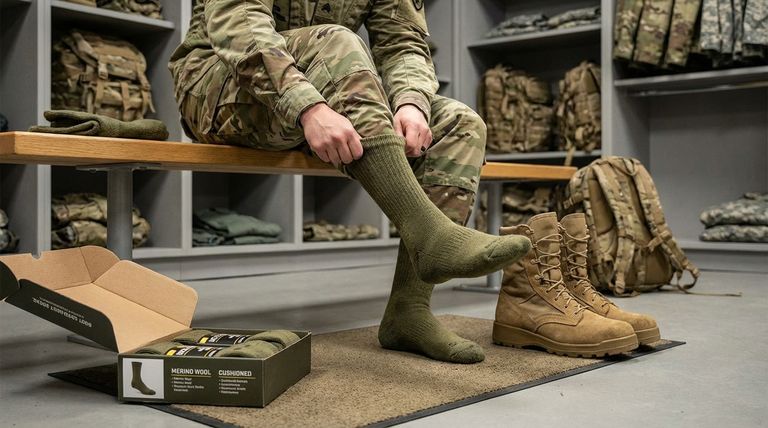
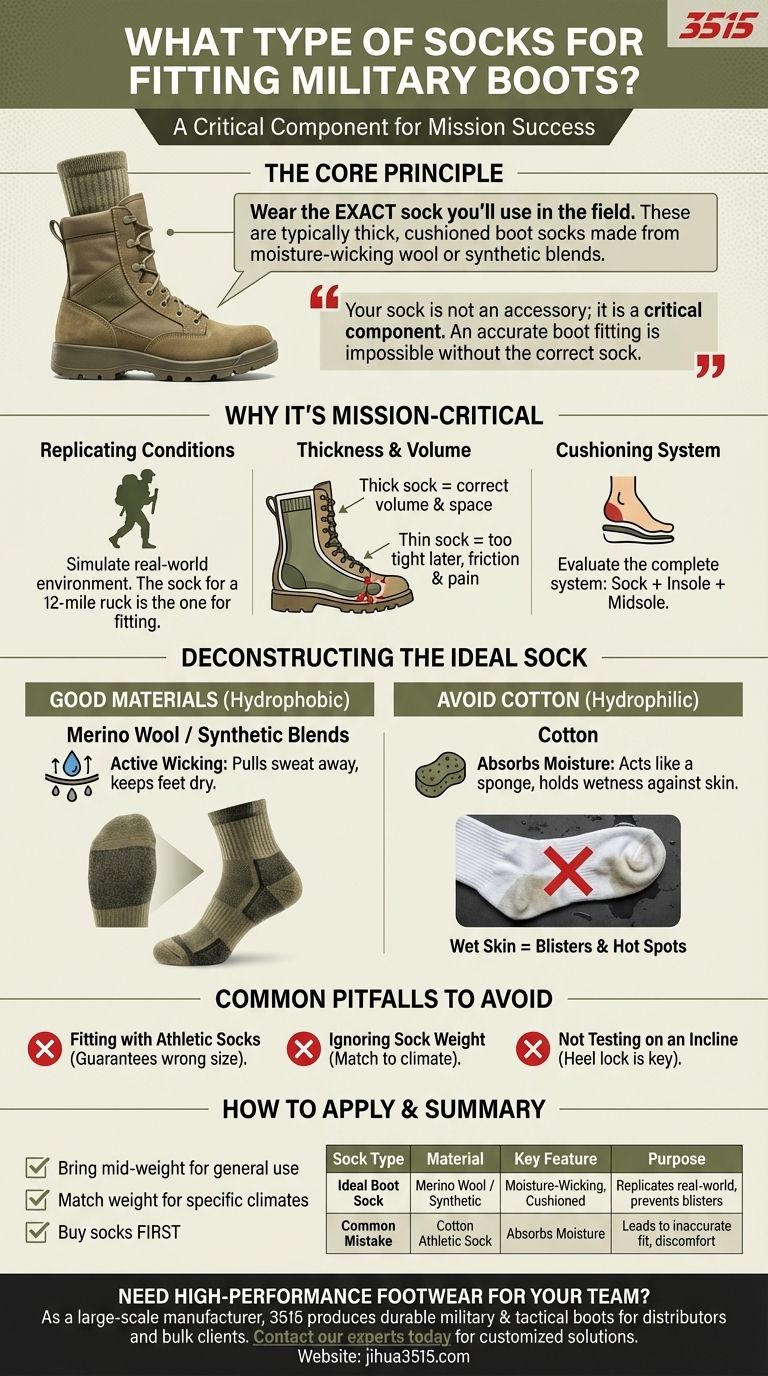
When fitting military boots, you must wear the exact type of socks you will be using during your intended activity. These are typically thick, cushioned boot socks made from a moisture-wicking material like wool or a synthetic blend. Using a standard athletic sock or, worse, a cotton sock, will result in an inaccurate fit and lead to significant problems in the field.
Your sock is not an accessory; it is a critical component of the boot's fitting system. An accurate boot fitting is impossible without the correct sock, as its thickness determines the boot's volume and its material dictates your foot's health under stress.
Why Your Sock Choice is Mission-Critical for Boot Fitting
Choosing a military boot is about creating a system that protects your feet under demanding conditions. The sock is the interface between your foot and the boot, and getting this interface wrong during the initial fitting undermines the entire system.
Replicating Real-World Conditions
The goal of a fitting is to simulate the environment of actual use as closely as possible. The sock you wear for a 12-mile ruck march is the only sock that matters when you're determining the correct size and shape of your boot.
The Impact of Thickness on Volume
A proper boot sock is significantly thicker than a standard athletic sock and takes up considerable space, or volume, inside the boot.
If you fit a boot with a thin sock, you will likely select a size that feels snug. However, when you later wear the required thicker sock, that same boot will become too tight, creating pressure points, restricting circulation, and causing intense friction.
Evaluating the Cushioning System
Modern boot socks provide substantial cushioning at the heel and ball of the foot. This cushioning works in tandem with the boot's insole and midsole. You must evaluate how the complete system feels, not just the boot in isolation.
Deconstructing the Ideal Boot Sock
The material composition of your sock is just as important as its thickness. The primary goal is moisture management.
Material: Wool and Synthetics are Non-Negotiable
The best materials for demanding use are merino wool or high-quality synthetic blends (like polyester or nylon).
These materials are hydrophobic, meaning they actively pull, or "wick," sweat away from your skin and move it to the outside of the sock where it can evaporate. This keeps your feet drier and more comfortable.
The Danger of Cotton
Cotton must be avoided at all costs. While comfortable when dry, cotton is hydrophilic—it acts like a sponge, absorbing and holding moisture directly against your skin.
Wet skin becomes soft and is exceptionally vulnerable to friction. This combination of moisture and rubbing is the primary cause of debilitating blisters and hot spots.
Common Pitfalls to Avoid
Many common mistakes in boot fitting originate from a misunderstanding of the sock's role. Being aware of these will ensure you get a truly accurate fit.
Fitting with Standard Athletic Socks
This is the most frequent error. Showing up to a store in everyday gym socks to try on serious tactical footwear guarantees you will walk out with the wrong size boot.
Ignoring Sock Weight
Even within the "boot sock" category, there are different weights: lightweight, midweight, and heavyweight. For the most precise fit, you should match the sock weight to the climate you anticipate operating in.
Forgetting to Test on an Incline
A well-fitting boot should prevent your foot from sliding forward on a decline. The thickness of your sock plays a major role in locking your heel into the back of the boot. Always test a potential boot by walking on a ramp or stairs during the fitting process.
How to Apply This to Your Fitting
Use these guidelines to ensure you select the correct boot size for your specific mission and prevent future foot injuries.
- If your primary focus is general field use or rucking: Bring a dedicated mid-weight, cushioned wool or synthetic boot sock to your fitting.
- If you are preparing for a specific climate: Match the sock weight to that environment (e.g., heavyweight for cold weather, lightweight for hot/arid) for the most precise fit.
- If you don't own the right socks yet: Your first step is to purchase the socks. Buy the socks first, then use that exact pair to try on boots.
Treating your socks as essential equipment is the first step toward a proper fit and injury-free performance.
Summary Table:
| Sock Type | Material | Key Feature | Purpose |
|---|---|---|---|
| Ideal Boot Sock | Merino Wool / Synthetic Blend | Moisture-Wicking, Cushioned | Replicates real-world conditions, prevents blisters |
| Common Mistake | Cotton Athletic Sock | Absorbs Moisture | Leads to inaccurate fit, blisters, and discomfort |
Need High-Performance Footwear for Your Team?
As a large-scale manufacturer, 3515 produces a comprehensive range of durable military and tactical boots for distributors, brand owners, and bulk clients. Our production capabilities ensure your personnel are equipped with the right gear for any mission.
Contact our experts today to discuss your specific requirements and receive a customized solution.
Visual Guide
Related Products
- Heavy-Duty Waterproof Nubuck Safety Boots Safety Shoes for Bulk Supply
- Factory Direct Wholesale Rain Boots Durable Waterproof & Fully Customizable
- Premium Wholesale Tactical Style Safety Shoes Boots with Quick Lacing
- Durable Waterproof Rain Boots | Custom Manufacturer for Wholesale & Brands
- Premium Wholesale Waterproof Safety Boots High Performance Protection for Industrial Markets
People Also Ask
- What primary protective functions do professional safety boots provide in urban solid waste recovery and waste picking processes? Discover Dual-Layer Protection.
- How do safety boots reduce cutting hazards? Essential Protection for Your Workforce
- Which organizations develop safety standards for work boots? Ensure Compliance & Worker Safety
- What are the common types of safety boots and their primary uses? A Guide to Industrial Footwear
- Why is ankle and arch support important in safety footwear? Prevent Injury & Fatigue



















