
For those with plantar fasciitis, the best shoes are not defined by a specific brand but by a core set of features designed to reduce stress on the inflamed ligament. Look for shoes that provide excellent arch support, deep cushioning in the heel, a firm heel counter to prevent slipping, and a wide, stable base.
The goal is to find a shoe that acts as an external support system for your foot. It must control improper motion and absorb impact, giving the strained plantar fascia the stable, low-stress environment it needs to heal.
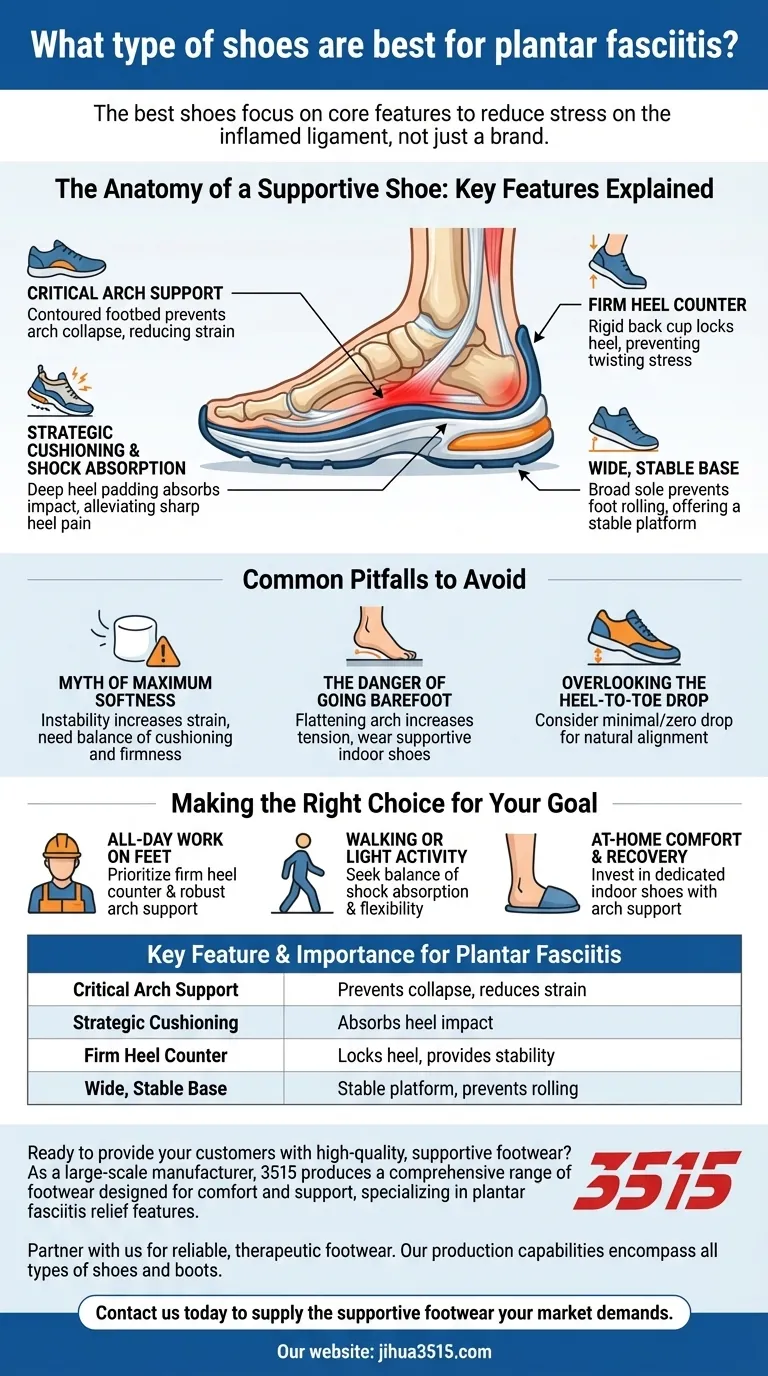
The Anatomy of a Supportive Shoe: Key Features Explained
Understanding why certain features work is the key to selecting a shoe that provides genuine relief. Each component plays a specific role in protecting the plantar fascia ligament.
Critical Arch Support
Your plantar fascia is the ligament that supports the arch of your foot. When you walk, an unsupported arch can collapse slightly, causing micro-tears and inflammation in this ligament.
A shoe with a contoured, ergonomic footbed or pronounced arch support prevents this collapse. It keeps your foot in its optimal alignment, significantly reducing the strain with every step you take.
Strategic Cushioning and Shock Absorption
Plantar fasciitis pain is often sharpest in the heel, where the ligament attaches to the heel bone. A shoe must absorb the impact of your foot striking the ground.
Look for ample cushioning, especially a padded or shock-absorbing heel. The cushioning should be moderate—soft enough to absorb impact but firm enough to provide a stable foundation without causing your foot to wobble.
A Firm Heel Counter for Stability
The heel counter is the rigid structure at the back of the shoe that cups your heel. Its job is to lock your heel in place and prevent excessive side-to-side motion.
A firm heel counter provides crucial stability, ensuring your foot moves correctly and doesn't place twisting stress on the already-sensitive plantar fascia.
A Wide, Stable Base
A shoe with a broad sole provides a more stable platform for your foot. This wider base of support helps prevent the foot from rolling inward or outward, which can aggravate the ligament.
Common Pitfalls to Avoid
Choosing the wrong type of support can be just as detrimental as choosing no support at all. Be aware of these common misconceptions.
The Myth of Maximum Softness
Extremely soft, mushy shoes may feel comfortable at first, but they often lack the structure needed for proper support. If a shoe is too soft, your foot can become unstable, forcing the muscles and ligaments to work harder to maintain balance.
This instability can actually increase the strain on your plantar fascia. The ideal shoe balances cushioning with firmness.
The Danger of Going Barefoot
Walking barefoot on hard, flat surfaces is one of the worst things for plantar fasciitis. It allows your arch to completely flatten, putting maximum tension on the ligament.
Even at home, it is critical to wear supportive indoor shoes or slippers. This continuous support is essential for allowing the fascia to heal.
Overlooking the Heel-to-Toe Drop
The heel-to-toe drop is the height difference between the heel and the forefoot. Some evidence suggests that a minimal or zero-drop shoe can promote better overall foot alignment and a more natural gait, potentially reducing strain. However, this is a feature to consider after confirming the shoe has the core requirements of support and stability.
Making the Right Choice for Your Goal
Your daily activities dictate the specific balance of features you should prioritize.
- If your primary focus is all-day work on your feet: Prioritize a firm heel counter and robust arch support over plush softness to ensure maximum stability.
- If your primary focus is walking or light activity: Seek a balance of excellent shock absorption in the heel and moderate flexibility to allow for natural foot movement.
- If your primary focus is at-home comfort and recovery: Invest in a dedicated indoor shoe or supportive slipper with a built-in arch support to avoid the damage of walking barefoot.
Ultimately, the right shoe stabilizes your foot and absorbs impact, offloading stress from the plantar fascia to give it a chance to recover.
Summary Table:
| Key Feature | Why It's Important for Plantar Fasciitis |
|---|---|
| Critical Arch Support | Prevents arch collapse, reducing strain on the plantar fascia ligament with every step. |
| Strategic Cushioning | Absorbs impact, especially at the heel, to alleviate sharp pain. |
| Firm Heel Counter | Locks the heel in place to provide stability and prevent twisting stress. |
| Wide, Stable Base | Offers a stable platform to prevent foot rolling and aggravation of the ligament. |
Ready to provide your customers with high-quality, supportive footwear?
As a large-scale manufacturer, 3515 produces a comprehensive range of footwear designed for comfort and support. We specialize in manufacturing shoes with the precise features needed for plantar fasciitis relief—excellent arch support, deep cushioning, firm heel counters, and stable bases.
We are the ideal partner for distributors, brand owners, and bulk clients looking to source reliable, therapeutic footwear. Our production capabilities encompass all types of shoes and boots, ensuring we can meet your specific product needs.
Contact us today to discuss how we can help you supply the supportive footwear your market demands.
Visual Guide
Related Products
- Custom OEM Training Shoes Wholesale Manufacturer Durable & Breathable
- Lightweight Breathable Training Shoes for Wholesale & Custom OEM Manufacturing
- Wholesale Durable & Breathable Training Shoes for Custom Brands
- Wholesale Breathable & Cushioned Training Shoes Custom Factory Production
- Wholesale Breathable Training Shoes Custom Athletic Footwear Manufacturer
People Also Ask
- Why is sole stiffness testing using a force gauge necessary? Build Superior Training Shoes with Precision
- Why is specialized athletic footwear necessary for ankle rehab? Unlock Safety and Stability in Recovery
- Why is the use of flat-soled or professional training shoes essential for WBV? Maximize Vibration Energy Transfer
- Why is the integration of advanced cushioning in training shoes necessary for athletes? Boost Recovery and Performance
- Why is it necessary for participants to wear professional training shoes? Ensuring Data Accuracy & Patient Safety




