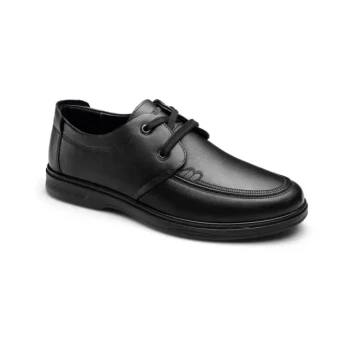
Customized support shoes and flexible connecting straps function as the primary physical interface between the human user and the lower limb exoskeleton. Their central role is to effectively transfer mechanical torque from the robot to the user's limbs while maintaining the structural integrity of the combined human-machine system.
The critical value of these components lies in reliability: they prevent connection slippage and joint misalignment, ensuring that robotic power is converted into safe, effective rehabilitation training rather than wasted movement or potential injury.
The Mechanics of Interaction
Efficient Torque Transfer
The fundamental purpose of an exoskeleton is to apply force to help the user move. The shoes and straps serve as the transmission system for this energy.
They are responsible for effectively transferring the mechanical torque generated by the robot directly to the lower limbs. Without this secure connection, the robot's power would not translate into human movement.
Creating a Consistent System
For an exoskeleton to work, the human and the machine must move as one unit. These components bind the two entities into a single, consistent human-machine system.
By bridging the gap between biological tissue and mechanical structure, they allow the exoskeleton to act as a true extension of the body.
Ensuring System Stability and Safety
Preventing Joint Misalignment
A major risk in exoskeleton use is the mismatch between the robot's joints and the user's joints.
Customized support shoes provide a stable anchor that helps maintain correct joint alignment. This prevents deviations during movement that could lead to ineffective training or physical strain.
Eliminating Connection Slippage
During dynamic movement, loose connections can cause the device to slide against the skin.
Flexible connecting straps are designed to secure the device firmly, preventing connection slippage. This ensures that the assistance provided by the robot remains constant throughout the walking cycle.
Understanding the Interface Challenges
The Necessity of Customization
Generic components often fail to provide the rigorous support needed for torque transfer.
The reference highlights customized support shoes, implying that a tailored fit is required to fully safeguard the user. A poor fit compromises the ability to prevent alignment deviations.
The Role of Flexibility
While the goal is rigid support, the straps must remain flexible.
This flexibility allows for comfortable interaction with soft tissue while still being robust enough to transfer force. The challenge lies in tightening straps enough to prevent slippage without restricting circulation or causing pain.
Optimizing the Human-Machine Link
To ensure the exoskeleton performs its intended rehabilitation function, you must prioritize the quality of these interface points.
- If your primary focus is Force Transmission: Ensure the flexible connecting straps are tightened securely to prevent power loss through slippage.
- If your primary focus is User Safety: Prioritize the fit of the customized support shoes to strictly maintain joint alignment and prevent injury.
The success of any lower limb exoskeleton relies not just on the motor, but on how securely that motor is coupled to the human body.
Summary Table:
| Component | Primary Function | Impact on Interaction |
|---|---|---|
| Customized Support Shoes | Stable anchoring and joint alignment | Prevents joint mismatch and ensures structural integrity. |
| Flexible Connecting Straps | Mechanical torque transfer | Prevents slippage and secures the human-machine link. |
| Human-Machine Interface | Physical energy transmission | Converts robotic power into safe, effective movement. |
Elevate Your Product Performance with Professional Manufacturing
As a leading large-scale manufacturer, 3515 specializes in high-precision footwear and wearable components designed for durability and performance. Whether you are a distributor or a brand owner, we offer comprehensive production capabilities across our flagship Safety Shoes series, tactical boots, and specialized footwear to meet rigorous bulk requirements.
Our expertise ensures that every component—from customized support systems to flexible straps—meets the highest standards of safety and mechanical efficiency. Partner with us to bring superior reliability to your product line.
Ready to scale your production? Contact 3515 today to discuss your project!
References
- Denis Mosconi, Adriano A. G. Siqueira. Exploring Human–Exoskeleton Interaction Dynamics: An In-Depth Analysis of Knee Flexion–Extension Performance across Varied Robot Assistance–Resistance Configurations. DOI: 10.3390/s24082645
This article is also based on technical information from 3515 Knowledge Base .
Related Products
- Wholesale Durable & Breathable Training Shoes for Custom Brands
- Wholesale Modern Comfort Shoes with Dial Closure for Private Label & Bulk Orders
- Custom OEM Training Shoes Wholesale Manufacturer Durable & Breathable
- Wholesale Durable Camouflage Canvas Shoes with High-Traction Cleated Rubber Sole
- Wholesale Breathable & Cushioned Training Shoes Custom Factory Production
People Also Ask
- Why is structural stability in footwear required during dual-task walking tests? Ensure Sensor Precision & Data Integrity
- Why is the integration of advanced cushioning in training shoes necessary for athletes? Boost Recovery and Performance
- Why is the use of flat-soled or professional training shoes essential for WBV? Maximize Vibration Energy Transfer
- Why is it necessary for participants to wear professional training shoes? Ensuring Data Accuracy & Patient Safety
- How does the Ground Reaction Force (GRF) constancy hypothesis influence professional training shoes and sneakers?