
From the references, I've got a couple of starting points: neoprene boots and mid-height boots. But the real work is figuring out why these work. That's the key to making this article useful.
I'm thinking I'll start with a hook, right off the bat, to directly answer the question. Then, I'll put a central takeaway in a box - a kind of "here's the gist" for quick reference.
Then I'll dive into the meat of the article. I'll explain why standard boots often fail: the rigid materials and the one-size-fits-most design. Then, I'll detail the two core solutions: stretchable materials like neoprene, which is like a flexible hose compared to a rigid pipe, and the re-engineered cut of mid-height boots, which strategically avoids the widest part of the calf.
It's important to be honest, so I'll also address the trade-offs: neoprene might not offer the same support as leather, and mid-height boots won't give the same coverage.
Finally, I'll summarize it into actionable advice. The focus is always on making the right choice based on the user's goals. I want them to feel empowered, not just informed.
Okay, I think I've got it. I'm ready to write a clear, concise, and helpful guide to help them navigate boot options for wide calves. For individuals with wider calves, the most effective solutions are boots made from flexible, forgiving materials like neoprene or styles with a lower cut, such as mid-height boots. These options address the core challenge of fit by either stretching to accommodate your specific shape or strategically avoiding the widest part of the leg altogether.
The key to finding the right boot is to shift focus from searching for a specific "wide calf" label to understanding the principles of material and design. The right material provides flexibility, while the right cut eliminates the fit problem by design.
Why Standard Boots Often Fail
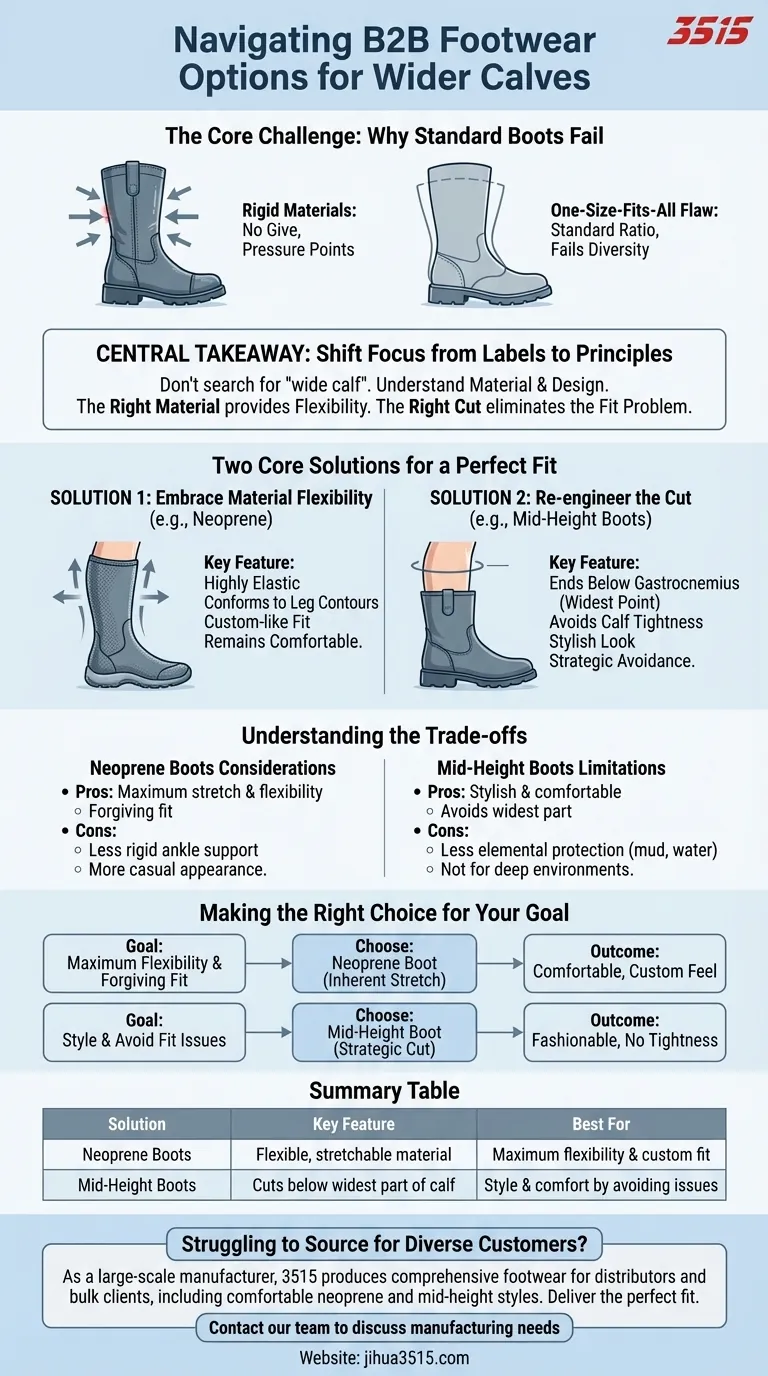
Finding a comfortable tall boot can be a significant challenge. The issue typically stems from two fundamental aspects of traditional boot design.
The Problem of Rigid Materials
Most standard tall boots are crafted from materials like traditional leather or stiff rubber. These materials have a fixed circumference with little to no give.
This rigidity creates a pressure point on the calf, leading to pinching, discomfort, and difficulty in putting the boot on or taking it off.
The "One-Size-Fits-All" Design Flaw
Boot manufacturers often design for an average calf-to-foot-size ratio. This standardized model fails to account for the natural diversity in body shapes.
As a result, many people find that even if a boot fits their foot perfectly, it is far too tight on the calf.
Two Core Solutions for a Perfect Fit
Instead of fighting against flawed designs, you can solve the problem by choosing boots that are intelligently constructed for a more adaptable fit.
Solution 1: Embrace Material Flexibility
The most direct solution is to choose a boot made from a material designed to stretch. Neoprene is a prime example.
As a highly elastic synthetic rubber, neoprene conforms to the unique contours of your leg. This creates a custom-like fit that remains comfortable throughout the day without sacrificing support.
Solution 2: Re-engineer the Cut
An equally effective strategy is to choose a boot that bypasses the problem area. Mid-height boots are an excellent choice for this reason.
These boots are designed to end below the gastrocnemius muscle, which is the widest point of the calf. This lower cut provides a stylish look while completely avoiding the common issue of calf tightness.
Understanding the Trade-offs
Every design choice comes with considerations. Understanding them ensures you select the option that best aligns with your needs.
Neoprene Boot Considerations
The primary benefit of neoprene is its stretch, but this can mean it offers less rigid ankle support compared to a traditional leather boot. Its appearance is also typically more functional and casual.
Mid-Height Boot Limitations
While stylish and comfortable, mid-height boots offer less protection from the elements, like deep mud or water, compared to a full-height boot. Their suitability depends on the environment and intended use.
Making the Right Choice for Your Goal
Your ideal boot depends on what you value most. Use your primary goal to guide your decision.
- If your primary focus is maximum flexibility and a forgiving fit: A neoprene boot is the ideal choice, as its inherent stretch will provide a comfortable, custom-like feel.
- If your primary focus is style and avoiding fit issues altogether: A mid-height boot offers a fashionable and comfortable solution by strategically avoiding the widest part of the calf.
By understanding these core principles of material and design, you can confidently select a boot that delivers both comfort and style.
Summary Table:
| Solution | Key Feature | Best For |
|---|---|---|
| Neoprene Boots | Flexible, stretchable material | Maximum flexibility and a forgiving, custom-like fit |
| Mid-Height Boots | Cuts below the widest part of the calf | Style and comfort by strategically avoiding fit issues |
Struggling to source boots that fit a diverse customer base?
As a large-scale manufacturer, 3515 specializes in producing a comprehensive range of footwear for distributors, brand owners, and bulk clients. Our production capabilities encompass all types of shoes and boots, including styles designed for superior comfort and fit, like flexible neoprene and mid-height cuts.
We can help you deliver the perfect fit to your market. Contact our team today to discuss your manufacturing needs.
Visual Guide
Related Products
- Durable Leather High-Ankle Tactical Boots for Wholesale & Custom Manufacturing
- Durable High-Ankle Tactical Boots Wholesale Manufacturer for Custom & Bulk Orders
- Durable High-Ankle Tactical Boots for Wholesale & Custom Manufacturing
- Premium Grain Leather Safety Boots for Bulk Supply
- Durable Goodyear Welt Leather Work Boots for Wholesale & Private Label
People Also Ask
- How do military uniforms and tactical boots impact the prediction of thermal risk? Essential Safety Insights
- How does the material of tactical boots affect their performance? Choose the Right Material for Your Mission
- Why is sequential analysis utilized to evaluate tactical boots? Master Dynamic Boot Development and Ergonomic Performance
- How do tactical boots differ from regular boots? Performance, Durability & Design Explained
- What are the primary differences between tactical boots and combat boots? Choose the Right Boot for Your Mission


















