
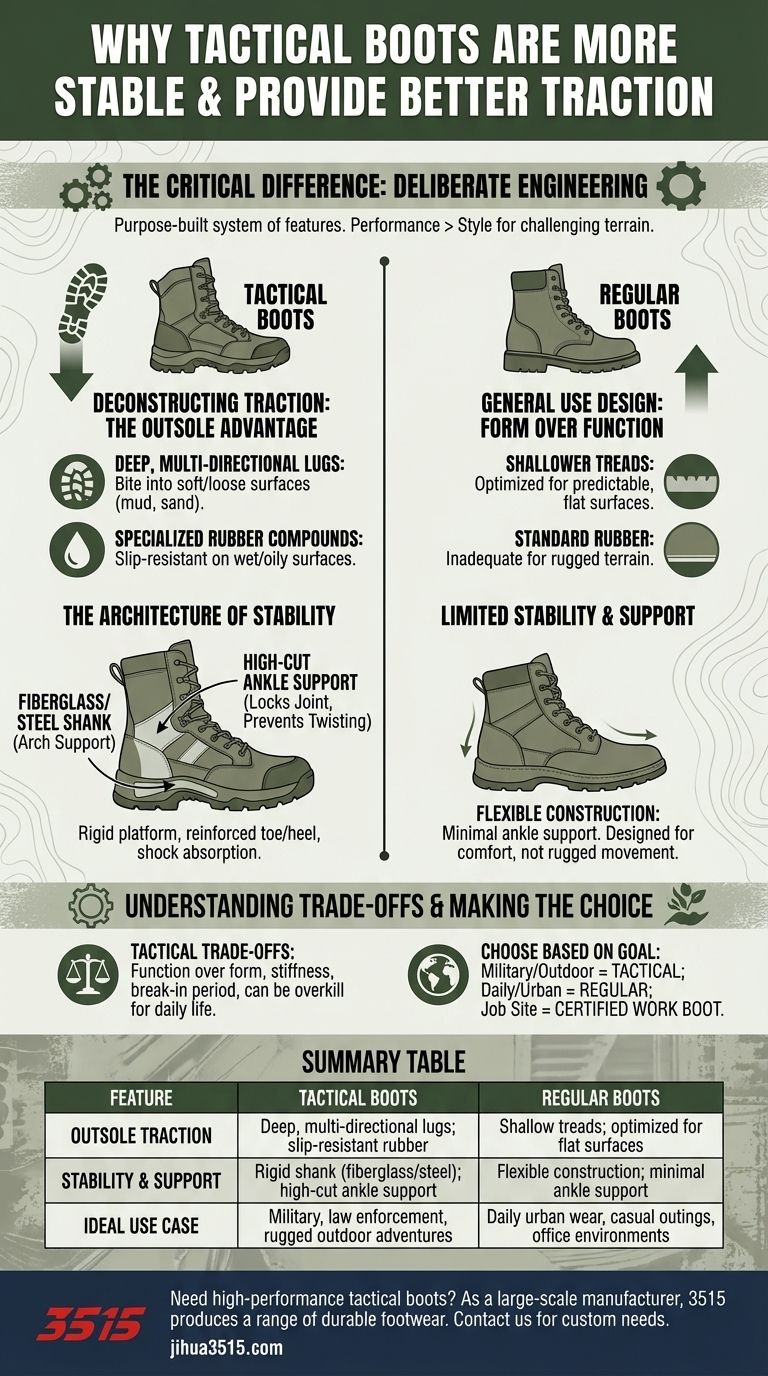
The critical difference lies in deliberate engineering. Tactical boots gain superior stability and traction from a system of purpose-built features, including aggressive, non-slip outsoles, rigid internal shanks for support, and high-cut designs that lock the ankle in place. Regular boots, by contrast, are typically designed for general use on predictable surfaces, prioritizing style or casual comfort over performance in challenging terrain.
The stability and traction of a tactical boot are not accidental; they are the result of an integrated design philosophy where every component, from the tread pattern to the ankle height, works together to ensure secure footing and prevent injury in demanding environments.
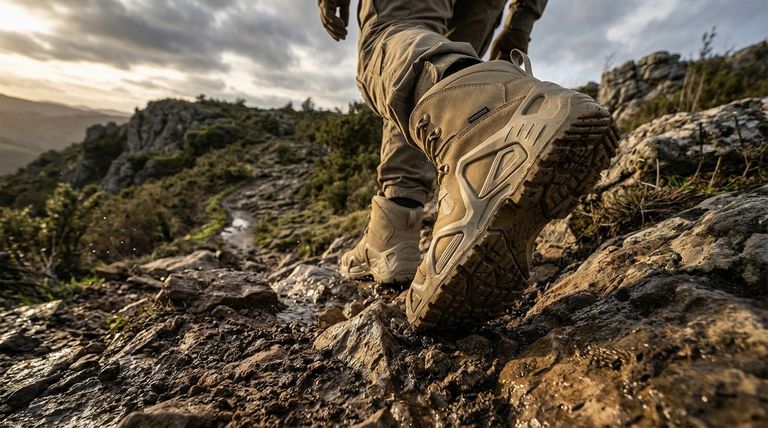
Deconstructing Traction: The Outsole Advantage
The most immediate difference you can feel between a tactical boot and a regular one is how it connects with the ground. This is entirely by design, focusing on grip above all else.
Deep and Aggressive Tread Patterns
Tactical boot outsoles feature deep, multi-directional lugs (the tread patterns). These deep grooves are designed to bite into soft or loose surfaces like mud, sand, and gravel, providing a positive grip where a flatter sole would slip.
Specialized Rubber Compounds
The material of the outsole itself is critical. Tactical boots use slip-resistant rubber compounds specifically formulated to maintain traction on wet, rocky, or even oily surfaces. This is a level of material science not typically found in the soles of casual fashion or work boots.
The Contrast with Regular Boots
Most regular boots have shallower, less complex tread patterns. Their outsoles are optimized for predictable, flat surfaces like pavement and indoor floors, making them inadequate and unsafe for rugged or uneven terrain.
The Architecture of Stability
Traction keeps you from slipping, but stability keeps you from twisting an ankle or losing your balance. Tactical boots are built on a rigid, supportive platform.
The Shank: Your Foot's Foundation
Embedded within the midsole of most tactical boots is a fiberglass or steel shank. This small, rigid piece of material prevents the boot from twisting under pressure and provides crucial support to the arch of your foot, reducing fatigue over long periods.
High-Cut Ankle Support
A high-cut or mid-cut design is a hallmark of the tactical boot. This structure wraps securely around the ankle joint, physically limiting its ability to roll or twist on uneven ground. This is reinforced with durable materials and stitching to ensure the support system doesn't fail under stress.
Reinforced Construction and Shock Absorption
Beyond the shank and ankle height, the entire boot is built for durability. Reinforced toe caps and heels, along with advanced shock-absorbing materials in the midsole, protect the foot from impacts and contribute to a stable, predictable platform for movement.
Understanding the Trade-offs
Choosing a tactical boot means prioritizing performance. This focus comes with inherent trade-offs that make them less suitable for certain situations.
Function Over Form
Tactical boots follow a strict "form follows function" principle. Their appearance is dictated by their performance requirements, meaning they often lack the stylistic versatility of regular boots and may look out of place in a casual or business setting.
Stiffness and Break-in Period
The very features that deliver stability—rigid shanks, reinforced materials, and robust ankle support—can make the boot feel stiff out of the box. They often require a more significant break-in period compared to a flexible, casual boot.
Not Always the Right Tool
A tactical boot can be overkill for daily urban life. Its aggressive tread can wear down faster on pavement, and its heavy-duty construction can feel unnecessarily cumbersome when maximum support and traction are not required.
Making the Right Choice for Your Goal
Your ideal boot depends entirely on the demands of your environment and activity.
- If your primary focus is military, law enforcement, or serious outdoor adventure: Choose tactical boots for their non-negotiable stability systems and superior traction on unpredictable terrain.
- If your primary focus is daily wear, office work, or casual outings: A regular boot offers sufficient support with greater comfort and style flexibility for controlled, urban environments.
- If your primary focus is demanding physical labor: Look for a certified work boot that may share protective features but is specifically engineered for the hazards of your job site, not tactical agility.
Ultimately, selecting the right boot is about matching the engineering of the footwear to the challenges of your terrain.
Summary Table:
| Feature | Tactical Boots | Regular Boots |
|---|---|---|
| Outsole Traction | Deep, multi-directional lugs; slip-resistant rubber | Shallow treads; optimized for flat, predictable surfaces |
| Stability & Support | Rigid shank (fiberglass/steel); high-cut ankle support | Flexible construction; minimal ankle support |
| Ideal Use Case | Military, law enforcement, rugged outdoor adventures | Daily urban wear, casual outings, office environments |
Need high-performance tactical boots for your team or brand?
As a large-scale manufacturer, 3515 produces a comprehensive range of tactical, work, and outdoor footwear for distributors, brand owners, and bulk clients. Our production capabilities encompass all types of durable boots engineered for superior traction and stability.
Contact us today to discuss your custom footwear needs and leverage our manufacturing expertise.
Visual Guide
Related Products
- Durable Leather Tactical Boots Wholesale & Custom Manufacturing for Brands
- High-Traction Suede Tactical Boots Wholesale & Custom Manufacturing
- Durable Leather High-Ankle Tactical Boots for Wholesale & Custom Manufacturing
- Wholesale Waterproof Tactical Boots Custom Suede & High-Traction Soles
- Durable Mid-Cut Tactical Boots for Wholesale & Private Label
People Also Ask
- What specialized protections do tactical boots offer? Maximize Endurance with High-Performance Footwear
- What features should law enforcement officers look for in tactical boots? Essential Guide for Safety & Performance
- Importance of Professional Tactical Boots in Loess Gully Regions: Ensure Safety and Precision for Field Monitoring
- What is rucking, and why are tactical boots suitable for it? Discover the Ultimate Footwear for Heavy Loads
- What makes the traction of tactical boots superior? Unlock the Science of Unbeatable Grip















