Engineer boots are considered suitable for motorcycle riding due to a specific combination of features from their industrial heritage. Their tall, laceless shaft, rugged leather construction, and simple profile provide foundational protection and functionality that is far superior to any casual shoe.
While engineer boots offer critical baseline protection that makes them a viable option, they represent a trade-off. Modern, purpose-built motorcycle boots incorporate advanced safety features like certified armor and torsional support that most traditional engineer boots lack.

Why Engineer Boots Became a Riding Staple
The classic engineer boot was not designed for motorcycling, but its core attributes aligned perfectly with the needs of early riders, establishing a legacy that continues today.
A Design Born from Utility
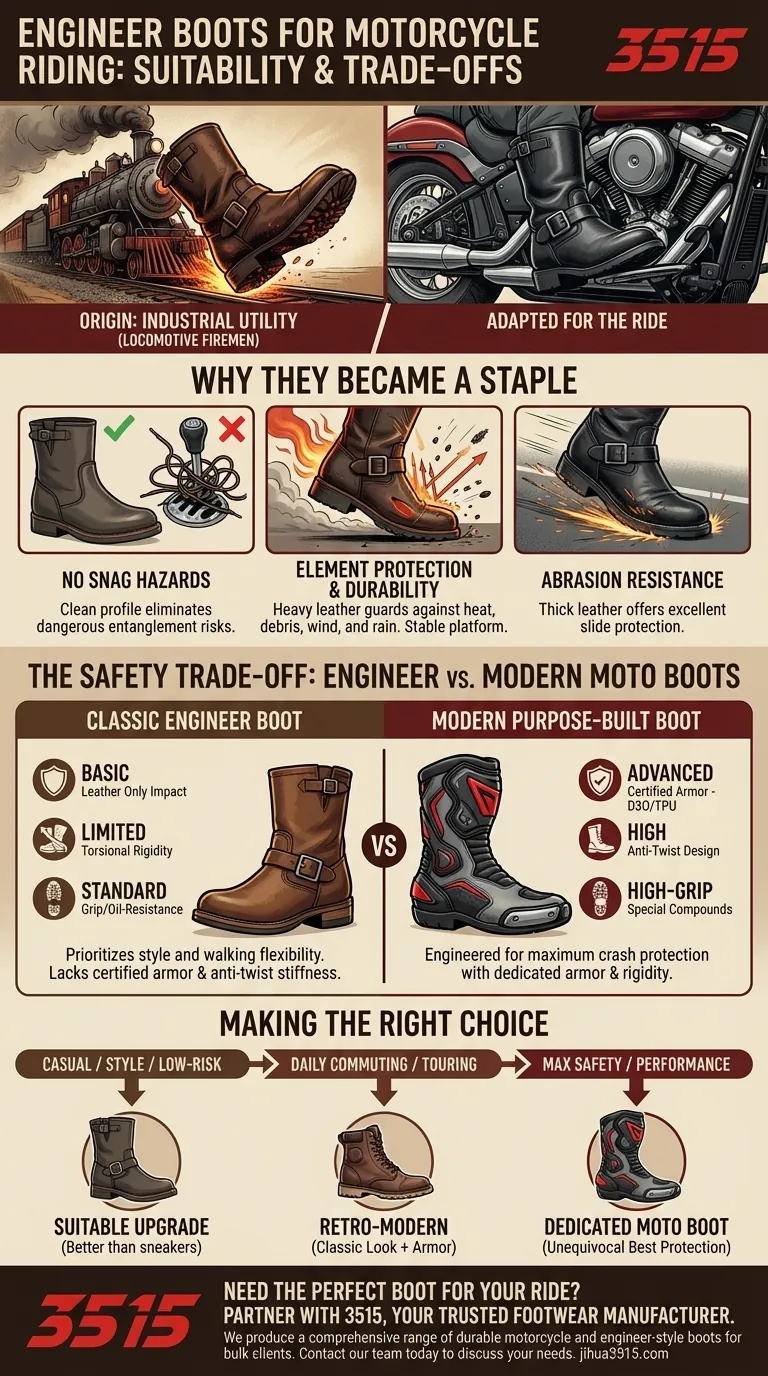
Engineer boots were originally made for steam locomotive firemen. They needed a tall, sturdy boot that could be kicked off quickly if hot embers fell inside, hence the laceless, pull-on design with a simple buckle for minor adjustment.
Protection from the Elements
The heavy leather and high shaft offer excellent protection from engine and exhaust pipe heat. They also provide a barrier against road debris, wind, and rain, keeping the rider more comfortable and focused.
No Snag Hazards
The most cited advantage is the complete absence of laces. Laces can easily become entangled in a bike's foot controls, such as the gear shifter or rear brake pedal, creating an extremely dangerous situation. The clean profile of an engineer boot eliminates this risk entirely.
Stability and Durability
Their sturdy construction and robust soles provide a stable platform for supporting the weight of a motorcycle at a stop. This solid footing is crucial for rider confidence and control, especially on uneven surfaces.
Core Principles of Motorcycle Footwear Safety
To understand where engineer boots fit, you must first understand what defines truly protective riding footwear. The key principles go beyond simple coverage.
Abrasion Resistance
In a slide, your footwear is the only thing between your skin and the pavement. Thick, high-quality leather, as found in good engineer boots, offers excellent abrasion resistance to prevent severe road rash.
Impact Protection
A proper riding boot must protect against crushing and impact forces. Modern boots achieve this with reinforced toe boxes, heel counters, and, most importantly, hardened armor (often using materials like D3O or TPU) placed over the delicate ankle bones.
Torsional Rigidity
This is a critical, often-overlooked feature. Torsional rigidity prevents the boot from twisting unnaturally. In a crash, it's this feature that stops your foot and ankle from being bent or broken in ways they were not meant to move.
Understanding the Trade-offs
Choosing an engineer boot over a dedicated riding boot is a conscious decision that involves accepting certain compromises in safety for the sake of style or tradition.
The Lack of Specialized Armor
This is the single biggest compromise. While the thick leather of an engineer boot offers some impact absorption, it cannot compare to the certified, energy-absorbing armor strategically placed in modern motorcycle boots to protect the ankles, shins, and heels.
Limited Torsional Support
Most traditional engineer boots are built like work boots, prioritizing walking flexibility over the anti-twist stiffness needed in a crash. A dedicated riding boot is intentionally stiff to prevent the hyper-flexion and rotation that cause severe ligament and bone damage.
Sole and Grip
The soles on many classic engineer boots are made of materials like nitrile cork or hard leather. While durable, they may not provide the same level of oil-resistance and grip as the specially formulated rubber compounds used on modern riding boots, which are designed to grip oily pavement and metal footpegs securely.
Making the Right Choice for Your Ride
Your ideal footwear depends on balancing classic style with the level of protection your specific riding habits demand.
- If your primary focus is classic style and casual, low-risk riding: A high-quality, well-constructed engineer boot is a suitable choice that offers a significant safety upgrade over standard shoes or sneakers.
- If your primary focus is daily commuting or frequent touring: Consider a modern, retro-styled riding boot that mimics the engineer boot's look but integrates certified ankle armor, reinforced construction, and a high-grip sole.
- If your primary focus is maximum safety and performance: A dedicated, modern motorcycle boot with features like torsional rigidity and comprehensive impact armor is the unequivocal best option.
Ultimately, the best boot provides the protection you need for the way you ride, without compromise.
Summary Table:
| Feature | Engineer Boots | Modern Motorcycle Boots |
|---|---|---|
| Abrasion Resistance | Excellent (Heavy Leather) | Excellent (Reinforced Leather/Textile) |
| Impact Protection | Basic (Leather Only) | Advanced (Certified Armor) |
| Torsional Rigidity | Limited | High (Anti-Twist Design) |
| Snag Hazards | None (Laceless) | None (Secure Closures) |
| Best For | Casual/Low-Risk Riding, Style | Daily Commuting, Touring, Max Safety |
Need the Perfect Boot for Your Ride? Partner with 3515, Your Trusted Footwear Manufacturer.
As a large-scale manufacturer, 3515 produces a comprehensive range of footwear for distributors, brand owners, and bulk clients. Our production capabilities encompass all types of shoes and boots, including durable motorcycle and engineer-style boots built with quality materials and construction.
We can help you develop the right product for your market, balancing style, safety, and performance. Contact our team today to discuss your manufacturing needs and bring high-quality footwear to your customers.
Visual Guide
Related Products
- Durable Leather Work Boots Wholesale Manufacturer & Custom Factory
- Durable Leather Work Boots for Wholesale & Custom OEM Manufacturing
- Durable Leather Work Boots for Wholesale & Custom Manufacturing
- Premium Waterproof High-Cut Industrial Safety Boots for Wholesale and Bulk Orders
- Wholesale Customizable Safety Boots Durable & Protective Footwear Manufacturing
People Also Ask
- What are the common workplace hazards that can be mitigated with the right work boots? Protect Your Workforce
- What certification standard do all work boots meet? Your Guide to ASTM F2413 & Beyond
- Which brands are known for high-quality work boots? A Guide to Durable, Safe Footwear
- What options are available for restoring worn-out work boots? Expert Strategies for Longevity
- What are the differences between Lace Up, Zip Sided, and Pull On work boots? Find Your Perfect Fit for Safety & Convenience