
What makes Chelsea boots truly unique is their iconic combination of a laceless, pull-on design and a sleek, ankle-high silhouette. The defining feature is the elastic side panel, or "gusset," which allows the boot to be slipped on and off with ease while maintaining a snug, clean fit that other boot styles cannot replicate.
The Chelsea boot's genius lies not in a single feature, but in the perfect balance of form and function. Its signature elastic side panel delivers unparalleled convenience, while its minimalist silhouette provides a level of style versatility that few other footwear options can match.
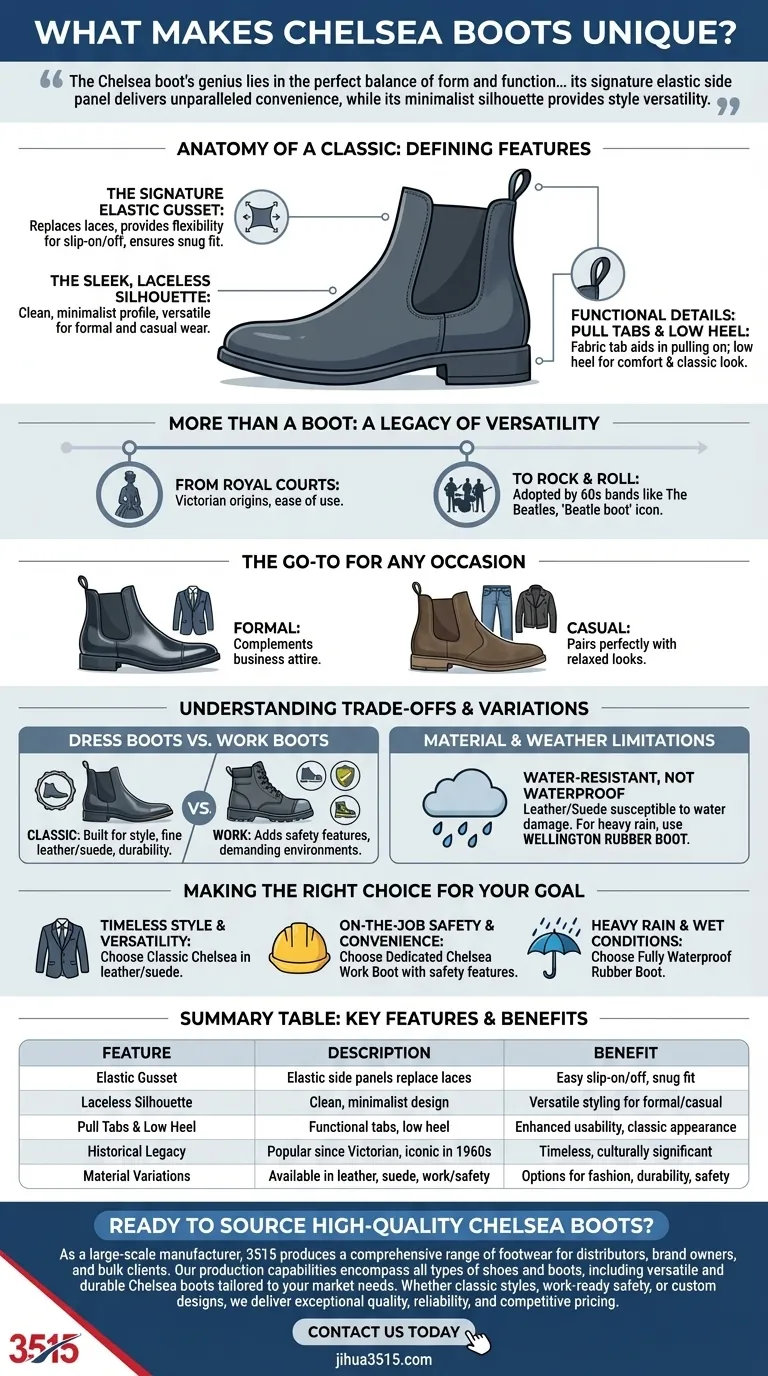
The Anatomy of a Classic: Defining Features
To understand the Chelsea boot's enduring appeal, we must first look at its core components. These elements work in concert to create its distinctive character.
The Signature Elastic Gusset
The most crucial identifying feature of a Chelsea boot is the elastic panel on each side of the ankle.
This design element replaces the need for laces or buckles. It provides the flexibility needed to pull the boot on and then contracts to ensure a close, comfortable fit.
The Sleek, Laceless Silhouette
The absence of laces gives the Chelsea boot an exceptionally clean and minimalist profile.
This uninterrupted line makes the boot highly versatile, allowing it to look just as appropriate with a tailored suit as it does with a pair of casual jeans.
Functional Details: Pull Tabs and Low Heels
Most Chelsea boots include a fabric pull tab at the back (and sometimes the front) of the boot's opening. This simple loop is a functional detail that aids in pulling the boot on.
They also typically feature a low heel, which contributes to their comfort and classic, understated appearance.
More Than a Boot: A Legacy of Versatility
The Chelsea boot’s design has allowed it to transcend trends and subcultures for over a century, cementing its place as a footwear staple.
From Royal Courts to Rock and Roll
The design has origins in the Victorian era, where its ease of use made it popular for walking and horse riding.
Its modern fame, however, was cemented in the 1960s when it was adopted by British rock bands like The Beatles, earning it the nickname "Beatle boot" and securing its status as a cultural icon.
The Go-To for Any Occasion
This boot effortlessly bridges the gap between formal and casual wear.
A polished leather pair complements formal trousers and business attire, while a suede version pairs perfectly with denim and leather jackets for a relaxed yet sharp look.
Understanding the Trade-offs and Variations
While the classic design is well-known, modern adaptations have created specialized versions. It's important to understand the distinctions and limitations of each.
Dress Boots vs. Work Boots
The classic Chelsea boot is built for style, typically using fine leather or suede and often featuring a Goodyear welt for durability.
A Chelsea work boot, however, retains the convenient pull-on shape but adds critical safety features. These can include steel or composite toe caps, puncture-resistant midsoles, and certified slip-resistant soles designed for demanding environments.
Material and Weather Limitations
A standard leather or suede Chelsea boot is generally water-resistant, not waterproof. Suede is particularly susceptible to water damage and staining.
For genuinely wet conditions, they are not a substitute for a fully waterproof rubber boot, often called a Wellington. The focus of a classic Chelsea is style and convenience, not all-weather protection.
Making the Right Choice for Your Goal
Selecting the correct boot depends entirely on your intended use.
- If your primary focus is timeless style and versatility: A classic Chelsea boot in leather or suede is the ideal choice for bridging casual and formal wardrobes.
- If your primary focus is on-the-job safety and convenience: Seek out a dedicated Chelsea work boot that specifies features like a safety toe and slip-resistant outsole.
- If your primary focus is protection from heavy rain and wet conditions: A fully waterproof rubber boot is the only appropriate and effective solution.
Understanding these fundamental differences empowers you to select the boot that truly serves your purpose.
Summary Table:
| Feature | Description | Benefit |
|---|---|---|
| Elastic Gusset | Elastic side panels replace laces | Easy slip-on/off with a snug, comfortable fit |
| Laceless Silhouette | Clean, minimalist design | Versatile styling for both formal and casual outfits |
| Pull Tabs & Low Heel | Functional tabs for easy wear; low heel for comfort | Enhanced usability and classic appearance |
| Historical Legacy | Popular since Victorian era; iconic in 1960s rock | Timeless, culturally significant style |
| Material Variations | Available in leather, suede, or work/safety versions | Options for fashion, durability, or workplace safety |
Ready to Source High-Quality Chelsea Boots?
As a large-scale manufacturer, 3515 produces a comprehensive range of footwear for distributors, brand owners, and bulk clients. Our production capabilities encompass all types of shoes and boots, including versatile and durable Chelsea boots tailored to your market needs.
Whether you're looking for classic styles, work-ready safety versions, or custom designs, we deliver exceptional quality, reliability, and competitive pricing.
Contact us today to discuss your footwear requirements and discover how we can help you build a successful product line!
Visual Guide
Related Products
- Wholesale Suede Chelsea Safety Boots for Custom & Private Label Manufacturing
- Durable Leather High-Ankle Tactical Boots for Wholesale & Custom Manufacturing
- Durable High-Ankle Tactical Boots Wholesale Manufacturer for Custom & Bulk Orders
- Wholesale Tactical Boots High-Traction & Reflective for Bulk & Brand Orders
- Wholesale Waterproof Tactical Boots Custom Suede & High-Traction Soles
People Also Ask
- Why are chelsea boots considered a versatile style? The Ultimate Wardrobe Foundation
- What makes Chelsea boots a popular choice and how can they be styled? A Guide to Versatile Footwear
- Why are Chelsea boots easy to wear? Slip-On Style & Timeless Versatility
- Why are Chelsea boots so popular? Discover the Secret to Effortless, Timeless Style
- What are the characteristics of Chelsea boots? The Ultimate Guide to Style & Function



















