
At its core, a carbon composite toe is a specialized, lighter-weight version of a standard composite safety toe. It is a proprietary technology engineered to provide the same certified impact and compression protection as steel or other composite toes, but with a significant reduction in weight.
The key innovation of a carbon composite toe is not about creating a stronger safety cap, but about achieving the same required safety standards with less material and weight, directly translating to reduced foot fatigue over a long workday.
The Context: Understanding Safety Toe Materials
To appreciate what makes a carbon composite toe unique, it's essential to understand the materials it evolved from. Each type of safety toe serves the same primary function but offers a different balance of properties.
The Original Standard: Steel Toes
Steel has been the traditional material for safety toes for decades. It offers maximum protection against impact and compression.
Its primary drawbacks are its significant weight, which can cause fatigue, and its conductivity. Steel readily transfers both heat and cold, making it less comfortable in extreme temperature environments.
The Lighter Alternative: Aluminum Toes
Aluminum toes were introduced as a lighter-weight alternative to steel. They provide the same level of safety protection while reducing some of the bulk and weight.
However, like steel, aluminum is a metal that still conducts temperature and electricity, and it can sometimes be bulkier than steel to achieve the same strength rating.
The Modern Solution: Standard Composite Toes
Composite toes are made from a blend of non-metallic materials, such as Kevlar, carbon fiber, plastic, or fiberglass. Their main advantage is being completely metal-free.
This makes them ideal for environments with electrical hazards or extreme temperatures, as they do not conduct electricity, heat, or cold. They are also significantly lighter than steel.
Where Carbon Composite Fits In
A carbon composite toe is not a fundamentally new category but rather a high-performance evolution of the standard composite toe.
An Enhancement, Not a Revolution
Think of it as a specialized formulation. By using carbon fiber—a material known for its exceptional strength-to-weight ratio—manufacturers can create a safety cap that meets or exceeds safety standards with less mass.
The Primary Benefit: Reduced Weight
The single most unique feature is its remarkably low weight. While a standard composite toe is already lighter than steel, a carbon composite toe pushes this advantage even further.
This seemingly small difference becomes significant over a workday consisting of thousands of steps, leading to noticeably less strain and fatigue on the wearer.
Proprietary Technology
As noted, this specific type of toe is proprietary to a particular brand (Cat Footwear). This means they have developed a unique blend and manufacturing process to achieve this specific balance of weight and strength.
Understanding the Trade-offs
Choosing the right boot means understanding that every material comes with compromises. Objectivity is key.
Safety Standards are the Baseline
It is critical to understand that all safety toes—whether steel, aluminum, or any composite—must meet the same ASTM International standards for impact and compression resistance to be sold as protective footwear.
A carbon composite toe is not rated as "safer" than a steel toe; it simply passes the same mandatory tests while offering different material properties like lower weight.
Bulk vs. Strength
Generally, non-metallic materials need to be slightly thicker or bulkier than steel to provide the same level of impact resistance.
The engineering behind the carbon composite toe aims to minimize this trade-off, creating a sleeker, more anatomical fit without sacrificing the lightweight and non-metallic benefits.
The Cost Factor
Advanced materials and proprietary manufacturing processes typically come at a higher price point. You can expect footwear with carbon composite toes to be positioned as a premium option compared to those with standard steel toes.
Making the Right Choice for Your Needs
Your specific work environment and daily tasks should dictate your choice.
- If your primary focus is working around electrical hazards or in extreme temperatures: Any non-metallic composite toe, including carbon composite, is the superior choice.
- If your primary focus is minimizing daily fatigue and maximizing comfort: A carbon composite toe offers the most significant weight advantage, making it ideal for long days on your feet.
- If your primary focus is maximum durability and cost-effectiveness: The traditional steel toe remains a proven, reliable, and budget-friendly option.
Ultimately, choosing the right safety toe is about selecting the right tool to keep you safe and comfortable for the job at hand.
Summary Table:
| Feature | Carbon Composite Toe | Steel Toe | Standard Composite Toe |
|---|---|---|---|
| Weight | Lightest | Heaviest | Lighter than steel |
| Material | Non-metallic (Carbon Fiber) | Metal | Non-metallic (e.g., Kevlar, Fiberglass) |
| Safety Rating | Meets ASTM Standards | Meets ASTM Standards | Meets ASTM Standards |
| Key Benefit | Superior weight reduction, reduces fatigue | Maximum durability, cost-effective | Non-conductive, good for electrical hazards |
Ready to equip your workforce with the lightest, safest footwear?
As a large-scale manufacturer, 3515 produces a comprehensive range of safety footwear for distributors, brand owners, and bulk clients. Our production capabilities encompass all types of safety shoes and boots, including models with advanced carbon composite toes. We can help you provide superior comfort and protection to your customers.
Contact our team today to discuss your bulk footwear needs and discover how we can bring value to your business.
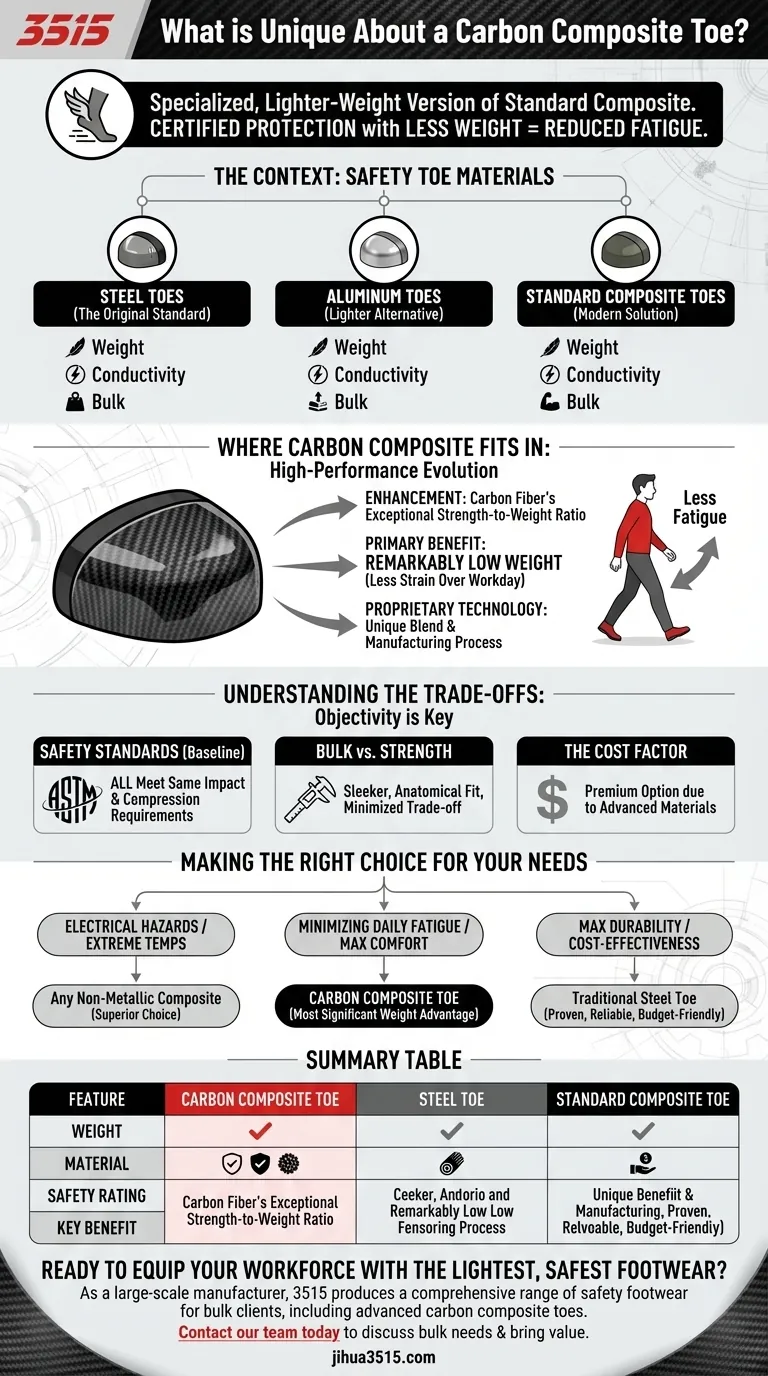
Visual Guide
Related Products
- Wholesale Durable Safety Boots Manufacturer Customizable Steel Toe Work Boots
- Advanced KPU Athletic Safety Shoe with Steel Toe Cap Anti-Slip Rotary Lacing System
- Wholesale Customizable Safety Boots Durable & Protective Footwear Manufacturing
- Wholesale Mesh Steel Toe Safety Shoes with Dial Closure Factory Production
- Wholesale Safety Footwear Manufacturer for Bulk & Custom OEM Orders
People Also Ask
- What are the pros and cons of steel toe work boots? A Guide to Maximum Protection vs. Comfort
- What are the different types of steel toe work boots? Choose the Right Boot for Your Job
- What is the history of steel toe work boots? From German Invention to Modern Safety Standard
- How much weight can steel toe work boots withstand? Unpacking the 3,372 lb. Safety Standard
- What are some common myths about steel toe work boots? Debunked for Modern Workers




