
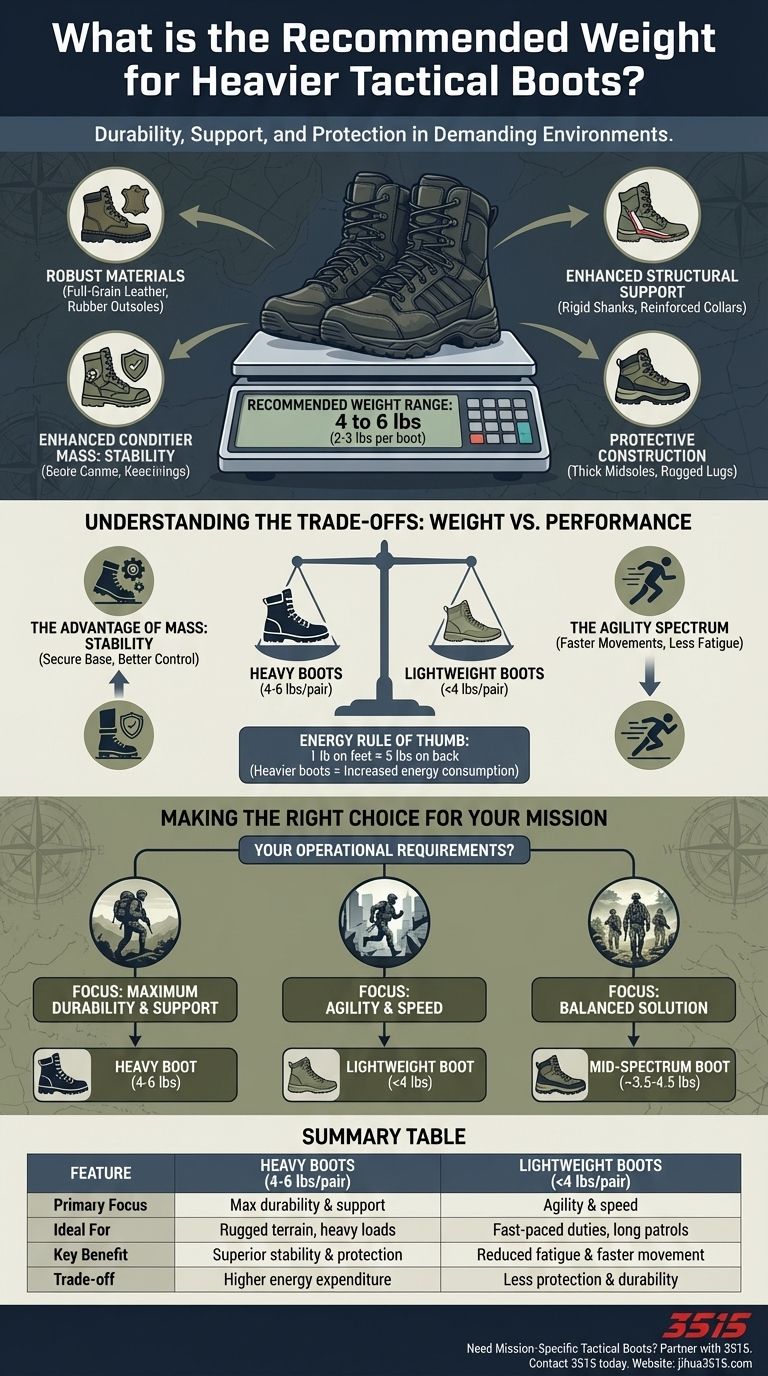
The recommended weight for heavier tactical boots typically falls between 2 to 3 pounds per boot, which translates to a combined weight of 4 to 6 pounds for a pair. This weight is not arbitrary; it is a direct consequence of the materials and construction required for maximum durability, support, and protection in demanding environments.
The weight of a tactical boot is the clearest indicator of its intended purpose. Heavier boots sacrifice agility and low fatigue for uncompromising stability and protection, a trade-off that is essential for certain missions and terrains.
What Defines a "Heavy" Tactical Boot?
A boot's weight is determined by its components. In heavier models, every element is chosen to maximize resilience and structural integrity, directly contributing to the final number on the scale.
Robust Materials
Heavier boots are constructed with thicker, more substantial materials. This often includes full-grain leather uppers and dense, heavy-duty rubber outsoles, which provide superior abrasion resistance and longevity compared to lighter synthetic fabrics.
Enhanced Structural Support
The internal architecture of these boots adds significant weight. Features like rigid shanks (the supportive structure between the insole and outsole), reinforced ankle collars, and protective toe caps are built to prevent foot fatigue and injury under heavy loads or on uneven ground.
Protective Construction
These boots are engineered for maximum protection. The added weight comes from thicker midsoles that absorb shock, rugged outsole lugs that grip terrain, and an overall build designed to shield the foot from impact, punctures, and environmental hazards.
Understanding the Trade-offs: Weight vs. Performance
Choosing a tactical boot is an exercise in balancing competing priorities. The decision between a heavy or lightweight model hinges on understanding the direct consequences of its weight.
The Advantage of Mass: Stability
The primary benefit of a heavier boot is stability. The substantial platform and rigid construction provide a secure base, reducing the risk of ankle rolls and offering better control when carrying heavy gear or navigating treacherous landscapes.
The Cost of Mass: Energy Expenditure
The most significant drawback is increased energy consumption. A common rule of thumb is that one pound on your feet is equivalent to carrying five extra pounds on your back. This means heavier boots can lead to faster fatigue during long movements.
The Agility Spectrum
In contrast, lightweight tactical boots (typically 2-4 pounds per pair) are designed for speed and agility. They allow for faster movements and reduce overall fatigue but offer less protection and may wear out more quickly under harsh conditions.
Making the Right Choice for Your Mission
Your operational requirements should be the sole determinant of your boot choice. The ideal weight is not a single number but a reflection of your specific needs.
- If your primary focus is maximum durability and support: A boot in the 4-6 pound range is the correct choice, as its robust construction is ideal for carrying heavy loads and operating in rugged, unpredictable terrain.
- If your primary focus is agility and speed: You should look for a boot under 4 pounds per pair, as its lighter weight is better suited for fast-paced duties or long patrols on more predictable surfaces.
- If you need a balanced solution: Target boots in the middle of the spectrum (around 3.5-4.5 pounds) that leverage modern materials to offer significant support without the full weight penalty of traditional designs.
By understanding the direct relationship between a boot's weight and its function, you can select the tool that will best serve as an asset for your specific mission.
Summary Table:
| Feature | Heavy Boots (4-6 lbs/pair) | Lightweight Boots (<4 lbs/pair) |
|---|---|---|
| Primary Focus | Maximum durability & support | Agility & speed |
| Ideal For | Rugged terrain, heavy loads | Fast-paced duties, long patrols |
| Key Benefit | Superior stability & protection | Reduced fatigue & faster movement |
| Trade-off | Higher energy expenditure | Less protection & durability |
Need Mission-Specific Tactical Boots? Partner with 3515.
As a large-scale manufacturer, 3515 produces a comprehensive range of tactical footwear for distributors, brand owners, and bulk clients. Whether your operational needs demand the ultimate stability of a 6-pound boot or the agile performance of a lightweight model, our production capabilities encompass all types of tactical shoes and boots, engineered for durability and performance.
Contact 3515 today to discuss your specific requirements and get a quote for your next order.
Visual Guide
Related Products
- High-Traction Suede Tactical Boots Wholesale & Custom Manufacturing
- Durable High-Ankle Tactical Boots Wholesale Manufacturer for Custom & Bulk Orders
- Durable Leather High-Ankle Tactical Boots for Wholesale & Custom Manufacturing
- Wholesale Tactical Boots High-Traction & Reflective for Bulk & Brand Orders
- Durable High-Ankle Tactical Boots for Wholesale & Custom Manufacturing
People Also Ask
- Why is sequential analysis utilized to evaluate tactical boots? Master Dynamic Boot Development and Ergonomic Performance
- How does the material of tactical boots affect their performance? Choose the Right Material for Your Mission
- How do tactical boots differ from regular boots? Performance, Durability & Design Explained
- How do military uniforms and tactical boots impact the prediction of thermal risk? Essential Safety Insights
- What are the benefits of integrating FES and sEMG into tactical boots? Safety, Reliability & Field-Ready Performance


















