
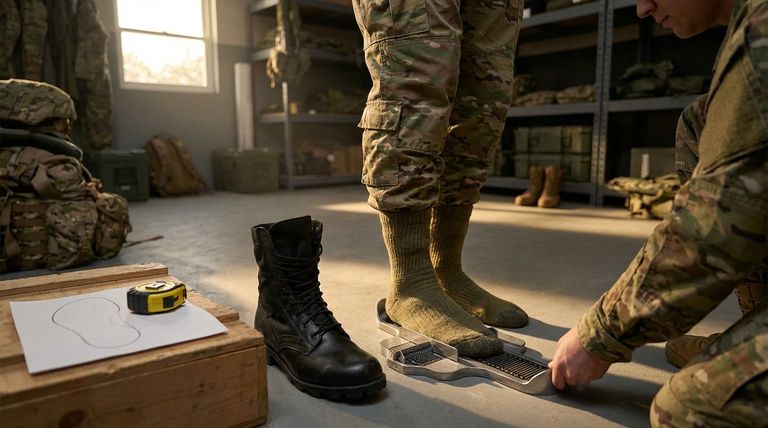
To properly measure your feet for military boots, you must measure them at the end of the day while standing to account for natural swelling and foot spread under load. You need to measure both the length and width of each foot, using the measurements from the larger foot as your guide and comparing them to the specific brand's sizing chart.
A proper boot fit is not a matter of comfort, but a critical component of your operational readiness. The goal is to measure your foot in its most expanded state—under weight and after a full day—to prevent the friction and pressure that lead to mission-compromising injuries.
Why a Precise Fit is Non-Negotiable
In a military context, your feet are your primary asset. An improperly sized boot can quickly lead to blisters, hot spots, stress fractures, and other debilitating injuries that can take you out of action during critical moments.
Unlike civilian footwear, military boots are worn for extended periods under extreme stress, including long ruck marches and dynamic field movements. A precise fit ensures stability, prevents injury, and allows you to focus on the mission at hand.
The Core Principles of Accurate Measurement
Before you take any measurements, understand the factors that will give you the most accurate results. These principles are designed to capture your foot's size when it is at its largest and under the most stress.
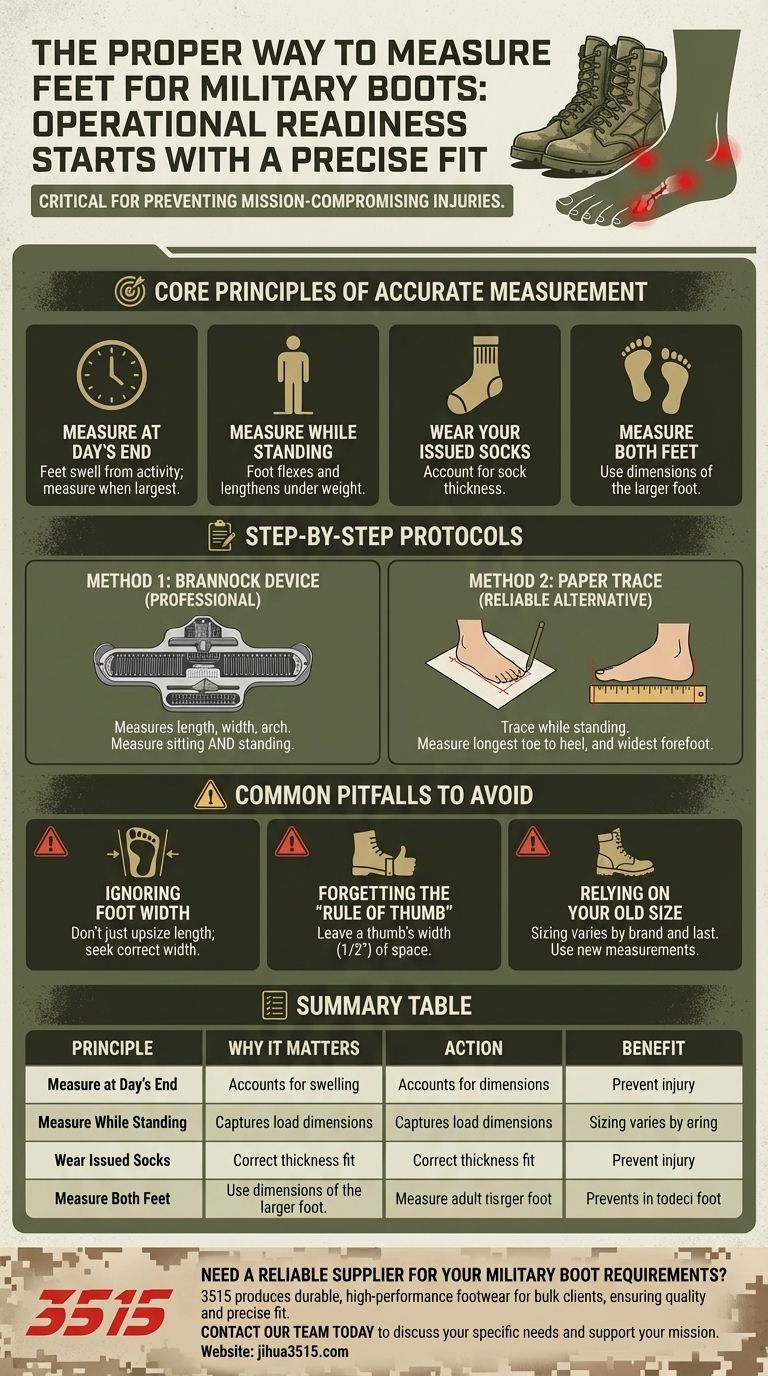
Measure at the End of the Day
Your feet naturally swell throughout the day from walking and standing. Measuring in the evening ensures you are fitting your boots to your foot at its largest size, preventing a fit that becomes too tight after hours of activity.
Measure While Standing
When you stand, your body weight causes your foot arch to flex and your foot to lengthen and spread. A sitting measurement will be inaccurate. Always measure with your full weight distributed evenly on both feet.
Account for Your Socks
Military-issued socks are typically much thicker than standard athletic or dress socks. Always wear the type of sock you will be wearing with your boots when you measure your feet or try on new boots.
Measure Both Feet
Nearly everyone has one foot that is slightly larger than the other. You must measure both feet and use the dimensions of the larger foot to determine your boot size. Sizing to the smaller foot will guarantee discomfort and potential injury.
Step-by-Step Measurement Protocols
You can achieve an accurate measurement using two primary methods. The Brannock Device is the professional standard, while the paper trace is a highly reliable alternative you can perform at home.
Method 1: The Brannock Device (Professional Standard)
This specialized tool, often found in footwear stores, measures length, width, and arch length simultaneously. For the most accurate reading, ensure you are measured both while sitting and while standing, as this captures how your arch flexes under load.
Method 2: The Paper Trace Method (Reliable Alternative)
Place a piece of paper on a hard, flat surface. While standing on the paper, have someone else trace the outline of your foot. It is critical that you remain standing with your weight on that foot during the trace.
Once traced, use a ruler to measure the longest and widest parts of the outline. Measure the length from the back of the heel to the tip of your longest toe, and measure the width across the widest part of your forefoot (the ball of your foot).
Common Pitfalls to Avoid
Getting an accurate measurement is only half the battle. You must also know how to interpret it and what mistakes to avoid when selecting your boots.
Ignoring Foot Width
Length is not the only critical dimension. If your foot width measurement indicates you need a "wide" (W) or "extra wide" (EW) size, do not try to compensate by simply going up in length. This creates an improper fit that leads to friction and instability.
Forgetting the "Rule of Thumb"
When trying on boots, there should be about a thumb's width (approximately half an inch) of space between the end of your longest toe and the front of the boot. This allows your foot to expand and your toes to splay naturally without hitting the front of the boot, especially on declines.
Relying on Your Old Size
Boot manufacturers use different lasts (the mold a boot is built on), meaning a size 10 in one brand may fit differently than a size 10 in another. Always refer to the specific brand's sizing chart with your new measurements.
Making the Right Choice for Your Mission
Your measurements are data points that empower you to select the right tool for the job. Use them to find a boot that will support you, not work against you.
- If your primary focus is absolute precision: Get professionally measured with a Brannock Device, ensuring you are measured both sitting and standing.
- If you need a reliable at-home measurement: Use the paper trace method at the end of the day while wearing your issued socks, and always size up to your larger foot.
- When finalizing your choice: Always confirm the fit by checking for a thumb's width of space at the toe and ensuring the boot's widest part aligns and flexes with the ball of your foot.
Ultimately, taking the time to measure correctly is a direct investment in your health, endurance, and overall effectiveness.
Summary Table:
| Key Measurement Principle | Why It Matters |
|---|---|
| Measure at Day's End | Accounts for natural foot swelling after activity. |
| Measure While Standing | Captures foot length and width under full body weight. |
| Wear Your Issued Socks | Ensures the fit accommodates the correct sock thickness. |
| Measure Both Feet | Use the dimensions of the larger foot to prevent injury. |
Need a reliable supplier for your military boot requirements?
As a large-scale manufacturer, 3515 produces a comprehensive range of durable and high-performance footwear for distributors, brand owners, and bulk clients. Our production capabilities encompass all types of military boots, ensuring quality, consistency, and the precise fit that is critical for operational readiness.
Contact our team today to discuss your specific needs and discover how we can support your mission.
Visual Guide
Related Products
- Durable Military Combat Boots with Water Drainage for Wholesale & OEM
- High-Traction Suede Tactical Boots Wholesale & Custom Manufacturing
- Durable High-Ankle Tactical Boots for Wholesale & Custom Manufacturing
- Durable Mid-Cut Tactical Boots for Wholesale & Private Label
- Wholesale Waterproof Tactical Boots Custom Suede & High-Traction Soles
People Also Ask
- Why must gait validation for military applications be conducted in combat boots? Ensure Data Accuracy for Soldiers
- What are the common types of combat boots? Find the Right Boot for Your Mission
- What factors should be considered when choosing military boots for hiking? Durability vs. Weight for Your Terrain
- What are the key considerations when choosing military boots? Prioritize Compliance, Environment & Fit
- How should the midfoot and heel fit in military boots? Achieve a Snug, Secure Fit for Blister Prevention



















