The term 'Chukka' is directly borrowed from the world of polo. It originates from a "chukker," a seven-minute period of play in a polo match. This name was adopted for the ankle-high boots frequently worn by off-duty players in British Colonial India, reflecting the boot's blend of sporting heritage and casual comfort.
While the name "Chukka" is tied to the action on a polo field, the boot's true identity comes from what players wore for relaxed comfort after the match. This duality of athletic origin and casual function is the key to its timeless appeal.
The Polo Field Connection
The story of the Chukka boot's name begins not with shoemakers, but with sportsmen. Its identity is inextricably linked to the culture and terminology of polo during the height of the British Empire.
From Game Time to Downtime
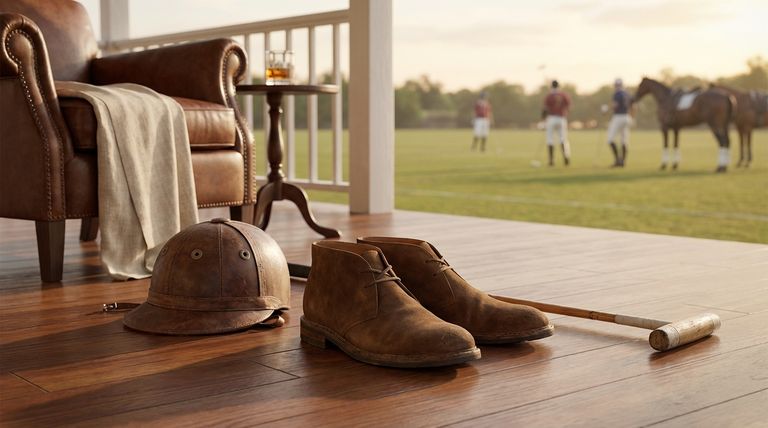
A game of polo is divided into periods of play called chukkers (or chukkas). The term itself is what gives the boot its name. It's widely believed the boots were favored by players for wearing before or after a match, rather than during the game itself.
The British-Indian Origin
The connection was forged in India, where British Army units and officials stationed there enthusiastically adopted polo. These off-duty soldiers needed comfortable, yet durable, footwear that was less formal than a riding boot.
A More Casual Alternative
The Chukka resembles the Jodhpur boot, another style with equestrian roots. However, the Jodhpur is a pull-on boot secured with a strap and buckle. The Chukka's simple two-or-three eyelet lacing system made it a more relaxed and practical choice for casual wear.
The Linguistic Root
Beyond the direct link to the game's terminology, the name also has a deeper linguistic connection that reinforces the boot's intended character.
The Hindi Word 'Chukkar'
The term 'chukker' is derived from the Hindi word 'chukkar,' which means "circle" or "turn." This can be interpreted in two ways that both fit the boot's narrative: it can refer to the circling of horses on the polo field, or it can translate more loosely to taking a "turn" or a "casual stroll," perfectly describing the boot's function.
Unraveling the Historical Path
While the origin of the name is clear, the exact path the boot took from the polo grounds of India to the wardrobes of the world involves a few key figures and some historical ambiguity.
The Role of the Duke of Windsor
The Chukka boot's popularity in the West was cemented in the 1920s. The Duke of Windsor, a renowned style icon, visited India, discovered the boots, and began wearing them frequently. His influence introduced the comfortable and versatile style to a global audience.
The Desert Boot Distinction
A common point of confusion is the relationship between the Chukka and the Clarks Desert Boot. The Desert Boot is a specific type of Chukka boot, characterized by its crepe rubber sole. Nathan Clark was inspired by a similar style of boot he saw in the bazaars of Cairo while stationed in Burma during WWII, but the general Chukka style predates this famous iteration.
An Uncertain Direct Lineage
While we know the context, the exact person or moment when the name "Chukka" was first applied to the boot is lost to history. The origin is more a story of cultural adoption than a documented invention, which adds to its classic, almost mythic, status.
How Its Origin Defines Its Style
Understanding where the Chukka comes from helps clarify its place in a modern wardrobe. It was never a formal dress shoe nor a rugged work boot; it was created to fill the space in between.
- If your primary focus is classic style: Embrace the Chukka's connection to the smart-casual dress codes of off-duty sportsmen and officers.
- If your primary focus is versatility: Use its "casual stroll" heritage as your guide, pairing it confidently with everything from denim to chinos.
- If your primary focus is authenticity: Look for simple, unlined suede or leather constructions that honor its original, functional design.
Knowing its history transforms the Chukka from a simple shoe into a piece of enduring, purpose-built design.
Summary Table:
| Key Aspect | Details |
|---|---|
| Origin of Name | Derived from a 'chukker', a period of play in polo. |
| Linguistic Root | From the Hindi word 'chukkar', meaning 'circle' or 'turn'. |
| Historical Context | Worn by British officers in India for off-duty comfort. |
| Key Style Icon | Popularized in the West by the Duke of Windsor in the 1920s. |
| Defining Feature | Simple 2-3 eyelet lacing, ankle-high silhouette. |
Ready to Step into Timeless Style?
As a large-scale manufacturer, 3515 produces a comprehensive range of footwear for distributors, brand owners, and bulk clients. Our production capabilities encompass all types of shoes and boots, including classic styles like the Chukka.
Partner with us to:
- Access High-Quality Production: Leverage our expertise in crafting durable, stylish footwear.
- Benefit from Scalability: Meet the demands of any market with our large-scale manufacturing capacity.
- Customize Your Collection: Develop your own line of Chukka boots or any other style with our flexible production services.
Contact our team today to discuss your manufacturing needs and bring your footwear vision to life.
Visual Guide

Related Products
- Wholesale High-Traction Camo Boots - Custom Manufacturer for Brands
- Durable Leather Tactical Boots Wholesale & Custom Manufacturing for Brands
- High-Traction Suede Tactical Boots Wholesale & Custom Manufacturing
- Durable Leather High-Ankle Tactical Boots for Wholesale & Custom Manufacturing
- Durable Leather Work Boots Wholesale Manufacturer & Custom Factory
People Also Ask
- What are the key features of the new line of camo boots? Built for Extreme Cold & Rugged Terrain
- Are camo boots necessary for hunting success? Prioritize Performance Over Pattern
- How does the Rank Score Test identify the primary causes of premature failure in tactical and work boots? Key Insights
- What is the technical logic behind using closed-eye testing for tactical boots? Unlocking Peak Footwear Stability
- What shoes to wear for a security job? Durable, Protective Footwear for Long Shifts