
The primary finding is clear: Following ankle fracture surgery, patients who use walking boots (WBs) experience a significantly faster functional recovery compared to those immobilized in traditional plaster casts (PCs). This includes a shorter time to stand on the affected leg and walk without crutches.
The core advantage of a walking boot is not just protection, but its ability to enable controlled, early mobility. This strategic approach accelerates healing and the return to normal function in a way that rigid casting cannot.
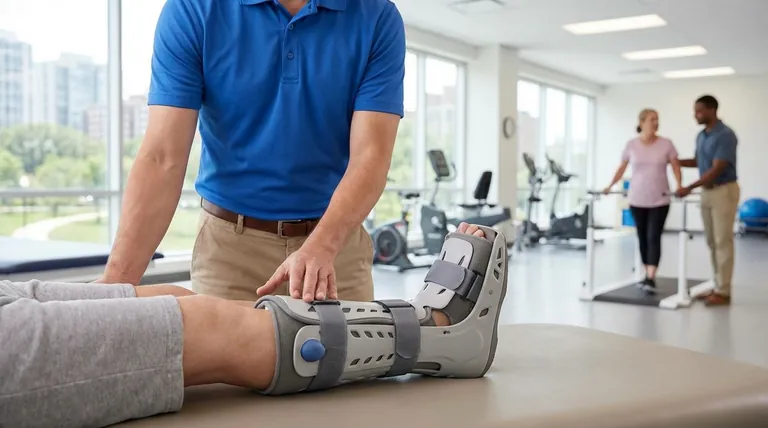
The Principle: Why Controlled Mobility Matters
The purpose of post-surgical immobilization is to create a stable environment for bone to heal. However, the method of immobilization has a profound impact on the speed and quality of recovery.
Protecting the Healing Bone
A walking boot provides the necessary immobilization to protect the surgical site. It stabilizes the ankle and foot, restricting movement to allow the fractured bones to mend without disruption.
This protective shell shields the area from accidental bumps and external forces, which is critical in the early stages of healing.
Enabling Early Weight-Bearing
Unlike a plaster cast, a walking boot is engineered for a gradual return to activity. Its rocker bottom sole is a key feature, designed to minimize motion in the ankle joint while still allowing a more natural walking gait.
This design provides the fixity required to begin bearing weight sooner, which stimulates bone healing and helps maintain muscle strength.
Accommodating Swelling and Comfort
Post-operative swelling is a given. The adjustable straps of a walking boot allow it to be fitted precisely, accommodating changes in swelling and ensuring a secure, comfortable fit.
Features like an adjustable heel lift can also be used to place the ankle in a slightly plantarflexed (pointed down) position, which can make walking more comfortable in a swollen ankle.
Understanding the Trade-offs and Guidelines
While a walking boot offers significant advantages, its effectiveness is entirely dependent on proper use. It is a medical device, not a simple piece of footwear, and requires adherence to specific protocols.
The Critical Role of Consistency
It is generally not recommended to remove the boot, even for sleeping. The body does its most important healing work during rest, and the boot provides the constant support and proper alignment necessary for this process.
Prioritizing short-term comfort by removing the boot can compromise the stability of the fracture and ultimately hinder your recovery.
Medical Guidance is Non-Negotiable
A walking boot facilitates a dynamic recovery process. This means your doctor will provide specific instructions on when to start partial weight-bearing and how to progress.
Never self-direct your recovery. The transition from non-weight-bearing to full weight-bearing must be guided by a medical professional to avoid re-injury.
Making the Right Choice for Your Goal
Your post-operative care is designed to achieve specific outcomes. Understanding how a walking boot contributes to these goals empowers you throughout your recovery.
- If your primary focus is a rapid return to daily activities: The walking boot is the superior choice, as studies confirm it shortens the time required to walk independently.
- If your primary focus is ensuring the most stable healing environment: The walking boot provides the necessary protection while also leveraging the benefits of controlled mobility to promote stronger, faster healing.
Ultimately, the walking boot is a tool that transforms recovery from a passive waiting period into an active, progressive journey.
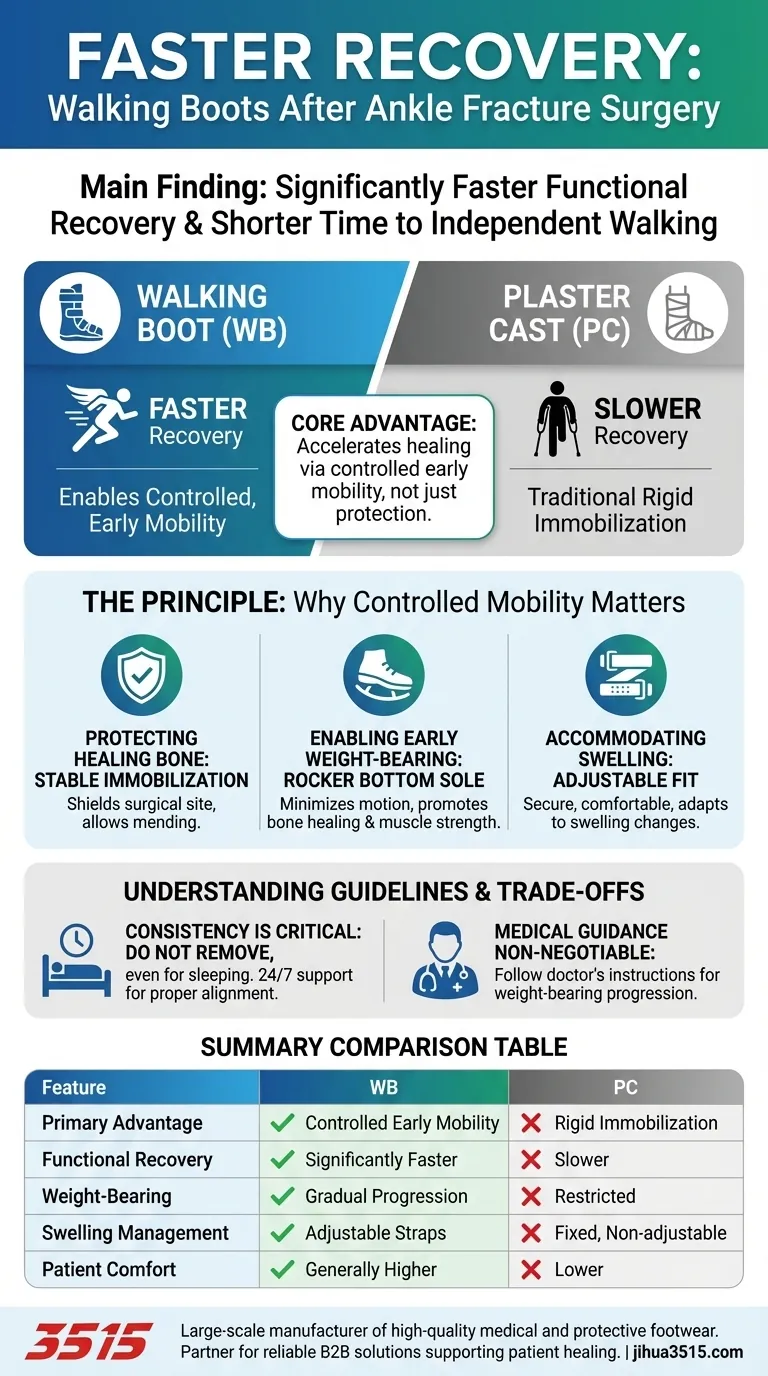
Summary Table:
| Feature | Walking Boot (WB) | Plaster Cast (PC) |
|---|---|---|
| Primary Advantage | Enables controlled, early mobility | Provides rigid, total immobilization |
| Functional Recovery | Significantly Faster | Slower |
| Weight-Bearing | Allows gradual, guided progression | Restricted |
| Swelling Management | Adjustable straps accommodate changes | Fixed, non-adjustable |
| Patient Comfort | Generally higher due to adjustability | Lower |
As a large-scale manufacturer, 3515 produces a comprehensive range of high-quality medical and protective footwear, including walking boots designed for optimal post-surgical recovery.
If you are a distributor, brand owner, or bulk client in the medical supply chain, partnering with us ensures access to reliable products that support patient healing and mobility. Our production capabilities encompass all types of therapeutic shoes and boots, built to exacting standards.
Let's discuss how our footwear solutions can meet your specific needs. Contact our team today to learn more about our products and manufacturing partnership opportunities.
Visual Guide
Related Products
- Heavy-Duty Waterproof Nubuck Safety Boots Safety Shoes for Bulk Supply
- Durable Goodyear Welt Leather Work Boots for Wholesale & Private Label
- Durable Rubber Sole Outdoor Shoes Wholesale & Custom Manufacturing
- Wholesale Safety Boots Manufacturer for Custom & Private Label Orders
- Wholesale High-Traction Camo Boots - Custom Manufacturer for Brands
People Also Ask
- What primary protective functions do professional safety boots provide in urban solid waste recovery and waste picking processes? Discover Dual-Layer Protection.
- How do safety boots reduce cutting hazards? Essential Protection for Your Workforce
- Which organizations develop safety standards for work boots? Ensure Compliance & Worker Safety
- What are the common types of safety boots and their primary uses? A Guide to Industrial Footwear
- Why is ankle and arch support important in safety footwear? Prevent Injury & Fatigue



















