
The historical significance of cowboy boots is rooted entirely in their function as a purpose-built tool for the working American cowboy. Originally designed in the post-Civil War era, every element of the boot was engineered to provide safety and efficiency for long, arduous hours spent on horseback. It was this commitment to pure utility that forged its identity as an icon of resilience and Western heritage.
The cowboy boot’s true significance lies in its evolution from essential equestrian equipment to a powerful cultural symbol. Its design was dictated by the practical needs of a rider, and this legacy of durability and purpose is precisely why it transcended its origins to represent the spirit of the American West.
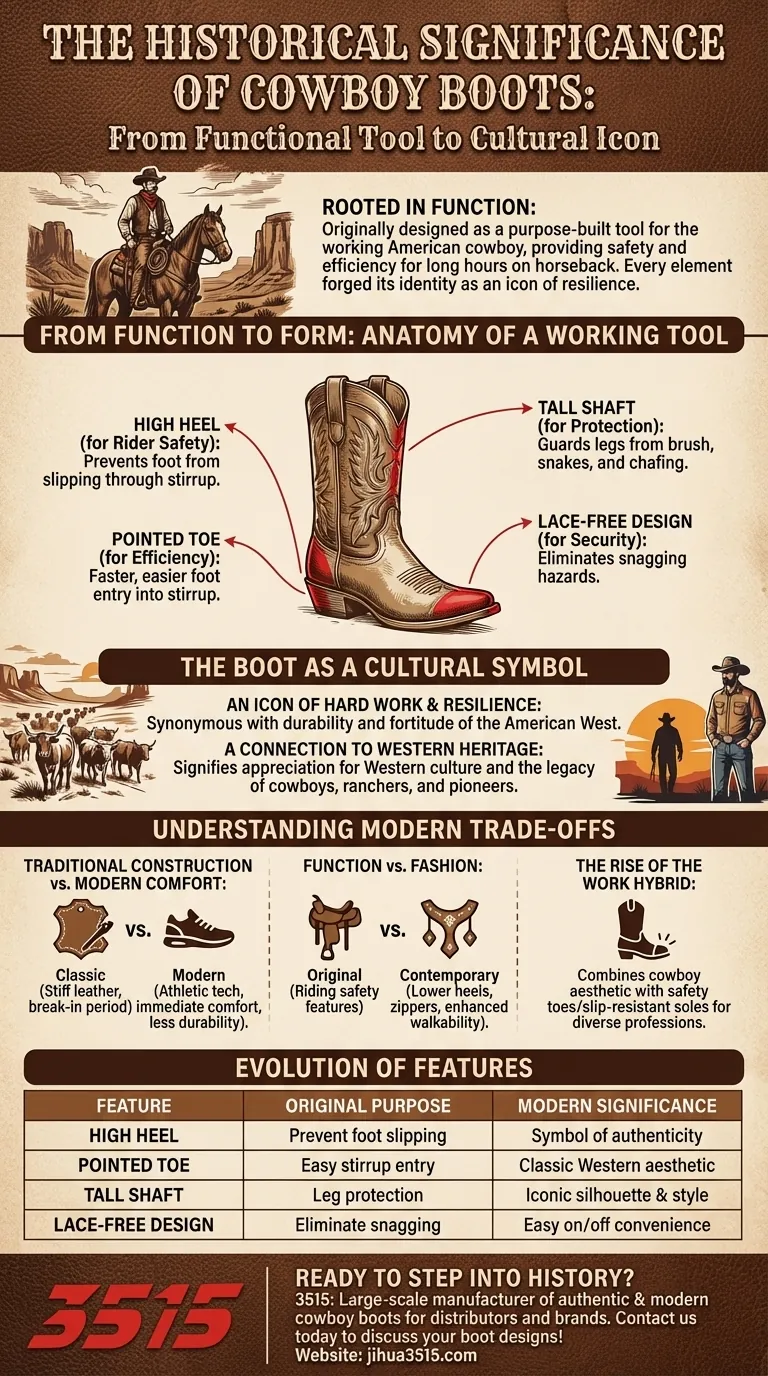
From Function to Form: Anatomy of a Working Tool
The classic cowboy boot is a masterclass in purpose-driven design. Each feature was developed not for style, but to solve a specific problem faced by riders on the open range.
The High Heel for Rider Safety
The tall, often angled heel is perhaps the boot's most critical feature. It was not designed for walking but to prevent a rider's foot from accidentally slipping forward through the stirrup, a dangerous and potentially fatal event.
The Pointed Toe for Efficiency
A narrow or pointed toe made it faster and easier for a mounted cowboy to guide his foot back into the stirrup, a crucial advantage when needing to mount quickly or regain footing.
The Tall Shaft for Protection
The high leather shaft, typically reaching mid-calf, served as a protective shield. It guarded the rider’s legs against thorny brush, snake bites, and the constant friction and chafing from the saddle and stirrup leathers.
The Lace-Free Design for Security
The smooth, laceless design was another key safety feature. Laces could easily snag on branches or equipment, posing a significant risk to a rider. The pull-on style eliminated this hazard entirely.
The Boot as a Cultural Symbol
As the era of the great cattle drives faded, the cowboy boot's function began to merge with its symbolism. It became a powerful visual shorthand for a specific set of values.
An Icon of Hard Work and Resilience
Because the boots were built to withstand incredible punishment, they became synonymous with the hard work and rugged individualism required to survive in the American West. They were a testament to durability and fortitude.
A Connection to Western Heritage
Today, wearing cowboy boots often signifies a connection to or appreciation for Western culture and its history. It is a way of carrying forward the legacy of the cowboys, ranchers, and pioneers who shaped that identity.
Understanding the Trade-offs in Modern Boots
The transition from a specialized tool to a mainstream fashion item has introduced new designs and, with them, important trade-offs. The boot's modern versatility comes from adapting its original, uncompromising form.
Traditional Construction vs. Modern Comfort
Classic boots are made from thick, stiff leather that requires a significant "break-in" period to mold to the foot. In contrast, many modern boots integrate athletic shoe technology and moisture-wicking materials for immediate comfort, sometimes at the expense of long-term durability and traditional craftsmanship.
Function vs. Fashion
Many contemporary "Western-style" boots alter the original functional elements. They may feature lower heels, wider toes, or zippers, which enhance walkability or ease of wear but sacrifice the specific safety features designed for horseback riding.
The Rise of the Work Hybrid
The modern work environment has led to hybrid designs that combine the cowboy boot silhouette with safety features like steel or composite toes. These boots honor the aesthetic while adapting to the protective needs of professions far beyond ranching.
Making the Right Choice for Your Purpose
Understanding the boot's history helps you select a pair that aligns with your goals.
- If your primary focus is authenticity and tradition: Seek boots with a tall heel, traditional leather construction, and a design that honors the original purpose of a riding tool.
- If your primary focus is all-day comfort and versatility: Look for modern interpretations that use flexible materials, cushioned insoles, and a more walking-friendly heel.
- If your primary focus is on-the-job safety: Choose a hybrid work boot that integrates certified safety toes and slip-resistant soles into the classic cowboy boot profile.
Ultimately, appreciating the cowboy boot is to understand its journey from an indispensable piece of workwear to an enduring symbol of American identity.
Summary Table:
| Feature | Original Purpose | Modern Significance |
|---|---|---|
| High Heel | Prevent foot slipping through stirrup | Symbol of authenticity and tradition |
| Pointed Toe | Easy foot entry into stirrup | Classic Western aesthetic |
| Tall Shaft | Protect legs from brush and saddle | Iconic silhouette and style |
| Lace-Free Design | Eliminate snagging hazards | Easy on/off convenience |
Ready to step into history with your own custom boots?
As a large-scale manufacturer, 3515 produces a comprehensive range of authentic and modern cowboy boots for distributors, brand owners, and bulk clients. Whether you value traditional craftsmanship, modern comfort, or workplace safety, our production capabilities encompass all types of boots to meet your needs.
Contact us today to discuss how we can bring your boot designs to life!
Visual Guide
Related Products
- High-Traction Suede Tactical Boots Wholesale & Custom Manufacturing
- Wholesale High-Traction Camo Boots - Custom Manufacturer for Brands
- Wholesale Lightweight Tactical Boots Custom Manufacturer for Desert & Combat Use
- Durable Leather Tactical Boots Wholesale & Custom Manufacturing for Brands
- Wholesale Durable Mid-Cut Tactical Boots for Custom & Private Label Brands
People Also Ask
- Why is sequential analysis utilized to evaluate tactical boots? Master Dynamic Boot Development and Ergonomic Performance
- How does the material of tactical boots affect their performance? Choose the Right Material for Your Mission
- How do tactical boots differ from regular boots? Performance, Durability & Design Explained
- How do military uniforms and tactical boots impact the prediction of thermal risk? Essential Safety Insights
- What are the benefits of integrating FES and sEMG into tactical boots? Safety, Reliability & Field-Ready Performance


















