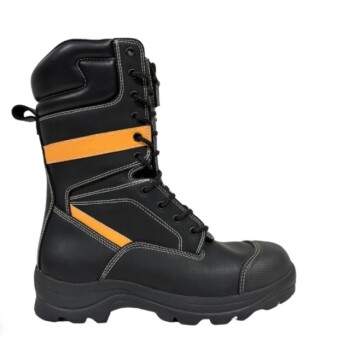
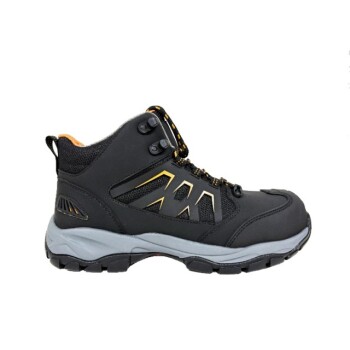
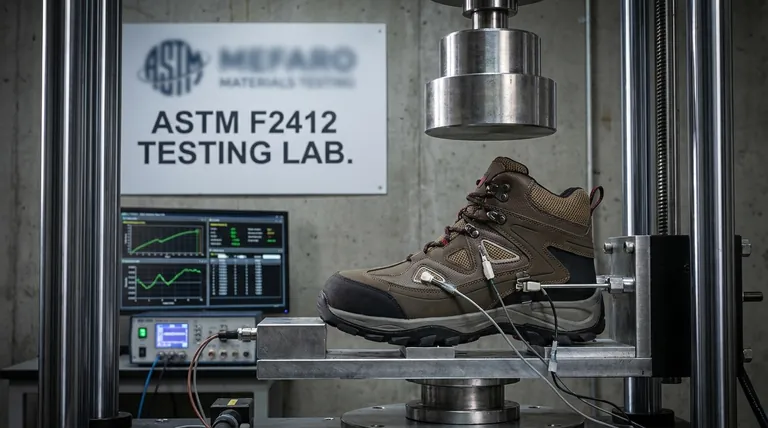
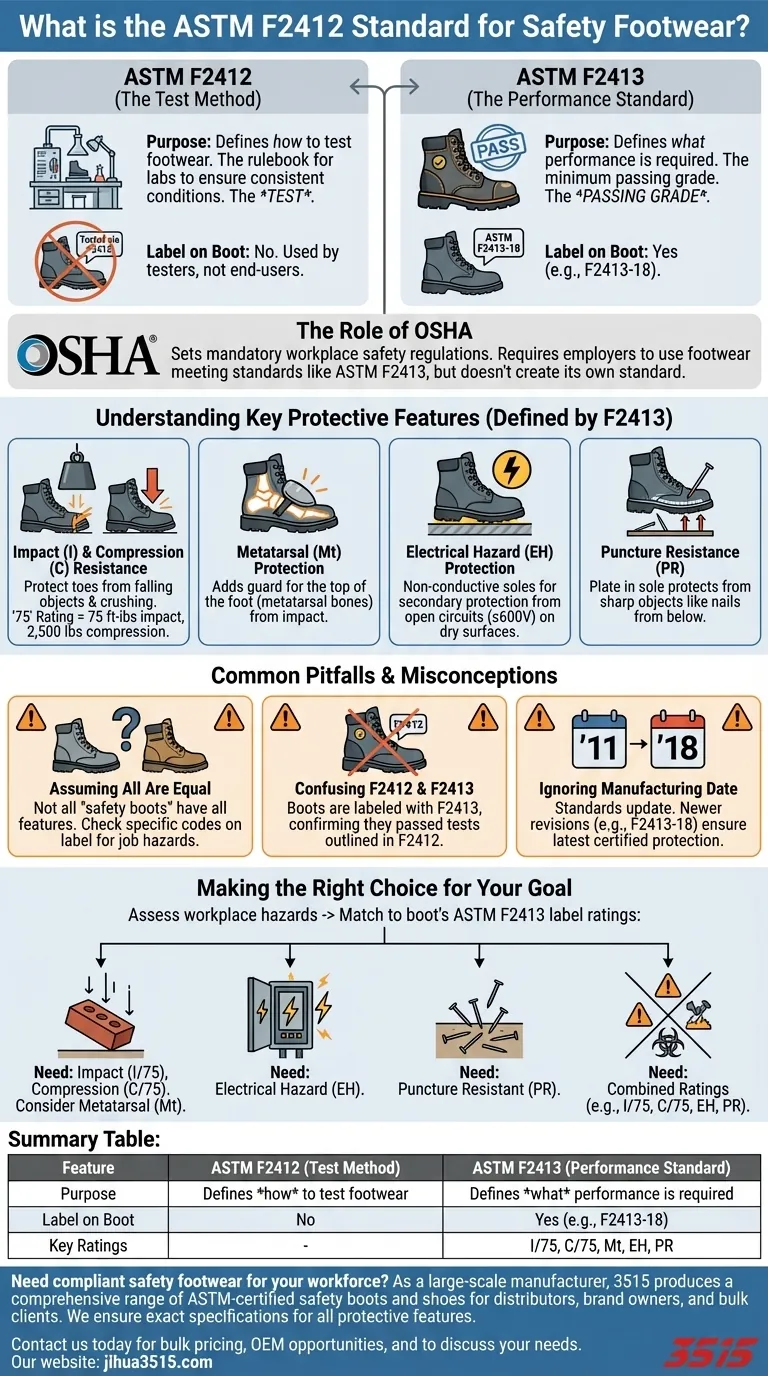
In simple terms, ASTM F2412 is the standard that specifies the methods for testing the performance of protective footwear. It is the "how-to" guide for labs to ensure a safety boot can withstand specific hazards, but it does not set the performance requirements itself. The standard that defines what performance a boot must meet is ASTM F2413.
The core misunderstanding is that ASTM F2412 is the standard for boot performance. Instead, think of it this way: ASTM F2412 defines the test, while ASTM F2413 defines the passing grade. You will find the performance ratings on the boot's label, not the testing method.
Deconstructing Safety Footwear Standards
To select the right footwear, you must understand how the two primary ASTM standards work together. They are separate but interconnected parts of the same safety system.
ASTM F2412: The Test Method Standard
This standard is the rulebook for the laboratory. It outlines the precise procedures, equipment, and protocols for testing safety features.
It ensures that every safety boot is evaluated under the exact same conditions, guaranteeing consistent and repeatable results. You will almost never see F2412 referenced on a boot's tag because it's a standard for the testers, not the end-users.
ASTM F2413: The Performance Requirement Standard
This is the standard that matters most to the user and employer. It specifies the minimum performance requirements a boot must meet to be certified for a particular hazard.
When a boot is labeled "ASTM F2413-18," it signifies that it was tested according to F2412 methods and passed the performance criteria set by F2413. The "-18" indicates the year the standard was last updated (2018).
The Role of OSHA
The Occupational Safety and Health Administration (OSHA) sets the mandatory workplace safety regulations.
OSHA requires employers to ensure workers wear protective footwear in hazardous environments but does not create its own footwear standard. Instead, it defers to and requires footwear that meets standards like ASTM F2413.
Understanding the Key Protective Features
The ASTM F2413 standard covers several distinct types of protection. A boot's label will indicate which of these specific standards it meets.
Impact (I) and Compression (C) Resistance
This is the most fundamental requirement for a safety toe boot. It protects the toes from falling objects and crushing forces.
The rating is almost always "75," which means the toe cap can withstand an impact of 75 foot-pounds and a compressive load of 2,500 pounds.
Metatarsal (Mt) Protection
This feature adds a guard that protects the top of the foot (the metatarsal bones) from impact. It's crucial in environments where objects could drop on the foot, not just the toes.
Electrical Hazard (EH) Protection
EH-rated footwear is designed with non-conductive, shock-resistant soles and heels. It is a secondary source of protection on dry surfaces from open circuits of 600 volts or less.
Puncture Resistance (PR)
This indicates a puncture-resistant plate is built into the sole of the boot to protect the foot from sharp objects like nails or scrap metal from below.
Common Pitfalls and Misconceptions
Understanding the nuances of these standards is critical for ensuring true safety. Simply picking any "safety boot" is a common and dangerous mistake.
Assuming All Safety Boots Are Equal
A boot with only an impact and compression rating offers no protection against electrical shocks or punctures. Always check the specific codes on the label to match the boot's features to the job's hazards.
Confusing F2412 and F2413
As established, F2412 is the test method, and F2413 is the performance specification. A compliant boot will always be labeled with F2413, confirming it passed the tests outlined in F2412.
Ignoring the Manufacturing Date
Standards are updated. The label will show the year of the standard the boot conforms to (e.g., F2413-11 or F2413-18). While older boots may still be acceptable, using footwear that meets the latest revision ensures the highest level of certified protection.
Making the Right Choice for Your Goal
Always start by assessing the specific hazards of your work environment. Then, match those hazards to the ratings on the boot's ASTM F2413 label.
- If your primary focus is protection from falling objects: You need a boot rated for Impact (I/75) and Compression (C/75). Consider Metatarsal (Mt) protection for enhanced safety.
- If your primary focus is working around live circuits: You need a boot specifically rated for Electrical Hazard (EH).
- If your primary focus is preventing sole punctures from below: You need a boot with a Puncture Resistant (PR) plate built into the sole.
- If your primary focus is general compliance in a multi-hazard area: You may need a boot that combines several of these ratings, such as I/75, C/75, EH, and PR.
By understanding the label, you empower yourself to choose the exact protection you need for the job at hand.
Summary Table:
| Feature | ASTM F2412 (Test Method) | ASTM F2413 (Performance Standard) |
|---|---|---|
| Purpose | Defines how to test footwear | Defines what performance is required |
| Label on Boot | No | Yes (e.g., F2413-18) |
| Key Ratings | - | I/75 (Impact), C/75 (Compression), Mt (Metatarsal), EH (Electrical Hazard), PR (Puncture Resistant) |
Need compliant safety footwear for your workforce?
As a large-scale manufacturer, 3515 produces a comprehensive range of ASTM-certified safety boots and shoes for distributors, brand owners, and bulk clients. Our production capabilities encompass all types of protective footwear, ensuring you get the exact specifications—from Impact and Compression to Electrical Hazard and Puncture Resistance—that your business requires.
Contact us today for bulk pricing, OEM opportunities, and to discuss your specific safety footwear needs.
Visual Guide
Related Products
- Wholesale Safety Footwear Manufacturer for Bulk & Custom OEM Orders
- Wholesale Durable Safety Boots Manufacturer Customizable Steel Toe Work Boots
- Premium Lightweight Safety Shoes for Wholesale & Bulk Orders
- Premium Wholesale Tactical Style Safety Shoes Boots with Quick Lacing
- Premium Flame-Retardant Waterproof Safety Boots and Shoes
People Also Ask
- What type of safety shoe is recommended for workers exposed to heavy machinery? Steel Toe Boots for Ultimate Protection
- Why are industrial safety boots with steel toes necessary for machine operators? Essential Foot Protection for Safety
- Why are steel toes popular in safety footwear? The Ultimate Guide to Heavy-Duty Protection
- Is the myth about steel toe shoes cutting off toes true? Debunking the Safety Footwear Myth
- What are the recommended uses for steel toe safety shoes? Essential Protection for High-Risk Industries