
For those seeking a definitive recommendation, the ideal cowboy boot is a classic style crafted from natural, understated leather. A non-embellished finish, especially on a vintage or well-made pair, offers timeless appeal that bypasses fleeting trends and honors the boot's functional heritage.
The single best "style" of cowboy boot does not exist. Instead, the right choice depends entirely on your intended purpose, as each design element—from the heel's angle to the shaft's height—is engineered for a specific function.
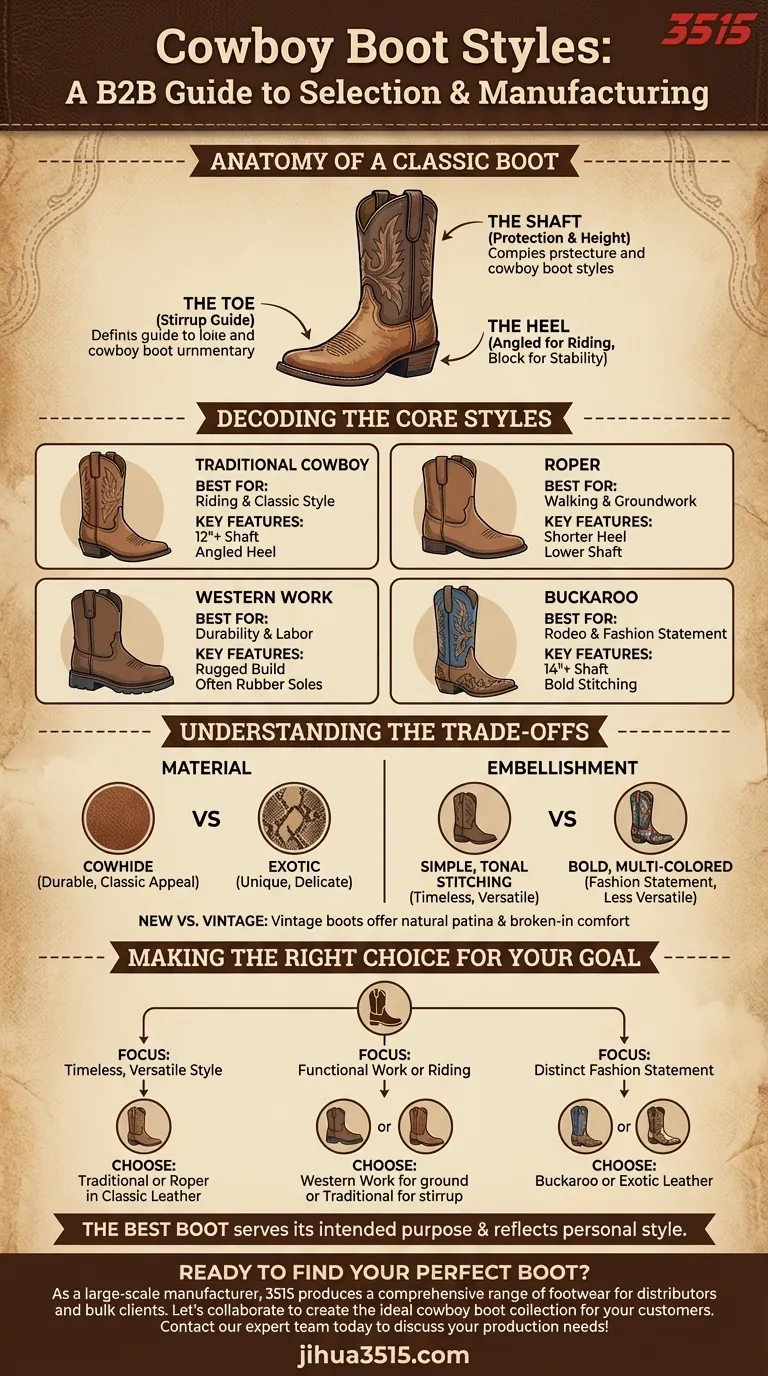
The Anatomy of a Classic Boot
Before comparing styles, it's crucial to understand the core components. Each part of a cowboy boot serves a purpose rooted in its history as practical workwear for ranchers and horsemen.
The Heel
The heel is one of the most significant functional differentiators. A taller, angled heel, often called a "Cuban heel," is designed to prevent a rider's foot from slipping through a stirrup. A shorter, squared-off block heel provides more stability for walking and groundwork.
The Shaft
The shaft is the tall part of the boot that covers the calf. Its primary historical purpose was to protect the wearer's legs from brush, snakes, and other hazards. The height of the shaft is a key characteristic of different boot styles.
The Toe
While toe shapes vary widely for aesthetic reasons, the traditionally pointed toe was developed to help a rider easily guide their foot into the stirrup.
Decoding the Core Styles
Most cowboy boots fall into a few primary categories, each defined by its functional design. Understanding these archetypes is the key to selecting the right boot for your needs.
The Traditional Cowboy Boot
This is the quintessential style, featuring a high shaft (often 12 inches or more) and a tall, angled heel. It is the original design intended for long hours in the saddle.
The Roper Boot
The Roper style was developed for rodeo cowboys who needed to dismount quickly, rope cattle, and run on foot. It features a shorter, rounder heel for walking comfort and a lower shaft for greater ankle flexibility.
The Western Work Boot
This is a modern hybrid that combines the silhouette of a cowboy boot with the rugged features of a traditional work boot. They often include elements like rubber soles and enhanced durability for demanding labor.
The Buckaroo Boot
Buckaroo boots are an exaggerated version of the traditional style, built for both function and flash. They have exceptionally tall shafts (14 inches or more) to provide maximum protection for rodeo riders and often feature bold, decorative stitching.
Understanding the Trade-offs
Choosing a boot involves balancing aesthetics, function, and material. The initial recommendation for "understated leather" is based on principles of versatility and longevity.
Material: Cowhide vs. Exotic
Cowhide is the traditional, durable, and most common material for cowboy boots. It offers excellent longevity and classic appeal. Exotic leathers, such as snakeskin or ostrich, are primarily a stylistic choice, offering unique textures and visual impact but often requiring more delicate care.
Embellishment: The Role of Stitching
Simple, tonal stitching is a hallmark of classic bootmaking. Heavy, multi-colored embellishments or inlays shift the boot from a timeless piece of footwear toward a fashion statement, which can limit its versatility.
New vs. Vintage
A new, high-quality boot requires a break-in period. Vintage boots are often recommended because they are already broken in, may feature superior old-world construction, and have developed a natural patina that is difficult to replicate.
Making the Right Choice for Your Goal
Select your boot style by first defining its primary role.
- If your primary focus is timeless, versatile style: A traditional or roper boot in a classic leather like cowhide is the most reliable choice.
- If your primary focus is functional work or riding: Choose a Western work boot for durability on the ground or a traditional boot with an angled heel for security in the stirrup.
- If your primary focus is making a distinct fashion statement: Consider a Buckaroo style for its dramatic height or an exotic leather for its unique texture.
Ultimately, the best cowboy boot is one that serves its intended purpose while reflecting your personal style.
Summary Table:
| Boot Style | Best For | Key Features |
|---|---|---|
| Traditional Cowboy | Riding & Classic Style | Tall shaft (12"+), angled heel |
| Roper | Walking & Groundwork | Shorter, rounded heel, lower shaft |
| Western Work | Durability & Labor | Rugged build, often rubber soles |
| Buckaroo | Rodeo & Fashion Statement | Very tall shaft (14"+), decorative stitching |
Ready to Find Your Perfect Boot?
As a large-scale manufacturer, 3515 produces a comprehensive range of footwear for distributors, brand owners, and bulk clients. Our production capabilities encompass all types of shoes and boots, ensuring you get the perfect style, material, and fit for your market.
Let's collaborate to create the ideal cowboy boot collection for your customers.
Contact our expert team today to discuss your production needs!
Visual Guide
Related Products
- Wholesale High-Traction Camo Boots - Custom Manufacturer for Brands
- High-Traction Suede Tactical Boots Wholesale & Custom Manufacturing
- Wholesale Lightweight Tactical Boots Custom Manufacturer for Desert & Combat Use
- Durable Leather Tactical Boots Wholesale & Custom Manufacturing for Brands
- Wholesale Durable Mid-Cut Tactical Boots for Custom & Private Label Brands
People Also Ask
- What are the key features of the new line of camo boots? Built for Extreme Cold & Rugged Terrain
- Are camo boots necessary for hunting success? Prioritize Performance Over Pattern
- How does the Rank Score Test identify the primary causes of premature failure in tactical and work boots? Key Insights
- What is the technical logic behind using closed-eye testing for tactical boots? Unlocking Peak Footwear Stability
- What shoes to wear for a security job? Durable, Protective Footwear for Long Shifts

















