
The primary factors that should influence your choice of riding boot are your specific riding discipline, the frequency of your riding, and your budget. These criteria determine the required features for safety, performance, and durability, ensuring the boot is a functional tool for your needs, not just a matter of style.
Choosing a riding boot is a critical decision about equipment, not fashion. The right boot enhances safety, improves control, and provides the comfort necessary for peak performance, while the wrong boot can be a significant liability.
The Core Functions of a Riding Boot
Before selecting a style, you must understand what a riding boot is designed to do. Its features are engineered for a specific, demanding environment.
Safety: Your First Line of Defense
A defining feature of any riding boot is its pronounced heel, typically around one inch. This is a non-negotiable safety element designed to prevent your foot from accidentally slipping all the way through the stirrup.
Proper boots also protect your feet and legs from kicks, abrasions from the saddle, and the risk of being stepped on while handling a horse on the ground.
Performance: Enhancing Your Control
The sole of a riding boot should be relatively thin and smooth, not thick and lugged like a hiking boot. This design allows for close contact and "feel" on the stirrup, giving you greater control and dexterity for precise aids.
Good boots also provide crucial ankle support and stability, which reduces rider fatigue and helps maintain a correct and effective leg position.
Comfort: The Foundation of Endurance
The wrong boot can cause significant discomfort, blisters, and fatigue, cutting your ride short. A well-fitting boot that supports your foot correctly is essential for any length of time in the saddle.
Key Factors Driving Your Decision
With the core functions understood, you can now evaluate your personal needs against the available options. Your primary use case is the most important factor.
Your Riding Discipline
The type of riding you do is the single biggest determinant of boot style. A boot designed for one discipline may be unsuitable or even unsafe for another.
For example, a dressage boot is very stiff to encourage a long, still leg, while a field boot used for jumping has flexible ankle lacing to accommodate a shorter stirrup and more forward leg position.
The Critical Element of Fit
A boot's features are useless if it doesn't fit properly. Always try on boots later in the day when your feet are slightly swollen, and wear the exact socks you plan to ride in.
The fit should be snug and supportive without constricting circulation. Your foot should not slide forward, and there should be minimal slippage at the heel.
Frequency of Use and Durability
How often you ride directly impacts the materials and construction you should seek. A daily rider needs a boot made from high-quality leather with robust stitching that can withstand constant use.
A more casual or infrequent rider may find that a boot made from synthetic materials or a more budget-friendly leather serves their purpose perfectly well.
Understanding the Trade-offs
Choosing a boot involves balancing competing priorities. Being aware of these trade-offs will lead to a more informed decision.
Budget vs. Longevity
While budget is a real constraint, viewing a boot purchase as an investment is often wise. Higher-quality materials and craftsmanship typically result in a boot that lasts significantly longer and performs better over its lifespan.
A less expensive boot can be a good entry point, but it will likely wear out much faster with consistent use, costing more in the long run through replacements.
Stiffness vs. Flexibility
The ideal balance between support and flexibility is discipline-specific. A highly supportive, stiff boot offers stability but can limit mobility needed for other activities.
Conversely, a very flexible boot is comfortable for walking but may not provide the ankle support needed to prevent fatigue and maintain a stable leg position during intense riding.
Making the Right Choice for Your Goal
Ultimately, your selection should be a direct reflection of your primary equestrian activity.
- If your primary focus is competitive showing (dressage, jumping, etc.): Invest in a high-quality, discipline-specific boot that meets competition standards and enhances your performance.
- If your primary focus is casual trail riding or general horsemanship: Prioritize a durable, comfortable boot with excellent safety features, such as a distinct heel and good ankle support.
- If your primary focus is a mix of groundwork and riding: Look for a sturdy, all-purpose paddock boot or a robust Western boot that offers protection and a sole with safe stirrup grip.
Select your boots as a critical piece of equipment, and they will serve you well as a trusted partner in your riding.
Summary Table:
| Factor | Why It Matters | Key Consideration |
|---|---|---|
| Riding Discipline | Determines required features (e.g., stiffness, ankle flexibility). | Match boot type to activity (e.g., dressage vs. jumping). |
| Fit | Ensures safety, comfort, and control. | Boot should be snug without constricting; minimal heel slippage. |
| Frequency of Use | Impacts durability and material needs. | Daily riders need high-quality leather; casual riders can opt for synthetics. |
| Budget | Balances initial cost with long-term value. | Higher-quality boots last longer and perform better over time. |
Ready to equip riders with the perfect boots? As a large-scale manufacturer, 3515 produces a comprehensive range of riding footwear for distributors, brand owners, and bulk clients. Our production capabilities ensure high-quality, durable boots tailored to any discipline—enhancing safety and performance for your customers. Partner with us to deliver superior equestrian gear. Contact our team today to discuss your needs!
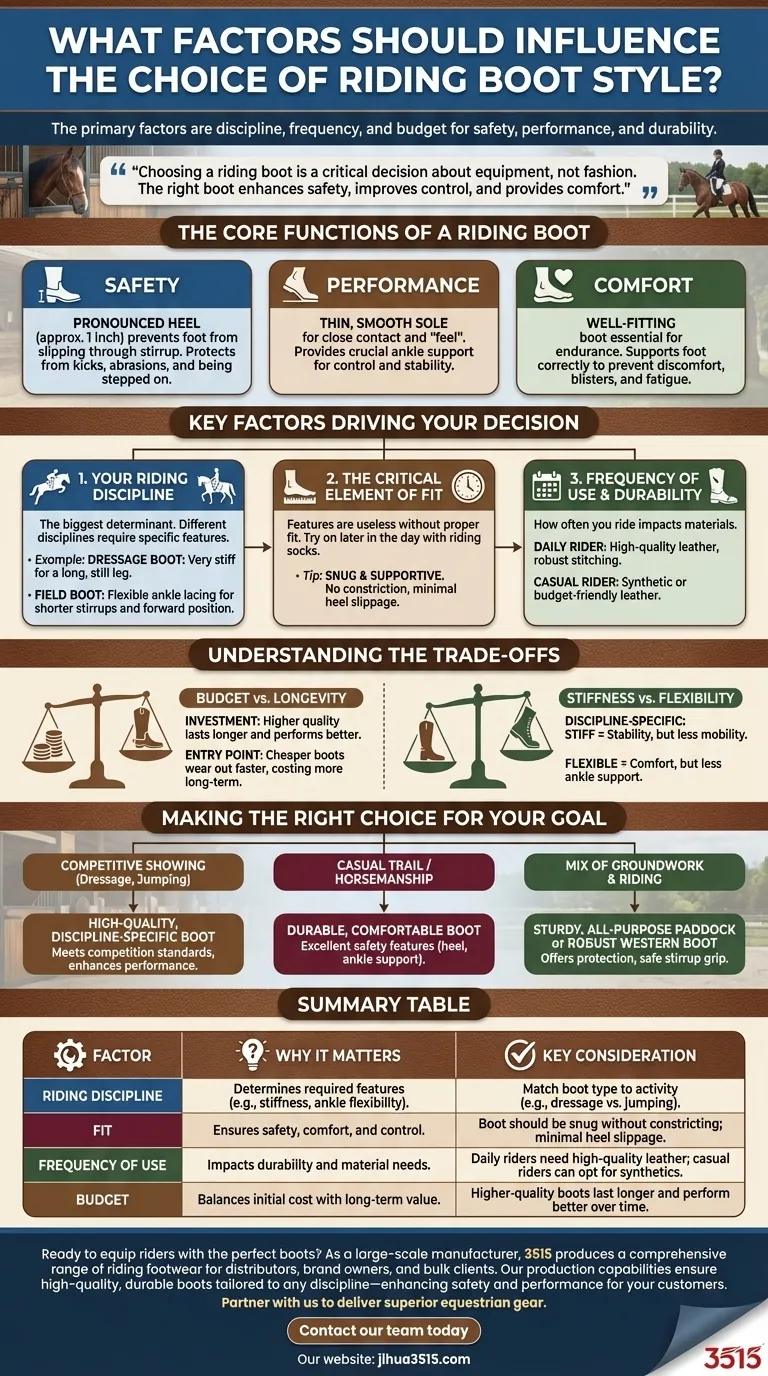
Visual Guide
Related Products
- Premium Wholesale Tactical Style Safety Shoes Boots with Quick Lacing
- Wholesale High-Traction Camo Boots - Custom Manufacturer for Brands
- Puncture-Resistant Velcro Safety Boots for Wholesale & Custom Manufacturing
- Wholesale Tactical Boots High-Traction & Reflective for Bulk & Brand Orders
- Durable Goodyear Welt Leather Work Boots for Wholesale & Private Label
People Also Ask
- How are gait analysis research findings applied to the functional design of safety shoes and tactical boots?
- Why is the synchronization of craftsmanship and UX development emphasized for bulk customization of safety shoes?
- How do quality certification standards for safety shoes reduce perceived risk? Buy Online with Technical Certainty
- How can specialized footwear mitigate safety risks? High-Volume OEM/ODM Solutions since 1951
- How does anthropomorphic design influence material selection? Enhance Footwear Performance through Biological Alignment



















